

Last updated: 2026-11-01
On 27 April 2026 the BSI published C3A, a set of criteria for assessing the sovereignty of a cloud service. This page explains what C3A is, how it is structured, what it asks of providers and how it relates to C5. For cloud and SaaS providers the last point matters most: C3A builds on C5.
What is C3A?
In the BSI’s words, C3A “provide a set of criteria for assessing whether a given set of cloud services allows for self-determined use within its respective risk context.” The catalogue is a guiding framework for transparency, and “The C3A Framework is not binding in itself” (C3A, section 1.1). The starting point is the shared responsibility model, which limits the decisions a cloud customer can take, including those affecting its sovereignty.
| Key facts (as of 1 November 2026) | |
|---|---|
| Name | C3A - Criteria enabling Cloud Computing Autonomy |
| Publisher | BSI (German Federal Office for Information Security) |
| Version | 1.0 of 27 April 2026, 16 pages |
| Language | English only; a German version was announced for the end of Q2 2026 but is not listed on the BSI site |
| Licence | CC BY-ND 4.0 |
| Binding effect | None in itself; applied through contracts, procurement and the customer’s risk analysis |
| Prerequisite | The provider meets the C5 criteria |
| Evidence | Audit; an audit guideline has been announced but not yet published |
How does C3A relate to C5?
“C3A presupposes that the cloud service provider meets the C5 criteria, as they reflect the security aspect of the sovereignty definition” (C3A, section 1.2). C3A adopts the structure and objectives of the European Commission’s EU Cloud Sovereignty Framework (EU CSF) and leaves out two of its areas on purpose: SOV-7 Security & Compliance, already covered by C5:2026, IT-Grundschutz and the BSI high-availability benchmark (HA-Benchmark kompakt), and SOV-8 Environmental Sustainability, which is outside the BSI’s remit.
Portability is part of self-determined use as well, but it is not in C3A because C5:2026 covers it in the area Portability and Interoperability (PI) (BSI C3A page). For providers this means: the service has to meet the C5 criteria; in practice, a C5 attestation for the service is how this is evidenced.
Which sovereignty criteria are already in C5:2026?
C5:2026 lists “the technical implementation of sovereignty” among its new focus areas (section 1.1). Only PSS-12 is explicitly called “a prerequisite for technical service sovereignty”; the other links in this table are our own, based on criterion titles and content.
| Topic | In C5:2026 | In C3A (examples) |
|---|---|---|
| Region of processing | PSS-12: customer data and backups only in the contractually specified region; additional criteria on selectable partitions with their own identity management. Multiple regions are not required. | SOV-3-01: customers can check where data is stored; service options with processing only in the EU or only in Germany |
| Law and locations | GC-01: applicable law, countries, regions and the country of the ultimate parent | SOV-1: jurisdiction, registered office and effective control in the EU or Germany |
| Government requests | GC-05 (citing the US CLOUD Act as an example) and INQ-01 to INQ-04 | SOV-2-01: annual identification and risk assessment of non-EU law |
| Customer-held keys | CRY-18 (external key management) and CRY-19 (customer managed keys, BYOK) | SOV-3-02 (external key management) and SOV-3-05 (client-side encryption) |
| Supply chain | SSO-07 (transparency about service organisations and their subcontractors), DEV-13 (software component list, also as SBOM) | SOV-5-01 to SOV-5-03: software, hardware and external services with countries of origin |
Our view: if PSS-12, GC-01, GC-05, INQ, CRY-18/19 and SSO-07 are in place and described in your system description, much of the evidence for a later C3A assessment already exists. What C3A adds is mainly about ownership, staffing and operations.
The six C3A sovereignty areas
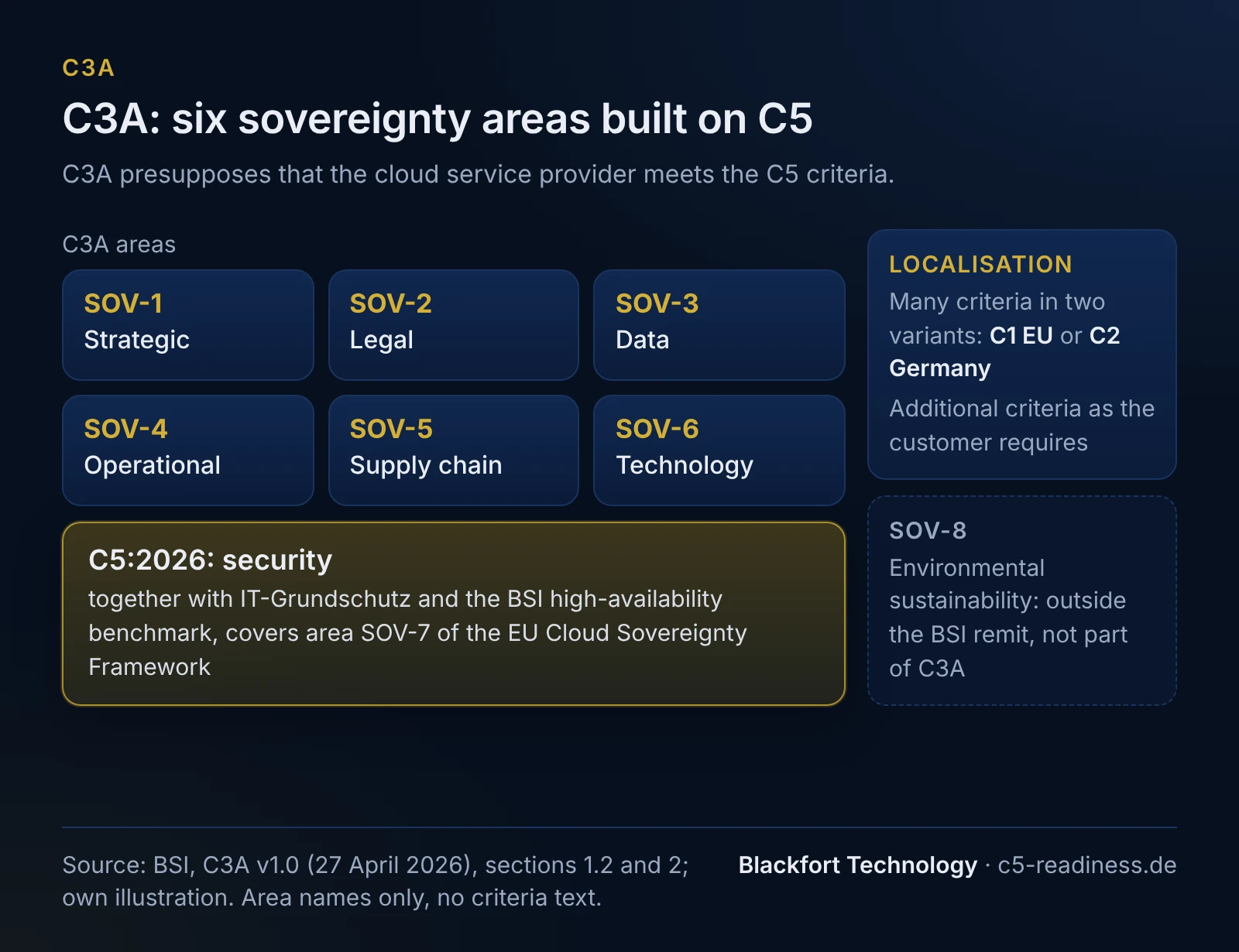
| Area | What it covers (our summary) | Criteria |
|---|---|---|
| SOV-1 Strategic Sovereignty | Jurisdiction, registered office, effective control; advance notice of control changes | SOV-1-01 to SOV-1-04 |
| SOV-2 Legal & Jurisdictional Sovereignty | Exposure to non-EU law, audit rights of the cybersecurity authority, takeover in a state of defence | SOV-2-01 to SOV-2-03 |
| SOV-3 Data Sovereignty | Data residence, external keys and identity providers, customer logs, client-side encryption | SOV-3-01 to SOV-3-05 |
| SOV-4 Operational Sovereignty | Staff, remote access, connectivity, SOC, updates, data exchange with third parties, disconnect and reconnect | SOV-4-01 to SOV-4-10 |
| SOV-5 Supply Chain Sovereignty | Software, hardware and external services with origin, export restrictions, capacity management | SOV-5-01 to SOV-5-05 |
| SOV-6 Technology Sovereignty | Source code backup in the EU, continued delivery without third parties, development tooling | SOV-6-01 to SOV-6-03 |
Criteria, additional criteria and the EU-or-Germany choice
C3A distinguishes criteria, additional criteria and supplementary information (section 1.3). Additional criteria “raise the bar on existing requirements or expand the scope of autonomy”, and it is up to customers to request them. Many criteria come in two variants: C1 refers to the EU, C2 to Germany, for example for the registered office (SOV-1-02), effective control (SOV-1-03) or operating personnel (SOV-4-01). Data residence (SOV-3-01) does not follow this pattern: its five subcriteria C1 to C5 are separate requirements that differ by type of data (customer data, derived and account data, provider data) and location (EU or Germany), with C1 covering the customer’s ability to check where data is stored (C3A, section 2.3.1).
Several criteria carry a note that restrictions to Germany or the EU “should be justified” and that their implementation, for example in procurement, must be legally permissible. A profile made only of C2 variants is therefore not the default; the customer’s risk analysis decides.
Disconnect, staffing and source code: the most demanding requirements
In our assessment, three requirements change operations and organisation the most. All three are worded as MUST requirements. We only summarise them here; the exact wording is in the original (BSI, C3A v1.0, sections 2.4 and 2.6).
- Disconnect and reconnect (SOV-4-09, SOV-4-10). The provider must be able to cut all non-EU network connections without impairing the service. The catalogue asks for a documented process, tested at least once a year; SOV-4-10 covers reconnecting afterwards. In practice, dependencies on services outside the EU, such as update or licence checks, must be known and under control.
- Staffing (SOV-4-01). Staff with access to the operating infrastructure, customer support and management must be EU citizens with their main residence in the EU (variant C1) or in Germany (variant C2). For providers with support teams in third countries this is an organisational and staffing question that cannot be solved at short notice.
- Source code (SOV-6-01). The provider must keep a source code backup in the EU that is “not older than 24 hours” and contains at least five versions, so that it can run and develop the service without external dependencies, including build and deployment tooling and documentation.
For a SaaS provider on a hyperscaler platform, some of these requirements fall on the platform and some on the provider’s own operations. How to split responsibility and reflect it in the audit scope is covered on C5 scope.
How does a C3A assessment work?
Providers select the criteria their offering meets and “provide the relevant evidence through an audit”; customers use C3A to define their baseline level of sovereignty and, for audited services, assess whether the criteria they care about are met (section 1.4). The BSI intends to publish how C3A audits can be standardised and how reports can be used, comparable to C5. As of 1 November 2026 that guidance was not yet published.
Until then we recommend this sequence:
- Derive the sovereignty need of the use case from your own risk analysis.
- Select criteria, variants (EU or Germany) and additional criteria per area and document why.
- Check the service’s C5 attestation, since C3A presupposes C5.
- Request and evaluate the provider’s evidence for the selected criteria.
- Close gaps by contract, for example data location, staffing and disconnect tests.
- Anchor the requirements in specifications and procurement.
Example: a sovereignty profile for document management in public administration
Fictitious example, not a real client. A German state administration procures a cloud-based document management service for files containing personal data and derives this profile from its risk analysis:
| Area | Selection | Administration’s rationale |
|---|---|---|
| SOV-1 | C1 (EU) for jurisdiction, office and control; SOV-1-04 | EU legal recourse, early notice of ownership changes |
| SOV-2 | SOV-2-01 | Assessment of non-EU law as a basis for decisions |
| SOV-3 | SOV-3-01 C3 (customer data only in the EU), SOV-3-02, SOV-3-04 | Keys and logs under own control |
| SOV-4 | SOV-4-01 C1, SOV-4-09, SOV-4-10 | Continued operation if non-EU connections are cut |
| SOV-5 | SOV-5-01 with additional criterion | Visibility of software supplier dependencies |
| SOV-6 | Not required | Provider exit remains possible via portability (C5, area PI) |
The provider presents its C5 attestation and maps its evidence to each selected C3A criterion. Where it relies on a third-party platform, it needs that platform’s evidence as well; the C5 report lists each subservice organisation with company name, location of processing and storage and an assessment of dependency (C5:2026, section 3.4.6).
Publication status
Checked on 1 November 2026: C3A is available as version 1.0 of 27 April 2026, in English. A German version and the audit guideline have been announced but are not yet listed by the BSI. C5:2026 itself applies to Type 1 dates and Type 2 periods beginning on or after 1 June 2027, and earlier use is permitted (section 3.5 of C5:2026).
How we support providers of sovereign cloud services
C3A presupposes C5, so we start with a C5 gap analysis and, if useful, look at the sovereignty-related C5 criteria and the C3A criteria your customers ask for at the same time. Blackfort Technology does not issue attestations or audit opinions; an independent auditor does. Book an initial call to discuss your sovereignty requirements.
Frequently asked questions
Is C3A mandatory?+
Do I need a C5 attestation for C3A?+
Is there a C3A certificate or attestation?+
Is there a German version of C3A?+
What do C1 and C2 mean in C3A criteria?+
Read more
Sources
- BSI: Criteria enabling Cloud Computing Autonomy (C3A), version 1.0 (PDF) (retrieved 2026-11-01)
- BSI: C3A download page with licence information (CC BY-ND 4.0) (retrieved 2026-11-01)
- BSI: C3A topic page (retrieved 2026-11-01)
- BSI: press release on C3A of 27 April 2026 (German) (retrieved 2026-11-01)
- BSI: Kriterienkatalog Cloud Computing C5:2026, version 1.1.0 (PDF, German), licensed under CC BY-ND 4.0 (retrieved 2026-11-01)
- BSI: Cloud Computing Compliance Criteria Catalogue C5:2026, version 1.0.1 (PDF), licensed under CC BY-ND 4.0 (retrieved 2026-11-01)
This content provides general technical and organisational information and does not constitute legal advice (no legal services within the meaning of the German RDG).