

Last updated: 2026-11-01
The scope determines what the auditor tests, what the report says and how useful it is to your customers. This page shows how to limit the scope to one service, what your cloud platform’s C5 report covers for you and when carve-out or inclusive is the right method. How to present the result is covered on C5 system description.
What goes into a C5 scope?
Six decisions, all of which end up in the system description and the report:
| Decision | What you define | Catalogue or source |
|---|---|---|
| Service | Name, type and scope of the cloud service, excluded modules | 3.4.5.1, item 1 |
| Regions | Regions and locations the attestation should cover | BSI FAQ |
| System components | Infrastructure, software, data, tooling and people delivering the service | 3.4.5.1, item 2 |
| Criteria | All basic criteria, selected additional criteria, justified exclusions | 3.4.3 |
| Report type | Type 1 with a date or Type 2 with a period | 3.4.4; see Type 1 or Type 2 |
| Suppliers | Which suppliers are subservice organisations, and carve-out or inclusive for each | 3.4.6 |
The scope always includes the processes relevant to developing and operating the service, such as HR, change management and risk management, because the subject matter is the system of internal control relevant to the development and operation of the cloud service (section 3.4.4).
Can I limit the scope to one service?
Yes. According to the BSI FAQ, a C5 attestation is always issued for the audited cloud services in the specified regions, never for the provider as a whole. You can start with the service your customers ask for. The FAQ also suggests covering several services in one attestation, since shared components are then tested once; with several similar products on the same platform this is worth comparing.
- Shared components are considered. Anything that contributes to delivering the service may, or must, be considered in the audit, such as a central directory or a shared pipeline, but only the service receives the attestation (BSI FAQ).
- Exclusions only with a permitted justification. It has to rest on the nature and design of the service or on your policies, procedures and measures, such as IaaS-only criteria for a SaaS service; missing or ineffective controls are never a reason (section 3.4.3).
- The scope has to match what customers buy. Customers are told to check first that the services they use are covered (BSI FAQ). A scope that leaves out the module they bought does not help sales.
For healthcare in Germany, Section 393 SGB V (Book V of the German Social Code) refers to an attestation for the cloud systems and technology used for the cloud service. Whether your scope meets this needs a legal assessment in each case; see Section 393 SGB V.
What does the AWS, Azure or STACKIT C5 report cover for my SaaS?
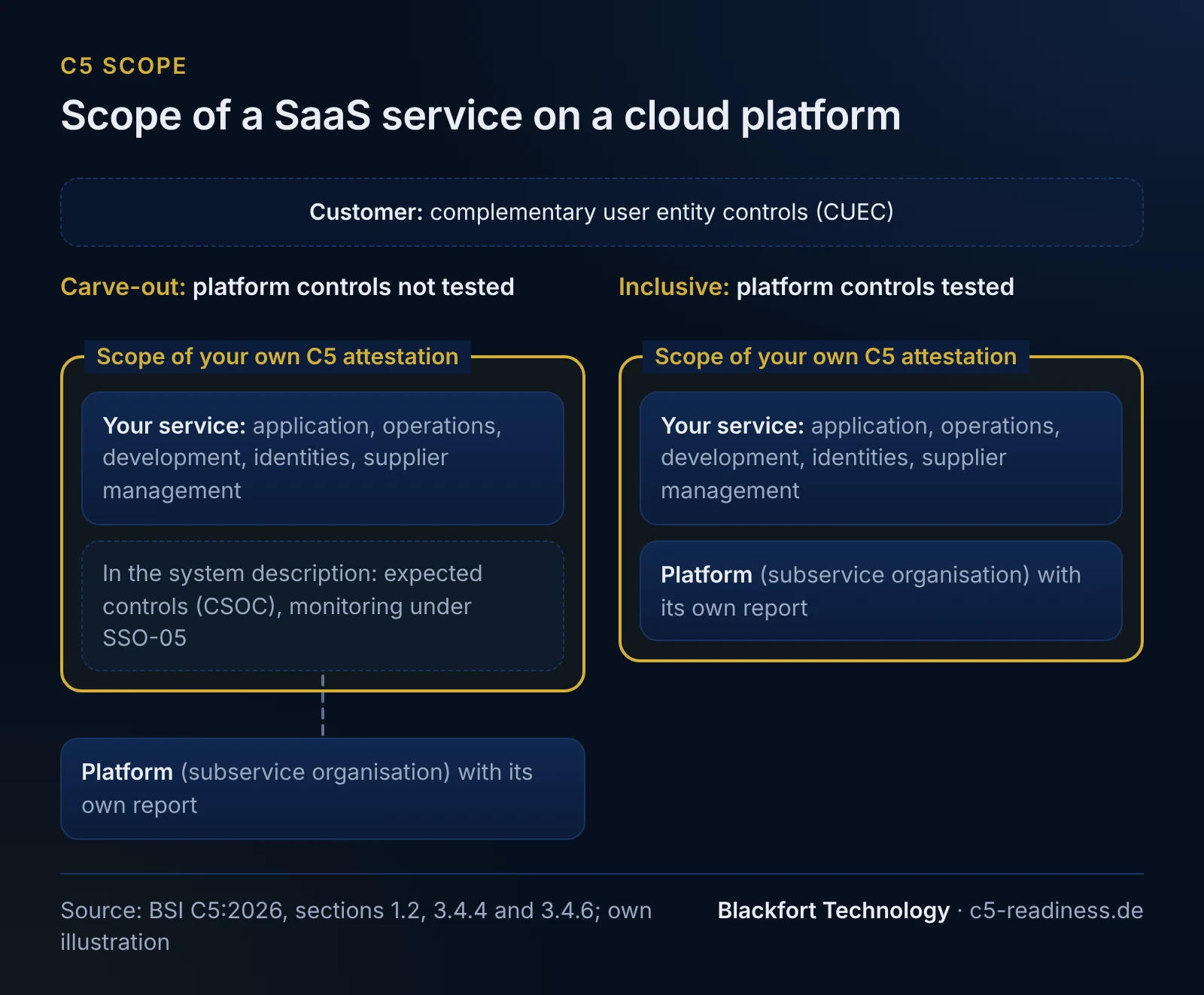
Your platform’s report covers the platform’s controls for its audited services and regions, not your service. The catalogue assumes that a service delivered on another provider’s infrastructure or platform generally creates a subservice organisation relationship, in particular for operations; for third-party data centres this applies especially to physical security (section 3.4.6). Microsoft’s own FAQ puts it this way: customers can use the Microsoft attestation as a foundation, “however, you need to achieve your own C5 attestation for components outside or built on top of these services”.
| What the platform report can cover | What stays with you |
|---|---|
| The platform’s controls for the services, regions and period stated in its report | Your application, your development and change management |
| For example data centre physical security and operation of the platform services, where included in the report | Your organisation: ISMS, HR, risk management, incident handling |
| The complementary user entity controls (CUEC) the platform provider relies on you to perform | Implementing those controls, such as configuration, identities and keys in your platform account |
| Monitoring the platform under SSO-05 and the required details in your system description |
The right-hand column is our assessment. Which controls a platform report actually contains is only in the report itself, so read it before you decide on the scope: services, regions, report type, period, catalogue revision, deviations and the complementary user entity controls (CUEC) listed.
What the platform providers state
We only repeat what the providers say on their own pages (retrieved 1 November 2026). The current report, requested from the provider, is the only reliable source. Where a provider page does not state something, the table says so; that says nothing about the report itself.
| Provider | Services per provider | Regions | Report type and period | Catalogue revision | How to obtain the report |
|---|---|---|---|---|---|
| AWS | Refers to the list “AWS Services in Scope by Compliance Program” | Including Frankfurt, Ireland, London, Paris, Milan, Stockholm, Singapore, Zurich and Spain | Per the provider page, an attestation on the “suitability of the design and operational effectiveness” of the controls against the basic and additional criteria, in substance Type 2; period not stated. For the AWS European Sovereign Cloud the page names a separate report on the “suitability of the design” only, in substance Type 1, also against basic and additional criteria | The page names C5:2020 as the current version | Through AWS Artifact; for the European Sovereign Cloud report the page refers to aws.eu |
| Microsoft | Combined report (C5, SOC 2 Type 2, CSA STAR) for Azure, Azure Government and Azure Germany | Not stated on the page | Per the provider page; type and period not stated there (for the C5 part of the combined report); the linked documents also list a C5 Type 2 report for Microsoft 365 | C5:2020 (page dated 21 March 2025) | Links to Microsoft’s Service Trust Portal |
| STACKIT | A list of 21 products, including Compute Engine (with GPU), Kubernetes Engine (SKE), Object Storage, PostgreSQL Flex and AI Model Serving; per the page with all basic and additional criteria | Not stated in the C5 section | Type 2 per the provider page; period not stated there | Not stated on the page | Request via an email address on the page |
Check every platform service you actually use against that list. A managed database or AI service missing from the platform report is an open point in your supplier management.
Carve-out or inclusive?
For each subservice organisation you choose a method and state it in the system description (section 3.4.6). A supplier is a subservice organisation if its service is relevant to customers' understanding and controls at the supplier (CSOC) are needed to meet the criteria; cleaning companies or advertising agencies typically are not (section 3.4.6).
| Carve-out | Inclusive | |
|---|---|---|
| Supplier’s controls | Excluded from the description and the audit | Included in the description and tested by the auditor |
| System description | Nature of services, expected controls (CSOC), your monitoring | Nature of services, the supplier’s controls, your monitoring |
| Auditor’s report | States that procedures did not extend to the supplier’s controls | States that procedures extended to those controls |
| Precondition (our assessment) | A usable supplier report or other evidence for your monitoring | The supplier allows your auditor to test its controls |
Carve-out does not shift accountability. The catalogue wants to prevent the method from being used to neglect criteria; the provider “remains ultimately accountable” and monitors subservice organisations under SSO-05 (section 3.4.6). SSO-05 includes regular review of independent third-party reports and, for subservice organisations, checking their controls against the expected CSOC. For each one the description names the company, the country of processing and storage, and a justified rating of complexity and dependency. Keep these details in a separate register, a subservice inventory; a template is on templates.
Three SaaS examples
Fictitious examples, not clients. The same rules lead to different decisions depending on architecture.
Example 1: billing SaaS on a hyperscaler
| Service | Billing platform for trade businesses, SaaS, running on the platform’s compute and database services |
| Regions | One region in Germany, backups in a second EU region |
| Subservice organisations | Cloud platform (carve-out, platform report available, the database service used is included); external support provider with access to customer data in second-level support (carve-out, no C5 report but ISO 27001, so contractual commitments and own reviews under SSO-05) |
| Point to note | Both regions have to be in scope because backups hold customer data; support access is a data flow in the description, and the support provider’s missing C5 report is stated openly. AI services using an external language model follow the same rules, with their own questions about the model provider. |
Example 2: practice software in a colocation data centre
| Service | Practice management SaaS on the provider’s own servers in rented racks |
| Regions | Two data centre sites in Germany |
| Subservice organisations | Data centre operator for physical security (generally a subservice organisation under section 3.4.6); no C5 report but ISO 27001, so the inclusive method, with a site visit by the provider’s auditor, is an option |
| Point to note | Hardware, hardening and network are the provider’s own, so it meets many OPS and COS criteria with its own controls. Physical security (PS) is split between provider and data centre operator, for example rack access versus building protection, and the split belongs in the description. |
Example 3: small B2B SaaS on managed Kubernetes
| Service | Ticketing and knowledge base for business customers, one product, a team of twelve |
| Regions | One region |
| Subservice organisations | Cloud platform with managed Kubernetes, database and object storage under carve-out; email delivery service assessed and classified as a subservice organisation because it transmits customer data |
| Point to note | Container criteria OPS-34 and OPS-35 apply to the part of the container life cycle the provider owns, such as images and deployment; the boundary with the platform is justified in the description. Confidential computing criteria do not apply because the service does not offer that capability (OPS-32). |
Common scoping mistakes
| Mistake | Effect | Fix |
|---|---|---|
| Treating the platform report as evidence for your own service | Customers who require a C5 attestation have no evidence for your service | Have your service audited and treat the platform as a subservice organisation in it |
| A platform service you use is not in the platform report | Gap in supplier management, auditor questions | Compare the report’s service list with your architecture and decide on alternatives or own controls |
| Backup or support region forgotten | Incomplete description, wrong location details | Map all data flows including backup, logging and support access |
The scope sheet is available as a template on templates. How the scope drives timing is explained on C5 audit process.
Frequently asked questions
Is the AWS or Azure C5 report enough for my SaaS service?+
Do I have to include all of our products?+
Can I exclude criteria the platform covers?+
What if a key supplier has no C5 report?+
Does my attestation extend to new regions automatically?+
Read more
Sources
- BSI: Kriterienkatalog Cloud Computing C5:2026, version 1.1.0 (PDF, German), licensed under CC BY-ND 4.0 (retrieved 2026-11-01)
- BSI: Cloud Computing Compliance Criteria Catalogue C5:2026, version 1.0.1 (PDF), sections 1.2, 3.4.3 to 3.4.6, SSO-05, licensed under CC BY-ND 4.0 (retrieved 2026-11-01)
- BSI: C5 FAQ (German) (retrieved 2026-11-01)
- AWS: BSI C5, including the AWS European Sovereign Cloud (provider statement) (retrieved 2026-11-01)
- Microsoft Learn: Cloud Computing Compliance Criteria Catalog (C5) (provider statement, page dated 21 March 2025) (retrieved 2026-11-01)
- STACKIT: certificates (provider statement) (retrieved 2026-11-01)
- Section 393 SGB V (Book V of the German Social Code; German) (retrieved 2026-11-01)
This content provides general technical and organisational information and does not constitute legal advice (no legal services within the meaning of the German RDG).