

Last updated: 2026-11-06
This page covers confidential computing as a focus topic of C5:2026. The OPS domain as a whole is covered on the page OPS domain, the cryptography policy and key management on the page CRY domain.
What is confidential computing about in C5:2026?
Confidential computing protects data while it is being processed. The catalogue adopts the definition of the Confidential Computing Consortium: computation takes place in a hardware-based, attested Trusted Execution Environment (TEE) (the German version 1.1.0 says “zertifiziert”, that is certified), an isolated part of the processor or chip in which only authorised code runs and whose data cannot be read or changed by code outside it (supplementary information on OPS-32). Attestation is used to check whether the TEE and the application running in it are trustworthy.
C5:2026 covers this in two new criteria. Both start with the same condition: “If the cloud service comprises capabilities for confidential computing” (OPS-32.01B, OPS-33.01B).
- OPS-32 Policies and procedures: The policy describes purpose and scope, the available technologies, which parts of the cloud stack are protected with which technology and where third-party access is possible, the suppliers involved and the use of TEEs or secure enclaves (OPS-32.01B). Customers receive this information according to PSS-01 (OPS-32.02B). One of the security requirements is that neither the provider nor any other unauthorised entity may access the customer data or the keys protecting it, and that the algorithms follow the cryptography policy (OPS-32.03B).
- OPS-33 Remote attestation: The provider offers remote attestation, rooted in trusted hardware and software, with an interface through which customers can verify the integrity of the attestation (OPS-33.01B to 03B).
The complementing additional criterion OPS-32.01AC requires a documented technical framework with eight points, among them documentation of all interfaces, remote attestation of TEE and code, monitoring, regular penetration tests under OPS-22 and updates of the Trusted Computing Base. OPS-33.01AC requires defining the available attestation levels and communicating them to customers.
Do OPS-32 and OPS-33 apply to my service?
If you offer confidential computing to your customers as a capability, for example confidential compute environments, both criteria apply. If you offer nothing of the kind, they are not applicable; you justify this in the system description. Under section 3.4.3 the justification can follow from the nature of the service or from your principles, procedures and measures; how you record exclusions in the scope is shown on the page C5 scope.
The case in between is open: you use the platform’s confidential virtual machines only internally, for example for a service that processes particularly sensitive data, and you promote this to customers. Whether the service then “comprises capabilities for confidential computing” is not expressly decided by the wording. Our recommendation: if you promise customers this protection as a property of the service, you should also be able to evidence it under OPS-32 and OPS-33. Clarify the classification with the auditor early on.
Starting point: an analytics platform with confidential compute environments
Fictitious example, not a client. A provider runs a platform on which research institutions and pharmaceutical companies jointly analyse pseudonymised health data without disclosing the raw data to each other. The analyses run in confidential virtual machines of a large cloud provider; the TEE technology comes from the processor manufacturer. The provider’s own key service releases the keys to the datasets only after the attestation of the compute environment has succeeded. Customers select a “confidential analysis” in the portal; confidential computing is therefore a capability of the service.
Before the project, the situation looks like this:
- The portal shows customers a green tick “Attestation successful”. Only the provider’s key service checks the evidence behind it.
- The operations documentation describes the confidential machines, but not which parts of the stack run outside the TEE: storage, network, key service, logging.
- The key service itself runs in an ordinary virtual machine; two administrators could change the release rules.
- Firmware and microcode updates of the platform go into operation without the provider assessing them first.
Who is responsible for what: provider, platform, customer?
The hardware comes from the processor manufacturer, the platform operates the confidential machines, the provider makes the promise to the customers. OPS-32 and OPS-33 are addressed to the provider; the catalogue lists no complementary customer criteria for them. Our classification for the example:
| Aspect | Provider | Platform (subservice organisation) | Customer (research institution) |
|---|---|---|---|
| Policy with purpose, technologies, protected parts of the stack and third-party access options | writes it and informs customers (OPS-32.01B, OPS-32.02B) | supplies the technical description of its confidential machines | - |
| List of the suppliers involved | maintains it (OPS-32.01B no. 4), ideally in the subservice inventory | names its own suppliers | - |
| No access by the provider to data and keys | designs key release and operations so that it cannot access them itself (OPS-32.03B) | technically rules out access by its staff to the TEE content | - |
| Remote attestation and verification interface | offers it and provides evidence (OPS-33) | provides the hardware’s attestation evidence | verifies the evidence if it wants to use the stronger scenario |
| Updates of the Trusted Computing Base | assesses and plans them (OPS-32.01AC no. 8, if in scope) | installs firmware and microcode | - |
The suppliers under OPS-32.01B no. 4 overlap with the subservice organisations in your report; a shared subservice inventory avoids duplicate lists. Customers verifying evidence themselves is not a catalogue criterion for customers; if you assume it, it belongs in the system description as a complementary customer control (CUEC).
Which remote attestation scenarios does the catalogue distinguish?
In the supplementary information on OPS-33.01AC the catalogue rates four scenarios. The more the customer verifies itself in an environment it fully trusts, the stronger the attestation. If the provider retrieves the evidence, verifies it in a service it controls and returns only the result, the catalogue rates this as a weak attestation. The green tick in the example corresponds to this weak scenario. If the provider also passes on the evidence and the customer verifies it itself, the catalogue rates the scenario as very strong. The interface for customers is mandatory in every case (OPS-33.03B); defining and communicating the levels is complementing (OPS-33.01AC).
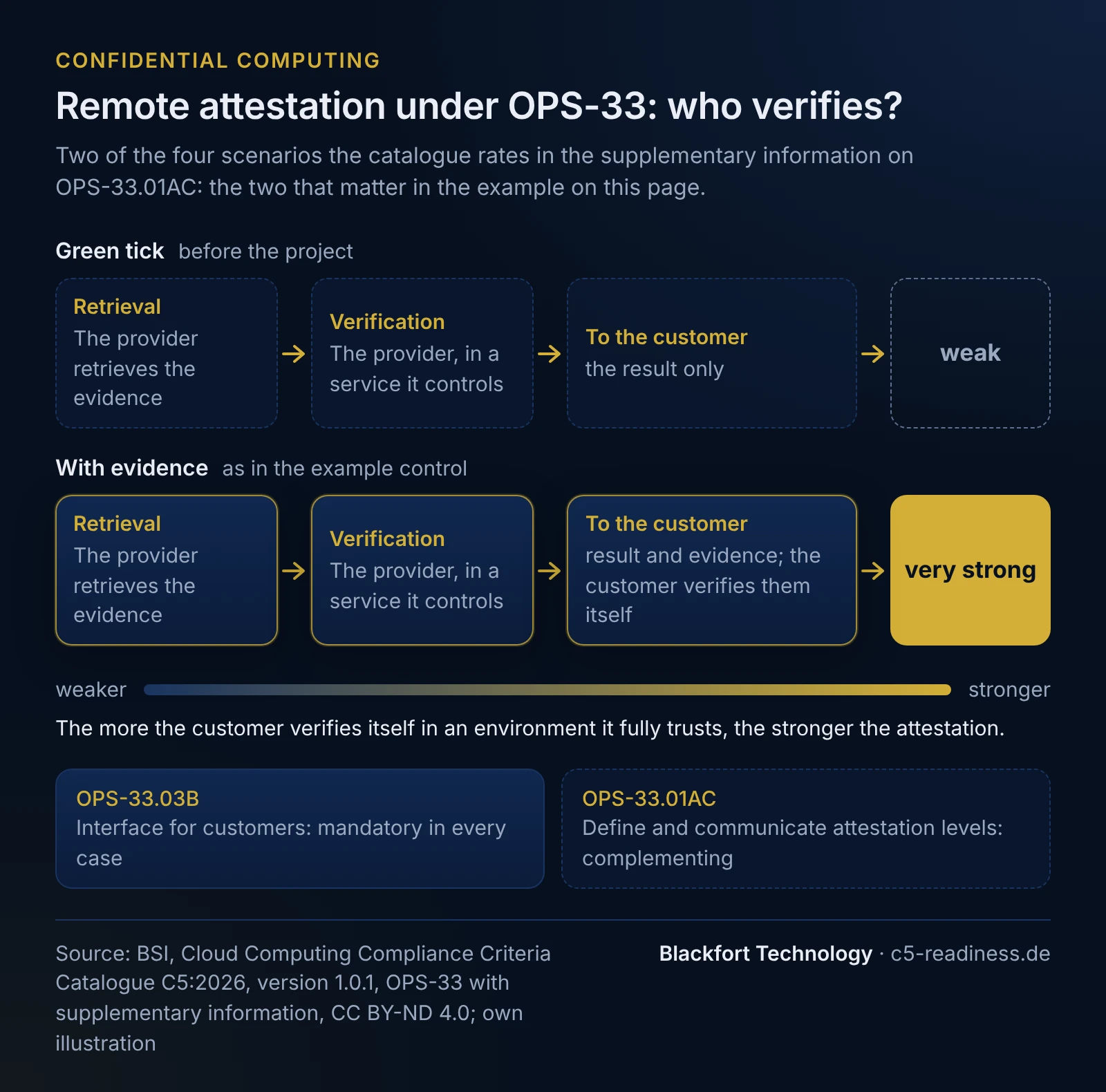
Example control description for OPS-32.03B and OPS-33
In the example, the promise to customers depends on one point: the key to a dataset may only reach an attested environment. Our example control (own wording, not catalogue text):
| Field | Example |
|---|---|
| Control ID | K-OPS-33-01 Key release only after successful attestation |
| Mapped to | OPS-32.03B, OPS-33.01B to OPS-33.03B; with levels OPS-33.01AC |
| Objective | Datasets are decrypted only in a compute environment whose hardware, firmware and code are attested against approved reference values; customers can verify every attestation themselves. |
| Responsible | Head of platform security (execution); checked by the information security officer |
| Trigger and frequency | every start of a confidential analysis; every change to the reference values; quarterly review |
| Execution | At start-up the environment presents its attestation evidence. The key service checks it against the approved reference values and releases the key only if they match. Evidence and verification result go to the interface for customers. New reference values, for example after a firmware update, are approved by the head of platform security under the four-eyes principle through change management. |
| Check | Each quarter the information security officer reconciles the key releases with the attestation logs and checks that no release took place without valid evidence and that changes to the release rules were approved. |
| Escalation | A rejected attestation triggers an alert in security monitoring. A release without valid evidence is treated as a security incident and reported to the affected customers. |
| Evidence | Attestation logs, release logs of the key service, change tickets for the reference values, documentation of the interface, record of the quarterly review |
For the requirement from OPS-32.03B to hold against your own staff as well, the key service itself must be protected, for example in a TEE of its own or a hardware security module with release rules that nobody can change alone. That is our recommendation; the catalogue leaves open how the provider meets the requirement.
What evidence the auditor wants to see
With confidential computing the auditor has to trace two things: that the architecture delivers what the policy promises, and that attestation works in operation. Examples from the scenario:
| Evidence | Criterion | Source | Owner | Timing |
|---|---|---|---|---|
| Policy with purpose, technologies, protected parts of the stack, third-party access options, suppliers | OPS-32.01B, OPS-32.03B | ISMS document repository | information security officer | version valid in the period |
| Architecture diagram with the TEE boundary | OPS-32.01B no. 3 | architecture documentation | head of platform security | current version, changes in the period |
| Customer information on confidential computing | OPS-32.02B, PSS-01 | customer documentation, portal | product management | versions published in the period |
| Attestation and release logs | OPS-33.01B, OPS-33.02B | key service, logging system | head of platform security | ongoing, sample |
| Documentation and test of the verification interface for customers | OPS-33.03B | interface documentation, test record | development | current version, test in the period |
| Approvals of new reference values after updates | OPS-32.01AC no. 8 (if in scope), DEV-03 | change tickets | head of platform security | every change in the period |
| Report of the penetration test of the confidential environment | OPS-32.01AC no. 7 (if in scope), OPS-22 | test provider’s report | information security officer | last test before or in the period |
How you map this evidence to the subcriteria and keep it available for the period is shown on the page Evidence and documentation.
Possible gaps: cause, effect, remedy
The following gaps follow from the wording of the criteria and the scenario. If a subcriterion is not met, the criterion counts as not met, and the auditor reports the deviation (sections 3.4.12 and 3.4.13).
| Possible gap | Cause | Effect | Remedy |
|---|---|---|---|
| Customers see only a result | The portal shows “Attestation successful”, the evidence stays with the provider. | OPS-33.03B requires an interface through which customers can verify the integrity of the attestation; a result alone does not allow verification. | Provide the evidence through an interface, document the verification tool and the reference values. |
| TEE boundary not described | The documentation shows only the confidential machines. | OPS-32.01B no. 3 requires stating which parts of the stack are protected and where third parties can gain access; storage, network and logging outside the TEE are missing. | Create an architecture diagram with the TEE boundary and access points and carry it over into the policy and the customer information. |
| Provider can release keys | Administrators can change the release rules of the key service. | Under OPS-32.03B neither the provider nor any other unauthorised entity may access customer data or keys. | Key service in a TEE of its own or a hardware security module, rule changes only under the four-eyes principle and with attestation of the key service itself. |
| Suppliers not listed | The processor manufacturer and its attestation service are treated as “technology”. | OPS-32.01B no. 4 requires a list of the suppliers and service organisations involved. | Keep the list in the subservice inventory, with each party’s role in the attestation chain. |
| Updates without assessment | Firmware and microcode go from the platform straight into operation. | New firmware changes the measurements; without approval of new reference values, attestation fails or is adjusted without review. | Run updates through change management with approval of the reference values, as in the control above. |
Which gaps to close first is a question of prioritising measures.
Criteria relevant to confidential computing
Titles as in the English version 1.0.1, number of subcriteria counted per section 5 (B = basic, AS = sharpening, AC = complementing). The selection beyond OPS-32 and OPS-33 is our classification. The column “What it covers” is our own short description, not catalogue text; the wording of the criteria in the catalogue is binding.
| ID | Title (catalogue) | B/AS/AC | What it covers |
|---|---|---|---|
| OPS-32 | Confidential Computing - Policies and Procedures | 3/0/1 | Only where confidential computing is offered: purpose, technologies, protected parts of the stack, suppliers, no access by the provider to data and keys. |
| OPS-33 | Confidential Computing - Remote Attestation | 3/0/2 | Only where confidential computing is offered: remote attestation with a verification interface for customers, defined levels as an addition. |
| PSS-01 | Guidelines and Recommendations for Cloud Service Customers | 4/0/1 | The channel through which customers receive the information on confidential computing. |
| OPS-22 | Managing Vulnerabilities, Incidents and Crashes - Penetration Tests | 8/3/5 | Penetration tests that the additional criterion OPS-32.01AC refers to for the confidential environment. |
| CRY-01 | Policy for the Use of Cryptographic Mechanisms | 2/0/3 | The cryptography policy that the algorithms in the TEE must follow under OPS-32.03B. |
OPS-32 and OPS-33 are new in C5:2026, with no predecessor.
Relationship to ISO/IEC 27001:2022 Annex A
The following mapping is our own, unofficial classification by topic. The BSI has not yet published a cross-reference for C5:2026. The catalogue refers to the BSI website for it (section 3.3). So far the table there covers C5:2020 only, and the BSI says the table for C5:2026 is “scheduled for publication in the near future” (as of 6 November 2026). According to the catalogue, even an official table only shows thematic proximity, not fulfilment of the criteria (section 3.3).
| C5:2026 | ISO/IEC 27001:2022 Annex A | Topic (short label) | What C5 additionally requires in concrete terms (our assessment) |
|---|---|---|---|
| OPS-32 | A.8.24, A.5.23 | Cryptography, information security for cloud services | Protection during processing in the TEE, description of the TEE boundary, no access by the provider |
| OPS-33 | no direct counterpart | Remote attestation | Verification interface for customers |
| OPS-32.01B no. 4 | A.5.19, A.5.21 | Suppliers and supply chain | List of the suppliers involved in confidential computing |
Frequently asked questions
Does every cloud service have to offer confidential computing?+
I use confidential VMs only internally. Do the criteria apply?+
What is remote attestation?+
Is it enough to show customers the result of the attestation?+
Who counts as a supplier in confidential computing?+
Read more
- C5 OPS: making operations audit-ready under C5:2026
- C5 CRY: cryptography and key management under C5:2026
- C5 tenant separation: evidencing separation of customer data
- C5 scope: service boundary, platform reports, carve-out
- C5 system description: minimum content, structure and example
- C5 subservice inventory: example and report review
- C5 documentation: keeping an evidence register for the audit
- C5 readiness assessment: gap analysis, action plan and timeline
Sources
- BSI: C5:2026 web page with downloads (German) (retrieved 2026-11-06)
- BSI: C5:2026 web page with downloads (retrieved 2026-11-06)
- BSI: Kriterienkatalog Cloud Computing C5:2026, version 1.1.0 (PDF, German), licensed under CC BY-ND 4.0 (retrieved 2026-11-01)
- BSI: Cloud Computing Compliance Criteria Catalogue C5:2026, version 1.0.1 (PDF), section 1.1, OPS-32 and OPS-33 with supplementary information, sections 3.3, 3.4.3, 3.4.12 and 3.4.13, licensed under CC BY-ND 4.0 (retrieved 2026-11-01)
- BSI: C5:2026 change history (Excel), new criteria OPS-32 and OPS-33 (retrieved 2026-11-01)
This content provides general technical and organisational information and does not constitute legal advice (no legal services within the meaning of the German RDG).