

Last updated: 2026-11-06
This page covers the INQ domain (Dealing with Investigation Requests from Government Agencies) of C5:2026, section 5.16 of the catalogue. How criteria and subcriteria are structured in general is explained on the page C5 criteria catalogue. This page describes which procedures the catalogue requires; whether an individual request is lawful is assessed by your legal department or a law firm you engage.
What is the INQ domain about?
INQ is meant to ensure appropriate handling of investigation requests from government agencies, and the catalogue names three building blocks: legal review, information to customers and limitation of access to or disclosure of customer data or cloud service derived data (objective in section 5.16). In searches, such requests also appear as “government data requests” or “law enforcement requests”; the catalogue does not use these words as terms. They include, for example, requests from law enforcement agencies or intelligence services; according to the notes on GC-05, which bodies these are and on what basis they act differs from country to country.
The domain comprises four criteria, INQ-01 to INQ-04, with 8 basic subcriteria and 2 complementing additional subcriteria. According to the BSI change history, the former criteria INQ-01 and INQ-03 from C5:2020 have been merged into INQ-01, and the former INQ-04 is now called INQ-03. INQ-04 is new: the provider documents the technical procedures with which it provides or discloses customer data in response to such requests and makes them available to its customers.
Closely related is the general condition GC-05: there the provider describes in the system description how it handles such requests and states the number of requests and their countries of origin, see General conditions. INQ contains the controls, GC-05 the information about them.
Starting point: a SaaS provider without a process for government requests
Fictitious example, not a client. A provider runs a whistleblowing system as SaaS for companies and municipalities: whistleblowers report violations via a web form, anonymously if they wish, and the customer’s reporting office processes the reports in the service. The service runs in a German region of a large cloud service provider. The reports are stored in encrypted form; the provider manages the keys.
Before the project, the situation looks like this:
- Last year a public prosecutor’s office asked support by email for the data on a specific report. Support asked management, and management asked a lawyer friend.
- Whether and when the affected customer was informed is not documented.
- For the disclosure, a developer pulled a database extract that contained more fields than requested.
- Customers ask in security questionnaires whether the provider can decrypt reports. There is no agreed answer.
For the audit, the provider needs a process that treats every request the same way, including those that do not lead to a disclosure.
Who is responsible for what: provider, platform, customer?
INQ lies with the provider, but the customer has to include the risks in its own risk management. The platform in the example is a subservice organisation. Our classification for the example:
| Aspect | Provider | Platform (subservice organisation) | Customer (company, municipality) |
|---|---|---|---|
| Requests addressed to the provider | assesses them legally, informs customers, limits the disclosure (INQ-01 to INQ-03) | - | receives notifications and assesses them legally according to its own specifications |
| Requests addressed to the platform | clarifies through the platform’s reports and contracts how it handles them, and monitors it under SSO-05, see SSO | handles them according to its own procedure (outside your audit under the carve-out method) | - |
| Disclosure of technical procedures | documents them per service and provides them (INQ-04) | - | uses this information to assess whether the service can be used for its protection needs |
| Risk of disclosure | limits it technically, for example through encryption | - | deals with it in its own risk management and minimises potential disclosure, for example through its own encryption |
INQ-01, INQ-02 and INQ-04 contain complementary customer criteria, INQ-03 does not. Whichever customer controls you assume belong in the system description as complementary customer controls (CUEC). The auditor does not test them at the customer, only whether they are fairly presented.
What does a process for government requests look like?
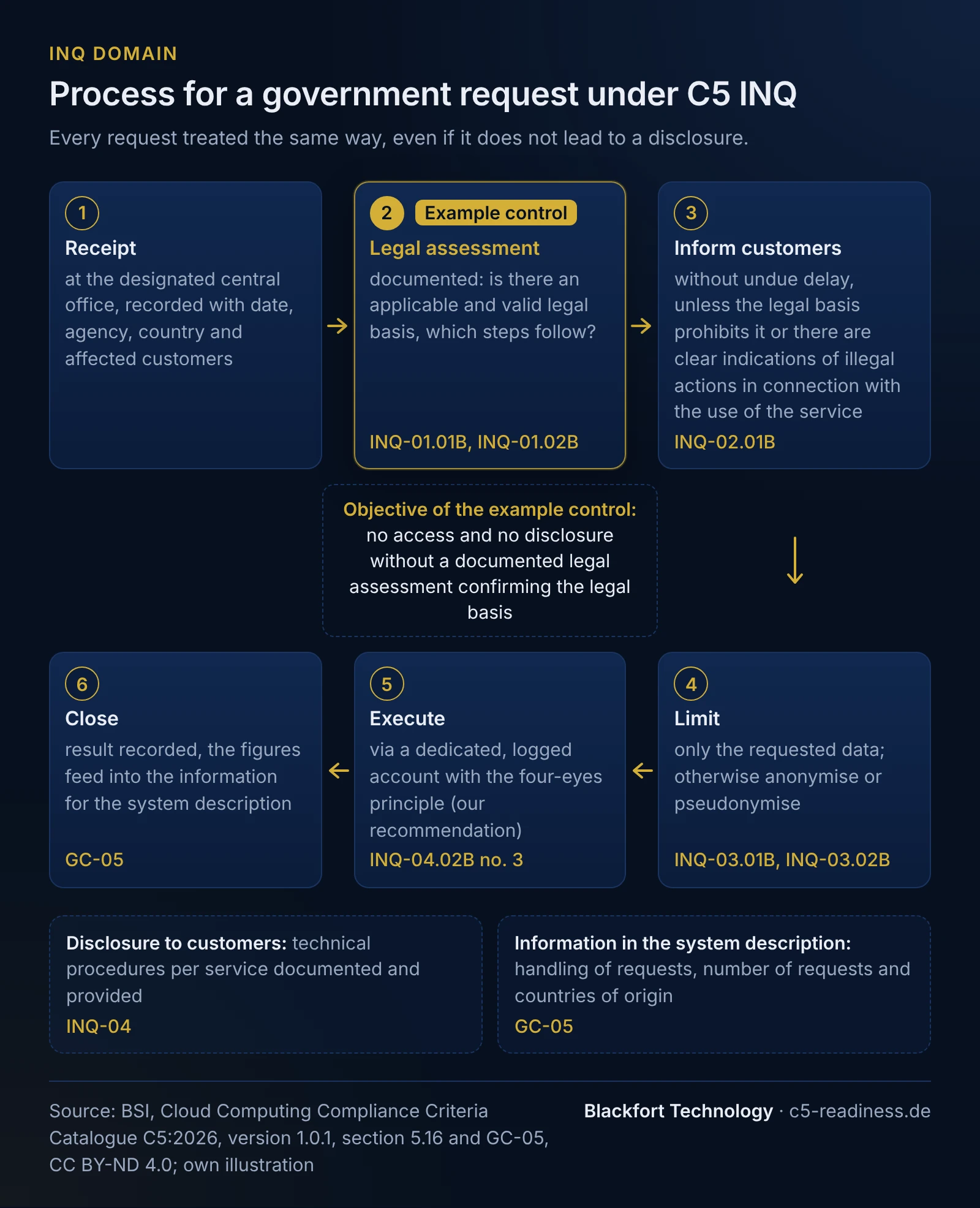
You write the process as a work instruction known to everyone a request may reach: support, sales, management. For the example it could look like this (own proposal, not catalogue text):
| Step | What happens | Who | Reference |
|---|---|---|---|
| 1 Receipt | Every request, whatever the channel, goes to the designated central office and is recorded with date, agency, country and affected customers. Nobody else responds on the substance. | all employees, central office | basis for INQ-01 and for the count under GC-05 |
| 2 Legal assessment | Subject matter experts check and document whether there is an applicable and valid legal basis and which steps follow. | legal department or law firm engaged | INQ-01.01B, INQ-01.02B |
| 3 Informing customers | The affected customer is informed without undue delay, unless the legal basis prohibits it or there are clear indications of illegal actions in connection with the use of the service. The decision is justified. | central office after the assessment | INQ-02.01B |
| 4 Limitation | Only the requested data is disclosed. If it cannot be clearly delimited, it is anonymised or pseudonymised so that it can only be assigned to the affected customers. If keys are handed over, this must not compromise any other customer data. | operations after approval | INQ-03.01B, INQ-03.02B |
| 5 Execution and logging | Every access for the disclosure runs via a dedicated, logged account with the four-eyes principle. | operations | INQ-04.02B no. 3; INQ-03.01AC if included |
| 6 Closure | The result (disclosure yes or no, scope) is recorded. The figures feed into the information under GC-05. | central office | GC-05 nos. 6 and 7 |
The four-eyes principle and the dedicated account are our recommendation. According to the supplementary information, the obligation under INQ-02 to inform without undue delay does not affect other legal or regulatory requirements that require customers to be informed earlier.
What belongs in the disclosure under INQ-04?
INQ-04.02B names six minimum aspects that the document for customers addresses: the process for provision and disclosure, the provider’s technical capabilities and limitations, the logging of such access, the customers’ possibilities to review these logs, the methods per service and the legal means that can restrict informing customers. According to the supplementary information, the criterion is limited to customer data. For the example, this above all means answering the question from the questionnaires honestly: the provider manages the keys and can therefore in principle decrypt reports. If you want to change that, consider procedures with customer-managed keys, see CRY; the disclosure then describes the new state. The document is maintained in accordance with SP-01 and aligned with the guidelines on minimising access to customer data (INQ-04.03B).
Example control description for INQ-01
INQ-01 is the core of the domain: every investigation request from a government agency for customer data, cloud service derived data and account data is subject to a documented legal assessment by subject matter experts (INQ-01.01B), and access or disclosure is only permitted if this assessment confirms an applicable and valid legal basis and that the request must be granted (INQ-01.02B). Our example control for the provider above (own wording, not catalogue text):
| Field | Example |
|---|---|
| Control ID | K-INQ-01-01 Legal assessment and approval of government requests |
| Mapped to | INQ-01.01B, INQ-01.02B; information under INQ-02.01B; limitation under INQ-03.01B and INQ-03.02B |
| Objective | No access to data and no disclosure without a documented legal assessment confirming the legal basis; every request is recorded, even if it is rejected. |
| Owner | management (central office and approval); law firm engaged (assessment); checked by the information security officer |
| Trigger and frequency | event-driven: every request from a government body for data from the service; additionally a quarterly review of the register |
| Execution | The central office records the request in the register and forwards it with all documents to the law firm. The law firm records in writing whether there is a legal basis and recommends how to proceed. Management approves the disclosure only on the basis of this assessment and sets the scope. Operations receives an order with exactly this scope. |
| Check | The disclosure order to operations is technically bound to a register number with a stored assessment. Every quarter the information security officer reconciles the register with the logs of the disclosure account: are there accesses without a register number or disclosures beyond the approved scope? |
| Escalation | An access without approval is handled as a security incident under SIM, see SIM. |
| Evidence | Register of requests, legal assessments, approvals, information to customers or justified non-notification, logs of the disclosure account, review records of the information security officer |
Whether the control covers all subcriteria is for the auditor to assess; for a type 2 report the auditor also tests whether it operated effectively throughout the period.
What evidence the auditor wants to see
The catalogue expressly defines the population for the audit: all investigation requests that were completely processed during the period, irrespective of whether they resulted in a disclosure (supplementary information on INQ-01.01B). A complete register is therefore the most important evidence. Examples from our scenario:
| Evidence | Criterion | Source | Owner | Timing |
|---|---|---|---|---|
| Register of all requests with status and result | INQ-01.01B | register of the central office | management | all requests completely processed in the period |
| Documented legal assessments | INQ-01.01B, INQ-01.02B | repository of the assessments | law firm engaged, management | all cases in the period |
| Information to customers or justified non-notification | INQ-02.01B | ticket system, correspondence | central office | all cases in the period |
| Scope of the data disclosed compared with the request | INQ-03.01B, INQ-03.02B | disclosure order, log | operations | all disclosures in the period |
| Document on the technical disclosure procedures per service | INQ-04.01B to INQ-04.03B | customer portal, document repository | information security officer | version valid in the period with maintenance note |
| Work instruction for the process and briefing of personnel | INQ-01 | document repository, training records | information security officer | version valid in the period, training sessions in the period |
An evidence register records which evidence belongs to which subcriterion; how to maintain one is shown on the page Evidence and documentation.
Possible gaps: cause, effect, remedy
The following gaps follow from the wording of the criteria and the scenario above. If a single subcriterion is not met, the criterion counts as not met, and the auditor reports the deviation (sections 3.4.12 and 3.4.13).
| Possible gap | Cause | Effect | Remedy |
|---|---|---|---|
| Requests bypass the process | Support or sales respond directly because nobody knows the central office. | INQ-01.02B: disclosure without a legal assessment is not permitted; the register is incomplete. | Designate a central office, train staff on the work instruction, forward incoming requests in support automatically. |
| Register contains only disclosures | Rejected or withdrawn requests are not recorded. | The population according to the supplementary information on INQ-01.01B is incomplete; the figures under GC-05 are wrong as well. | Record every request on receipt, add the result on closure. |
| Customer not informed or informed late | No one is responsible for informing customers, no justification for non-notification. | INQ-02.01B requires informing without undue delay, except in the cases named. | Information as a fixed step after the assessment, non-notification only with a documented reason. |
| Disclosure too broad | Database extracts contain more fields, periods or tenants than requested. | INQ-03.01B requires that agencies only receive the data that is the subject of the request. | Prepared queries per data type, approval of the scope by management, four-eyes principle. |
| No disclosure of the technical procedures | INQ-04 is new and was not required in C5:2020. | INQ-04.01B and INQ-04.02B are not met; customers lack the information for their risk assessment. | Prepare the document along the six minimum aspects, provide it in the customer portal, reconcile it with the system description. |
All criteria of the INQ domain
Titles as in the English version 1.0.1, number of subcriteria counted per section 5 (B = basic, AS = sharpening, AC = complementing). The column “What it covers” is our own short description, not catalogue text; the wording of the criteria in the catalogue is binding.
| ID | Title (catalogue) | B/AS/AC | What it covers |
|---|---|---|---|
| INQ-01 | Legal Assessment of Investigation Requests | 2/0/0 | Documented assessment of every request; disclosure only with a confirmed legal basis. |
| INQ-02 | Informing Cloud Service Customers about Investigation Requests | 1/0/0 | Informing the affected customers without undue delay, with two exceptions. |
| INQ-03 | Limiting Access to or Disclosure of Data in Investigation Requests | 2/0/2 | Only the requested data, otherwise anonymisation or pseudonymisation. |
| INQ-04 | Communication of Technical Procedures for Data Disclosure in Investigation Requests | 3/0/0 | Document for customers on process, capabilities, logging and legal limits, maintained per service. |
Both complementing subcriteria belong to INQ-03: the provider monitors access and activities performed by or on behalf of investigators (INQ-03.01AC) and remediates deviations identified during this monitoring in a timely manner (INQ-03.02AC).
Relationship to ISO/IEC 27001:2022 Annex A
There is no direct counterpart to INQ in ISO/IEC 27001. The following mapping is our own, unofficial classification by topic; it only shows where an existing ISMS offers points of contact. The BSI has not yet published a cross-reference for C5:2026. The catalogue refers to the BSI website for it (section 3.3). So far the table there covers C5:2020 only, and the BSI says the table for C5:2026 is “scheduled for publication in the near future” (as of 6 November 2026). The short labels are ours, not titles from the standard.
| C5:2026 | ISO/IEC 27001:2022 Annex A | Topic (short label) | What C5 additionally requires in concrete terms (our assessment) |
|---|---|---|---|
| INQ-01, INQ-02 | A.5.5, A.5.31 | Contact with authorities, legal requirements | documented legal assessment of every request, informing customers without undue delay |
| INQ-03 | A.8.3, A.8.11 | Access restriction, data masking | limitation to the subject of the request, pseudonymisation where the data cannot be delimited |
| INQ-04 | no counterpart | - | disclosure of the technical procedures per service to customers |
Frequently asked questions
Do I have to have every government request assessed legally?+
Do I have to inform the customer about a request under C5?+
Do requests that I rejected count as well?+
What is new about INQ-04?+
We have never had a government request. Does INQ apply then?+
Read more
- C5 criteria catalogue: structure, basic and additional criteria
- C5 general conditions: getting GC-01 to GC-06 right
- BSI C3A: sovereignty criteria for cloud services explained
- C5 Germany: BSI C5 for international healthcare SaaS providers
- C5 IAM: identity and access management under C5:2026
- C5 CRY: cryptography and key management under C5:2026
- C5 documentation: keeping an evidence register for the audit
- C5 readiness assessment: gap analysis, action plan and timeline
Sources
- BSI: C5:2026 web page with downloads (German) (retrieved 2026-11-06)
- BSI: C5:2026 web page with downloads (retrieved 2026-11-06)
- BSI: Kriterienkatalog Cloud Computing C5:2026, version 1.1.0 (PDF, German), licensed under CC BY-ND 4.0 (retrieved 2026-11-01)
- BSI: Cloud Computing Compliance Criteria Catalogue C5:2026, version 1.0.1 (PDF), section 5.16 INQ-01 to INQ-04 with supplementary information, section 4 GC-05, sections 3.3, 3.4.12 and 3.4.13, licensed under CC BY-ND 4.0 (retrieved 2026-11-01)
- BSI: C5:2026 change history (Excel), sheet “Change History”, INQ-01 to INQ-04 (retrieved 2026-11-01)
- BSI: C5:2026 overview page with downloads (German) (retrieved 2026-11-01)
This content provides general technical and organisational information and does not constitute legal advice (no legal services within the meaning of the German RDG).