

Last updated: 2026-11-06
This page covers the CRY domain (Cryptography and Key Management) of C5:2026, section 5.8 of the catalogue. How criteria and subcriteria are structured in general is explained on the page C5 criteria catalogue.
What is the CRY domain about?
CRY requires cryptography to be used appropriately and effectively to protect the confidentiality, authenticity or integrity of information (objective in section 5.8). The domain has 19 criteria with 32 basic subcriteria, one sharpening and five complementing additional subcriteria. It falls into three parts; the grouping is our reading aid:
- Policy and governance (CRY-01 to CRY-03): a cryptography policy with nine minimum aspects, change management for cryptographic systems and a review of the practice at least annually.
- Protection of data (CRY-04, CRY-05): encryption for transmission over public networks and for storage of customer data.
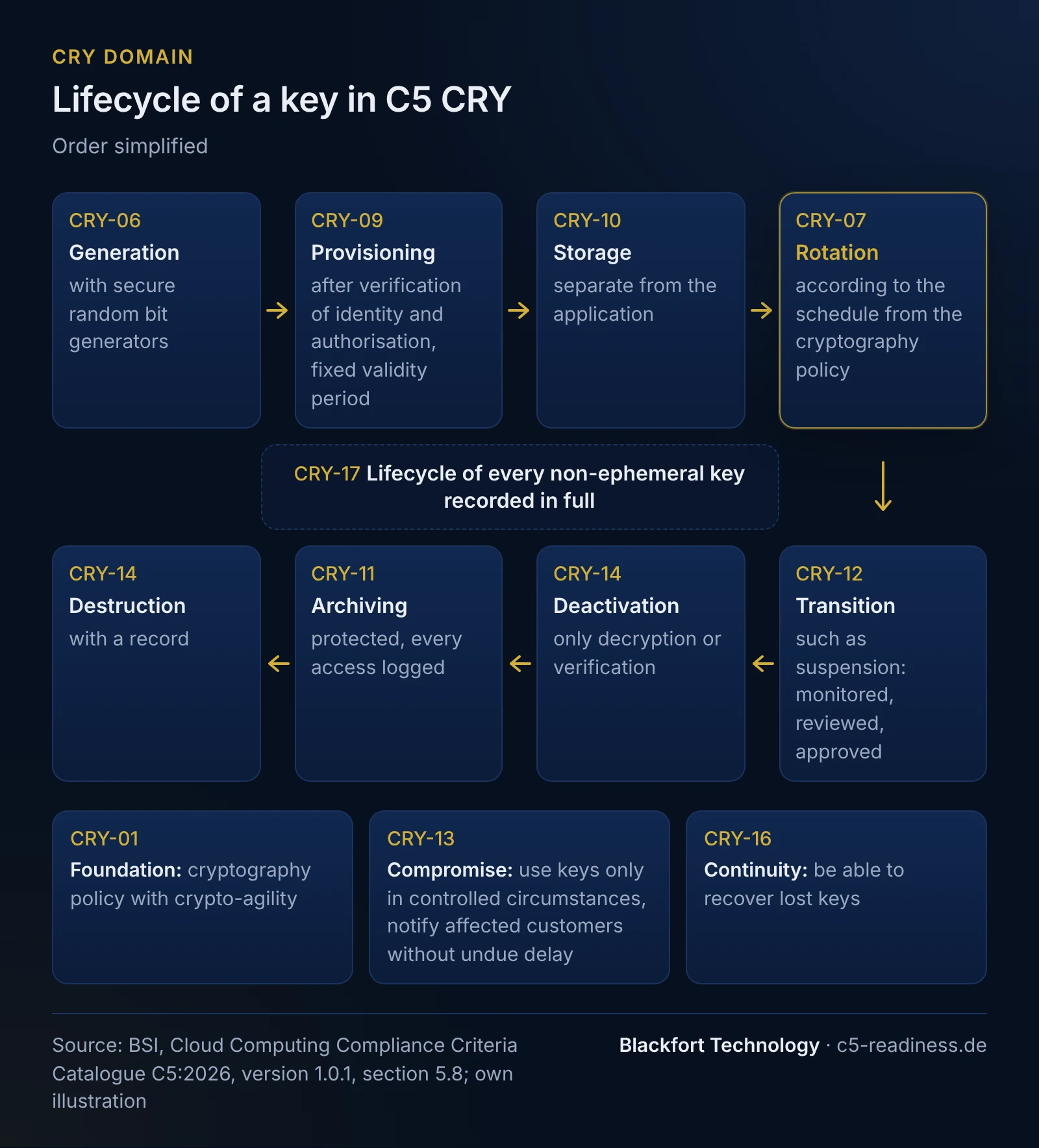
- Key lifecycle (CRY-06 to CRY-19): generation, rotation, certificates, provisioning, storage, archiving, transitions, compromise, deactivation, pre-shared keys, continuity, documentation, external key management and customer managed keys.
The third part has largely been restructured: the BSI split the former criterion CRY-04 from C5:2020 into ten criteria, and six further criteria are new without a predecessor, among them CRY-02, CRY-03, CRY-18 and CRY-19. If you have a “key management” control under C5:2020, you therefore have to distribute it across the new criteria.
As the benchmark, CRY-01.02B names the technical guideline BSI TR-02102 or suitable NIST guidelines such as the FIPS 140 and SP 800 series. The cryptography policy has to be checked against these guidelines regularly, and deviations are recorded in a risk assessment.
Starting point: a SaaS provider before its first audit
Fictitious example, not a client. A provider runs a platform through which tax advisory firms and their clients exchange documents and upload receipts. The service runs on the infrastructure of a large cloud service provider, with a managed database, object storage and the platform’s key management service. Large firms can bring their own keys. For internal services the provider runs its own certificate authority; it obtains public certificates automatically from a recognised certificate authority.
Before the project, the situation looks like this:
- The platform’s storage encryption is switched on everywhere; which keys exist, who manages them and when they are rotated is written down nowhere.
- For several subdomains the provider uses a wildcard certificate whose private key sits on three systems.
- A planned shutdown of older TLS versions would affect interfaces of some firms’ software; the firms do not know about it yet.
- No document governs what to do with a compromised key.
Who is responsible for what: provider, platform, customer?
The platform supplies the tools, the provider is responsible for how they are used. For six criteria the catalogue names duties of the customers (CRY-02, CRY-04, CRY-05, CRY-08, CRY-18, CRY-19). Our classification for the example:
| Aspect | Provider | Platform (subservice organisation) | Customer (tax advisory firm) |
|---|---|---|---|
| Cryptography policy, review, changes | writes and reviews it, evaluates changes and informs customers of their effects (CRY-01 to CRY-03) | - | evaluates announced changes for its own use (on CRY-02) |
| Transport encryption | defines protocols and procedures, configures load balancers and certificates (CRY-04) | provides load balancers and TLS functions | uses encrypted connections for its own links to the service (on CRY-04) |
| Encryption of stored data | switches it on, governs key access and exceptions with the customer (CRY-05) | provides storage encryption and key management service | with SaaS usually no task of its own; with IaaS parts for its own systems (on CRY-05) |
| Hardware security modules behind the key management service | monitors the subservice organisation | operates and secures them (outside your audit under the carve-out method) | - |
| Customer managed keys | integrates them securely, logs all activities, governs access (CRY-19) | provides the function for imported keys | generates and manages its own keys and ensures suitable agreements (on CRY-19) |
CRY-18.01B applies “in the case that external key management systems (KMS) are integrated into the service”. Whether the platform’s key management service counts as an “external key management system” in this sense is something you define in the scope and justify in the system description; our recommendation is to agree this with the auditor early on. Carve-out and inclusive are explained on the page C5 scope. Whether and when the provider’s staff may access keys or customer data is governed by CRY-05.02B with reference to IAM-07; see the page C5 IAM.
And post-quantum cryptography?
In C5:2026 it is a complementing additional criterion, not part of the basic criteria: CRY-01.01AC to CRY-01.03AC require a PQC strategy with an inventory of the mechanisms in use, transition plans and review at least annually. In the basic criteria, the cryptography policy has to consider crypto-agility (CRY-01.01B no. 9), that is, describe how mechanisms can be substituted efficiently during their lifetime. The core of a post-quantum migration is a crypto inventory and a migration plan.
Example control description for CRY-07
CRY-07 requires a fixed rotation schedule: “The cloud service provider has established a schedule for rotating cryptographic keys that aligns with the requirements for cryptographic key rotation established in CRY-01.” If the provider deliberately does not rotate after a risk assessment, it has to communicate this transparently to the customers (CRY-07.01B). Our example control (own wording, not catalogue text; the rotation intervals are example values, not catalogue requirements):
| Field | Example |
|---|---|
| Control ID | K-CRY-07-01 Key rotation according to schedule |
| Mapped to | CRY-07.01B; rotation requirements from the cryptography policy (CRY-01.01B no. 6); records under CRY-17 |
| Objective | Every key is rotated according to the schedule of its key class; deliberate exceptions are documented after a risk assessment and communicated to the customers. |
| Owner | Head of platform operations as key owner (execution); checked by the information security officer |
| Trigger and frequency | Schedule per key class from the key inventory, for example data keys annually and automatically, signing keys of the application every two years manually, TLS certificates on every renewal; monthly automated reconciliation of key age against the schedule |
| Execution | Automatic rotation in the key management service for data keys. Manual rotation through a change ticket with a test in the staging environment; new key with activation date, old key only for decryption or verification. |
| Check | The monthly report lists all keys with age, last rotation and next due date. The information security officer reviews it and reconciles the number of keys with the inventory. |
| Escalation | Overdue by more than 30 days: notification to management and assessment as a deviation. If a key is not to be rotated permanently after a risk assessment: document the decision and inform the customers about it, as CRY-07.01B requires. |
| Evidence | Key inventory, rotation log of the key management service, change tickets, monthly reports with review notes |
Whether the control fully covers CRY-07 is for the auditor to judge; for a type 2 report the auditor also tests whether it was effective over the whole period.
What evidence the auditor wants to see
For CRY the most important evidence is a complete key inventory and the logs of key management. Examples from the scenario:
| Evidence | Criterion | Source | Owner | Timing |
|---|---|---|---|---|
| Cryptography policy with reconciliation against TR-02102 and risk assessment of the deviations | CRY-01 | ISMS document repository | information security officer | version valid in the period, date of the last review |
| Change tickets on cryptographic systems with impact assessment and customer information | CRY-02 | ticket system, customer communication | head of platform operations | per change in the period |
| Report on the review of cryptography practices | CRY-03 | internal audit | information security officer | at least annually and after incidents involving cryptography |
| TLS configuration of the public endpoints and of remote access | CRY-04 | configuration export, external test | operations | state at the start and end of the period, changes in between |
| Evidence of storage encryption per data store | CRY-05.01B | configuration export of the platform | operations | reference date and changes |
| Key inventory with lifecycle data | CRY-09.02B, CRY-17 | key management service, inventory | head of platform operations | ongoing, complete from generation to destruction |
| Procedure for imported customer keys and log of their use | CRY-19 | key management service, logging system | operations | ongoing |
| Procedure and exercise record for compromised keys | CRY-13 | emergency handbook, exercise report | information security officer | valid version, last exercise |
How to manage this evidence per subcriterion and due date is shown on the page Evidence and documentation.
Possible gaps: cause, effect, remedy
The following gaps follow from the wording of the criteria and the scenario. If a single subcriterion is not met, the criterion counts as not met, and the auditor reports the deviation (sections 3.4.12 and 3.4.13).
| Possible gap | Cause | Effect | Remedy |
|---|---|---|---|
| Encryption on, keys unknown | The platform encrypts with default settings, there is no inventory. | For all keys except ephemeral keys, that is, keys used only briefly, CRY-17.02B requires detailed records from creation to destruction, CRY-09.02B activation and deactivation dates; without an inventory CRY-07 cannot be audited either. | Generate a key inventory from the key management service, define key classes and owners. |
| Wildcard certificate without a procedure of its own | Convenience with many subdomains. | CRY-15.01B requires dedicated procedures and technical safeguards for the use and provisioning of wildcard certificates and pre-shared keys. | Justify the use or replace it with individual certificates; where it stays, limit the storage locations, log access, document the procedure. |
| Cryptographic change without customer information | The TLS changeover is planned as a pure operations task. | CRY-02.01B requires the impact of changes to cryptographic systems to be evaluated, including potential disruptions to workloads that customers manage themselves, and customers to be informed of these effects. | Run the change through change management with an impact assessment, inform the firms in good time, offer a transition period. |
| No procedure for compromised keys | The case is considered unlikely. | CRY-13 requires compromised keys to be used only in controlled circumstances for decryption or verification and affected customers to be notified without undue delay; CRY-16.02B requires procedures for the recovery of lost or corrupted keys. | Add the procedure to the emergency handbook, prepare the customer notification, practise it once a year. |
| Policy without a benchmark | The cryptography policy names “strong encryption”, but no mechanisms and key lengths. | CRY-01.02B requires a check against BSI TR-02102 or suitable NIST guidelines and a risk assessment for deviations; a policy without concrete requirements cannot be audited in this way. | Define permitted mechanisms, protocol versions and key lengths per purpose and document the reconciliation. |
Which gaps actually block the audit and in which order you close them is settled by prioritising measures across all domains.
All criteria of the CRY domain
Titles as in the English version 1.0.1, number of subcriteria counted per section 5 (B = basic, AS = sharpening, AC = complementing). The column “What it covers” is our own short description, not catalogue text; the wording of the criteria in the catalogue is binding.
| ID | Title (catalogue) | B/AS/AC | What it covers |
|---|---|---|---|
| CRY-01 | Policy for the Use of Cryptographic Mechanisms | 2/0/3 | The cryptography policy with nine minimum aspects, reconciliation with TR-02102 or NIST and, as an addition, the PQC strategy. |
| CRY-02 | Cryptographic Change Management | 3/0/0 | Evaluate changes to cryptographic systems, document them traceably and inform customers of their effects. |
| CRY-03 | Review of Cryptography Practices | 2/0/0 | Audit the cryptography practice at least annually and after incidents and align it with the state of the art. |
| CRY-04 | Protection of Data for Transmission (Transport Protection) | 2/1/0 | Transmit customer data over public networks and remote access to production in encrypted form, sharpened to all data. |
| CRY-05 | Encryption of Sensitive Data at Rest | 5/0/1 | Encrypt stored customer data and govern who can access the keys. |
| CRY-06 | Secure Key Generation | 1/0/0 | Generate keys only with secure random bit generators. |
| CRY-07 | Rotation of Cryptographic Keys | 1/0/0 | A rotation schedule according to the policy; whoever does not rotate tells the customers. |
| CRY-08 | Public-Key Certificate Issuance | 1/0/0 | Issue own certificates only after identity verification and obtain external ones only from trusted authorities. |
| CRY-09 | Secure Key Provisioning | 2/0/0 | Activate keys only after verification of identity and authorisation, with a fixed validity period. |
| CRY-10 | Secure Storage of Keys | 1/0/1 | Key management separate from the application, with regulated access and storage location, as an addition in a security module. |
| CRY-11 | Cryptographic Key Archival | 1/0/0 | Keep archived keys protected and only as long as needed, and log every access. |
| CRY-12 | Cryptographic Key Transition Management | 1/0/0 | Monitor, review and approve transitions such as suspension. |
| CRY-13 | Handling of Compromised Keys | 2/0/0 | Use compromised keys only in controlled circumstances and notify affected customers without undue delay. |
| CRY-14 | Secure Deactivation of Cryptographic Keys | 1/0/0 | Use expired keys only for decryption or verification and destroy them in the end, with a record. |
| CRY-15 | Requirements for Pre-Shared Keys | 1/0/0 | Dedicated procedures for pre-shared keys and wildcard certificates. |
| CRY-16 | Operational Continuity for Key Management | 2/0/0 | Weigh backup against redundancy of the keys in security modules and be able to recover lost keys. |
| CRY-17 | Cryptographic Key Lifecycle Management | 2/0/0 | Record the lifecycle of every non-ephemeral key in full from creation to destruction. |
| CRY-18 | Usage of External Key Management Systems | 1/0/0 | If external key management systems are integrated into the service: certification, secure integration, access, rotation and monitoring. |
| CRY-19 | Secure Handling of Customer Managed Keys | 1/0/0 | Integrate keys imported by customers securely, log their use and restrict access. |
Customer managed and externally managed keys (CRY-18, CRY-19) are also a question of sovereignty; the BSI has published further criteria on this with C3A.
Relationship to ISO/IEC 27001:2022 Annex A
The following mapping is our own, unofficial classification by topic. The BSI has not yet published a cross-reference for C5:2026. The catalogue refers to the BSI website for it (section 3.3). So far the table there covers C5:2020 only, and the BSI says the table for C5:2026 is “scheduled for publication in the near future” (as of 6 November 2026). According to the catalogue, even an official table only shows thematic proximity, not fulfilment of the criteria (section 3.3). The short labels are ours, not titles from the standard.
| C5:2026 | ISO/IEC 27001:2022 Annex A | Topic (short label) | What C5 additionally requires in concrete terms (our assessment) |
|---|---|---|---|
| CRY-01, CRY-06 to CRY-17 | A.8.24 | Use of cryptography and key management | Nine minimum aspects of the policy, crypto-agility, every step of the key lifecycle as a criterion of its own |
| CRY-01 no. 7 | A.5.31 | Legal requirements for cryptography | Part of the cryptography policy |
| CRY-02 | A.8.32 | Changes to systems | Informing customers of the effects on the workloads they manage |
| CRY-03 | A.5.35 | Independent review | At least annually and after incidents involving cryptography |
| CRY-04 | A.5.14, A.8.24 | Protection in transit | Remote access to production expressly included |
| CRY-05 | A.8.24 | Protection of stored data | Key access by the provider only under IAM-07, agreement with the customer |
| CRY-18, CRY-19 | A.5.23 (partly) | Use of cloud services | Criteria of their own for external and customer managed keys |
Frequently asked questions
Is post-quantum cryptography mandatory in C5:2026?+
Is my cloud platform’s default encryption enough?+
Do I have to rotate keys?+
Which benchmark does C5 apply to mechanisms and key lengths?+
Do I have to offer customer managed keys?+
Read more
- C5 criteria catalogue: structure, basic and additional criteria
- C5 post-quantum cryptography: crypto inventory, migration plan
- C5 IAM: identity and access management under C5:2026
- C5 OPS: making operations audit-ready under C5:2026
- BSI C3A: sovereignty criteria for cloud services explained
- C5 PI: portability, data handover and deletion under C5:2026
- C5 documentation: keeping an evidence register for the audit
- C5 readiness assessment: gap analysis, action plan and timeline
- C5 COS: communication security and network segmentation
Sources
- BSI: C5:2026 web page with downloads (German) (retrieved 2026-11-06)
- BSI: C5:2026 web page with downloads (retrieved 2026-11-06)
- BSI: Kriterienkatalog Cloud Computing C5:2026, version 1.1.0 (PDF, German), licensed under CC BY-ND 4.0 (retrieved 2026-11-01)
- BSI: Cloud Computing Compliance Criteria Catalogue C5:2026, version 1.0.1 (PDF), section 5.8 CRY-01 to CRY-19, sections 3.3, 3.4.12 and 3.4.13, licensed under CC BY-ND 4.0 (retrieved 2026-11-01)
- BSI: C5:2026 change history (Excel), mapping CRY C5:2020 to C5:2026 (retrieved 2026-11-01)
- BSI: C5:2026 overview page with downloads (German) (retrieved 2026-11-01)
This content provides general technical and organisational information and does not constitute legal advice (no legal services within the meaning of the German RDG).