

Last updated: 2026-11-01
If you supply software or infrastructure as a cloud service to banks, insurers or payment service providers, you have been getting different questions since 2025. This page explains where they come from, what a C5 report contributes to answering them and where contract and operations have to do more. It is general information; which obligations apply in a given case needs a legal assessment.
Who DORA applies to and why cloud service providers are affected
Regulation (EU) 2022/2554 on digital operational resilience for the financial sector (DORA) has applied directly since 17 January 2025 (Article 64). Its obligations are addressed to financial entities. From their point of view, cloud service providers are ICT third-party service providers, and DORA requires financial entities to manage ICT third-party risk as part of their ICT risk management (Article 28(1)). The financial entity shall “at all times, remain fully responsible” for complying with its obligations, even when it uses a service (Article 28(1)(a)).
For the provider this means that DORA works through the contract and through the customer’s questions. Depending on whether your service supports a “critical or important function” of the customer, the requirements are stricter (Article 28(4)(a), Article 30(3)). The customer makes this classification, not you. Ask about it early, because it determines the scope of the contract negotiation. The risk-management and reporting obligations of the BSI Act do not apply to financial entities (Section 28(6) BSIG); your own NIS2 obligations as a cloud service provider remain unaffected, see C5 and NIS2.
Do DORA or BaFin require a C5 attestation?
DORA does not mention C5; according to our full-text search, it does not appear in the text of the Regulation (as of 1 November 2026). The Regulation requires financial entities to enter into contractual arrangements only with ICT third-party service providers “that comply with appropriate information security standards” and, for critical or important functions, to take due consideration of whether the provider uses “the most up-to-date and highest quality information security standards” (Article 28(5)). The Regulation does not specify which evidence demonstrates this.
In its supervisory notice on outsourcing to cloud service providers (“Aufsichtsmitteilung zu Auslagerungen an Cloud-Anbieter”, as of February 2024), BaFin, the German Federal Financial Supervisory Authority, names C5 as an example of evidence that supervised entities can use when assessing the suitability of a cloud service provider, alongside certifications according to ISO/IEC 2700X, SOC 2 reports and audit reports from recognised third parties. The notice describes itself as guidance without new requirements and dates from before DORA applied, which it treats as an outlook in separate boxes. It sets conditions for using such evidence: it must relate specifically to the services used, cover a relevant period and come from a suitable, independent auditor. The entity is expected to analyse the audit report; section V.4.2.3 states that the internal audit function may not rely on such reports alone for material outsourcing.
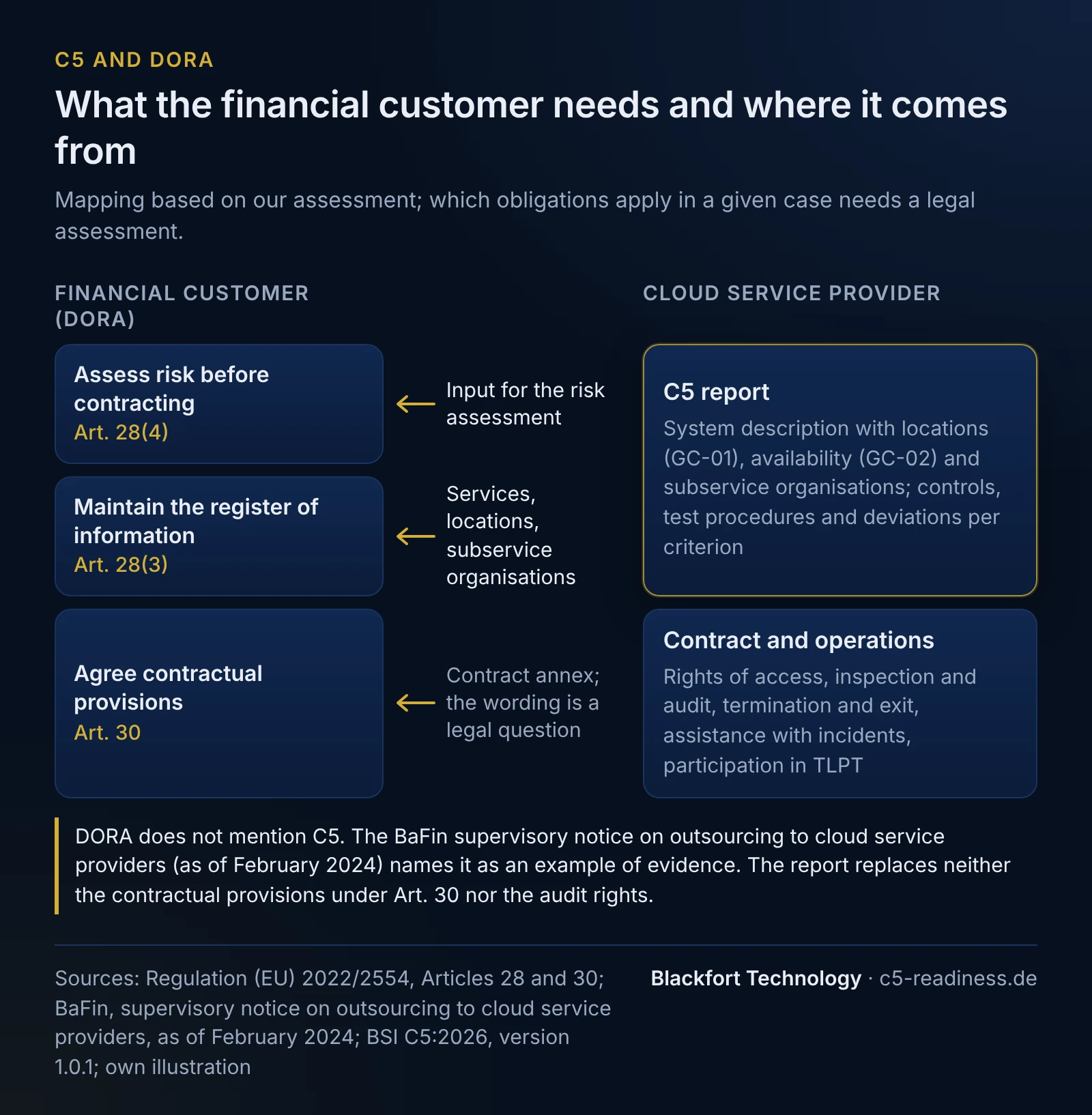
In practice this means: a C5 type 2 report is evidence that financial customers know from the BaFin notice and can classify. It replaces neither the contractual provisions under Article 30 nor the audit rights of the customer and the supervisory authority.
What a C5 report contributes to DORA obligations
The following table takes the contractual provisions under Article 30 and the pre-contract obligations under Article 28 and sets out next to them what a C5 report supplies. The mapping is our assessment; the wording of the Regulation as published in the Official Journal is binding.
| DORA requirement | What the C5 report supplies | What else is needed |
|---|---|---|
| Risk assessment and due diligence before contracting (Article 28(4)) | System description, controls, test procedures and deviations per criterion; the information on deviations is intended to enable the specified parties to determine the effects on their own risk assessment (section 3.4.12) | Answers to questions the report leaves open, for example on concentration risk and conflicts of interest |
| Description of functions and conditions for subcontracting (Article 30(2)(a)) | Name, type and scope of the service; subservice organisations with company name, place of processing and an assessment of dependency (section 3.4.5.1 item 8, section 3.4.6) | Contractual rules on whether and under which conditions you may subcontract |
| Locations and advance notice of changes (Article 30(2)(b)) | Information on countries, regions and locations under GC-01 | Contractual obligation to notify the customer before a change of location |
| Availability, integrity, confidentiality, protection of personal data (Article 30(2)(c)) | Controls for the criteria in scope; according to the BSI FAQ, a C5 attestation is not evidence of data protection compliance | Contractual provisions, data protection agreements |
| Access to data and return on insolvency or termination (Article 30(2)(d)) | Controls in the PI domain (portability and interoperability), where in scope | Contractual commitment on format, deadline and procedure |
| Service levels (Article 30(2)(e), Article 30(3)(a)) | Information on availability and incident handling under GC-02 | Agreed quantitative and qualitative performance targets |
| Assistance with ICT incidents (Article 30(2)(f)) | Incident process under SIM; for type 2, the significant events during the period | Commitment to assist at no additional cost or at a cost determined in advance |
| Cooperation with authorities (Article 30(2)(g)) | The catalogue explicitly names regulators as intended users of the report (section 3.4.13 item 1.7) | Contractual obligation to cooperate fully with the competent authorities |
| Termination rights and minimum notice periods (Article 28(7), Article 30(2)(h)) | Nothing | Allow the termination grounds under Article 28(7) in the contract |
| Customer training programmes (Article 30(2)(i)) | Nothing | Conditions for your participation |
| Implementing and testing contingency plans (Article 30(3)(c), only critical or important functions) | Controls in the BCM domain, for type 2 with testing of operating effectiveness | Contractual commitment and test results for the customer |
| Participation in the customer’s threat-led penetration testing (TLPT) (Article 30(3)(d)) | Nothing | Commitment to take part and a procedure for it |
| Rights of access, inspection and audit (Article 30(3)(e)) | A basis of information; according to the BaFin notice, however, an entity must not let its audit rights be limited to submitted audit reports | Unrestricted rights for the customer, appointed third parties and the supervisory authority; Article 30(3)(e)(ii) allows alternative assurance levels to be agreed if other clients’ rights are affected |
| Exit strategies with a transition period (Article 30(3)(f)) | Controls in the PI domain, where in scope | Agreed transition period and support with the switch |
The register of information that financial entities have to keep under Article 28(3) for all contractual arrangements on ICT services needs information from you. Much of it is already in the system description, such as services, locations and subservice organisations. Keep this information in a form you can hand over without the full report.
How to make the C5 report useful for financial customers
Our recommendation for providers with financial customers, in five points:
- Align the scope with the customer. The report only helps if it covers the services and regions the customer uses. That is also the first condition in the BaFin notice. How to define the scope is covered on C5 scope.
- Type 2 and periods without gaps. A type 2 report shows operating effectiveness over a period. For ongoing contracts, customers need the subsequent reports; plan the periods without gaps, see type 1 or type 2.
- Be able to explain deviations. Deviations appear in the report even if the criterion as a whole is considered met. Prepare a short statement for each, with cause, measure and date.
- Prepare a DORA contract annex. An annex that answers Article 30(2) and (3) point by point and refers to the relevant parts of the report shortens negotiations. Drafting the clauses is a legal question.
- Organise audit rights. Decide how you carry out audits by customers, appointed third parties and supervisors without disclosing other customers’ data. The C5 report can be the basis on which auditors build their own questions.
Example: account opening as SaaS for regional banks
Fictitious example, not a client. A provider runs a platform for digital account opening with identity verification and document storage as SaaS on an IaaS platform. It has a C5 type 2 report for the platform in a German region. A regional bank classifies the service as supporting an important function.
| The bank’s question | The provider’s answer |
|---|---|
| Does the report cover our service? | Yes, the platform and region are named in the report; the IaaS platform is carved out, its own report is available and is supplied on request where its distribution terms allow. |
| Where is data processed? | Information under GC-01 from the report, plus the commitment to give advance notice of changes of location. |
| How are our audit rights secured? | Contract annex with rights of access, inspection and audit for the bank, appointed third parties and the supervisory authority; the C5 report serves as the basis on which the bank’s auditors build their own audit procedures. |
| Will you take part in our TLPT? | Commitment to take part, with an agreed procedure and test window. |
| How do we get out again? | Export function for application data and documents, agreed transition period, support with the switch. |
The bank takes the information into its register of information and its risk assessment. Its internal audit function evaluates the report itself; according to the BaFin notice, it may not rely on the report alone for material outsourcing.
What this page does not settle
Whether your customer is a financial entity within the meaning of Article 2 DORA, whether your service supports a critical or important function and how contract clauses are drafted needs a legal assessment in each case. We have not evaluated further legal acts on DORA or supervisory publications for this page. We read the Regulation on 1 November 2026 as published in the Official Journal; check before making decisions whether it has been amended since.
Frequently asked questions
Is a C5 attestation mandatory under DORA?+
Does BaFin recognise C5?+
Does the C5 report replace the financial customer’s audit rights?+
Do we as a cloud service provider need our own DORA evidence?+
Does NIS2 or DORA apply to us?+
Read more
- C5 and NIS2: what remains to do alongside the attestation
- Reading a C5 report: evaluating the audit report as a customer
- C5 attestation vs C5 certification: report and meaning
- C5 subservice inventory: example and report review
- C5 scope: service boundary, platform reports, carve-out
- C5 readiness assessment: gap analysis, action plan and timeline
Sources
- Regulation (EU) 2022/2554 on digital operational resilience for the financial sector (DORA), OJ L 333, 27.12.2022, Articles 28, 30 and 64 (retrieved 2026-11-01)
- BaFin: Aufsichtsmitteilung zu Auslagerungen an Cloud-Anbieter (supervisory notice on outsourcing to cloud service providers), as of February 2024 (PDF, German), sections III.2, III.5.2 and V.4.2.3 (retrieved 2026-11-01)
- BSI Act (BSIG), Section 28(6) (German, gesetze-im-internet.de) (retrieved 2026-11-01)
- BSI: Kriterienkatalog Cloud Computing C5:2026, version 1.1.0 (PDF, German), sections 3.4.5.1, 3.4.6, 3.4.12, 3.4.13 and 4, licensed under CC BY-ND 4.0 (retrieved 2026-11-01)
- BSI: Cloud Computing Compliance Criteria Catalogue C5:2026, version 1.0.1 (PDF), sections 3.4.5.1, 3.4.6, 3.4.12, 3.4.13 and 4, licensed under CC BY-ND 4.0 (retrieved 2026-11-01)
- BSI: C5 FAQ (German; data protection, sharing the report) (retrieved 2026-11-01)
This content provides general technical and organisational information and does not constitute legal advice (no legal services within the meaning of the German RDG).