

Last updated: 2026-11-06
This page covers post-quantum cryptography as a focus topic of C5:2026. Cryptography policy, key management and rotation as a whole are covered on CRY domain.
What does post-quantum cryptography mean under C5:2026?
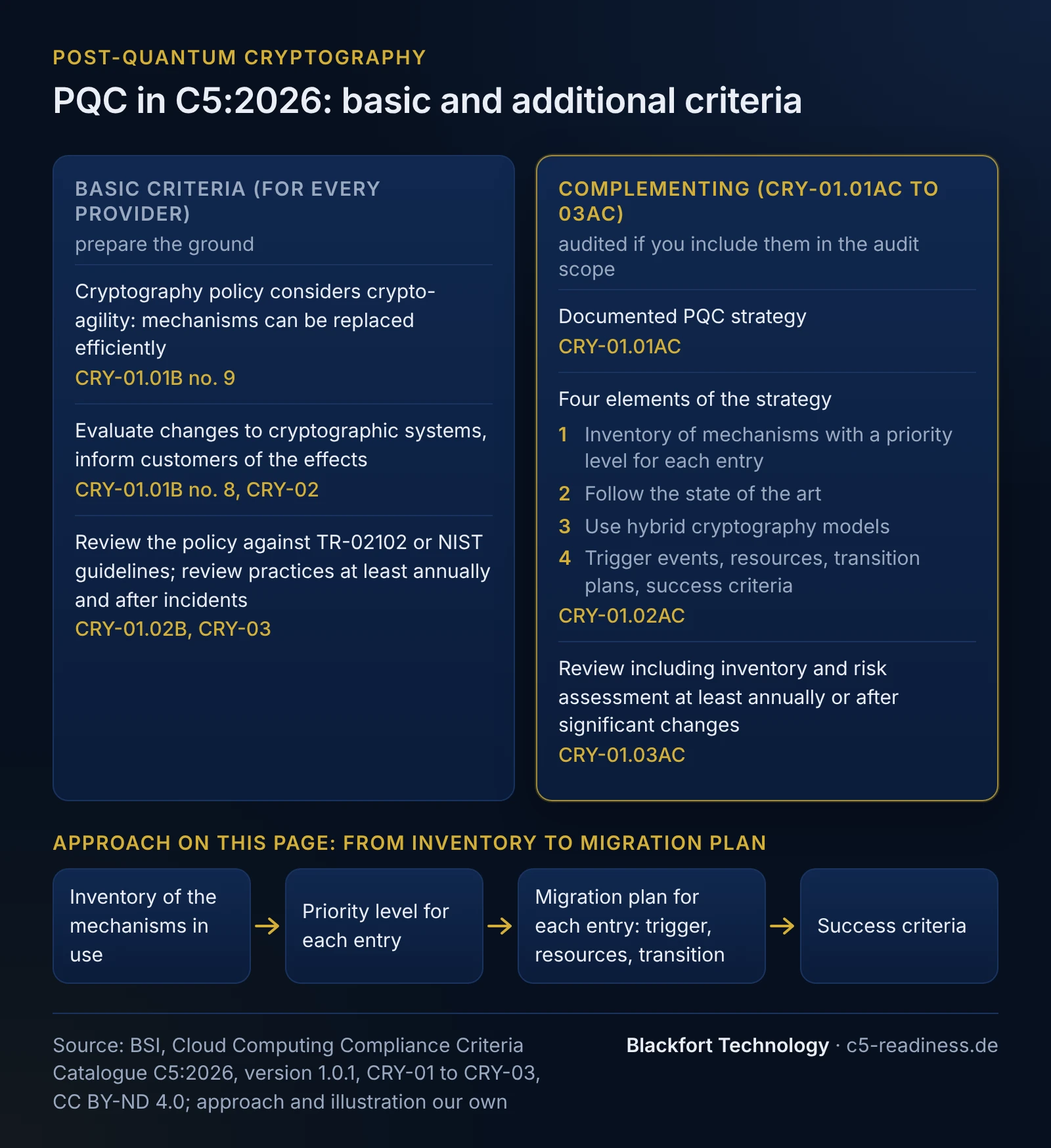
The catalogue counts post-quantum cryptography among its new focus topics (section 1.1). The aim is protection against adversaries in possession of a quantum computer. CRY-01.01AC requires a documented PQC strategy for this. CRY-01.02AC names four elements: an inventory of the cryptographic mechanisms in use with a priority level for each entry, staying informed about the state of the art, the use of hybrid cryptography models, and the definition of trigger events, resources, transition plans and success criteria. Under CRY-01.03AC, the strategy including the inventory and risk assessment is reviewed at least annually or in case of significant changes.
These three subcriteria are complementing, so they are not mandatory. They are audited if you include them in the audit scope. How that works is explained on C5 criteria catalogue. Three basic criteria already prepare the ground for every provider, though:
- Crypto-agility (CRY-01.01B no. 9): The cryptography policy has to consider that mechanisms can be replaced efficiently during their lifetime.
- Change management (CRY-01.01B no. 8 and CRY-02): Changes to cryptographic systems are evaluated for their effects, including on workloads that customers manage themselves, and customers are informed of these effects.
- Review (CRY-01.02B and CRY-03): The policy is checked against the BSI Technical Guideline TR-02102 or suitable NIST guidelines, and the mechanisms are reviewed against the state of the art at least annually and after incidents involving cryptographic components.
In practice you already need an inventory of mechanisms for these basic criteria: without knowing where which mechanism runs, you can demonstrate neither replaceability nor review. For the healthcare market, our classification is this: Section 393 SGB V refers to an attestation covering the basic criteria, or under certain conditions to evidence under the C5 Equivalence Ordinance (C5GleichwV) instead. The PQC strategy is not part of either (see Section 393 SGB V and C5 Equivalence Ordinance).
Why the topic is on the table now is explained in the catalogue’s supplementary information with the “store now, decrypt later” scenario: data that is transmitted or stored in encrypted form today could be captured and decrypted later. For the migration, it refers among others to the BSI guideline “Quantum-safe cryptography - fundamentals, current developments and recommendations”, an implementation roadmap of the European Commission and drafts of NIST SP 1800-38.
Starting point: a billing platform with long-lived data
Fictitious example, not a client. A provider runs a platform through which home care providers bill for their services. The service runs on the infrastructure of a large cloud provider (hyperscaler). Under the contracts with the customers, billing data stays stored for many years. Customers connect the platform to their practice software through an interface with client certificates, and documents are signed electronically.
This is the situation before the project:
- The cryptography policy names “state of the art” and TLS from version 1.2, but no mechanisms per purpose.
- The team knows from memory where encryption runs: at the load balancer, in the service mesh, in the database, in the backup and for the signatures. There is no inventory.
- The signature library is hard-coded; a different mechanism would mean rebuilding several services.
- The customers’ client certificates run for several years and come from the provider’s own certificate authority.
Management wants to include the PQC strategy in the audit scope because public sector customers ask for it. For that, the team first needs the inventory.
Who is responsible for what: provider, platform, customer?
The PQC strategy is the provider’s business. Many mechanisms run in platform services, though, and customers feel every change at their interfaces. Our classification for the example:
| Aspect | Provider | Platform (subservice organisation) | Customer (home care service) |
|---|---|---|---|
| PQC strategy and inventory | writes, prioritises and reviews them (CRY-01.01AC to 03AC) | - | - |
| Mechanisms in managed services (load balancer, key management, database) | records them in the inventory, chooses configurations, follows the platform’s announcements | offers mechanisms and changeovers | - |
| Own mechanisms (signature, client certificates, service mesh) | plans and carries out the replacement | - | - |
| Changeover at the customer interface | evaluates effects and informs customers in advance (CRY-02.01B) | - | changes over its own software in time |
For CRY-01 and CRY-03 the catalogue lists no complementary customer criteria. You still presuppose that customers change over their clients. That belongs in the system description as a complementary customer control (CUEC).
Work product: crypto inventory with priorities
The inventory under CRY-01.02AC no. 1 needs a priority level for each entry, based on the impact and probability of quantum computing attacks and on the effort to remediate. The columns below are our suggestion. The rating is that of the fictional provider from its own risk assessment, not a general classification of mechanisms.
| Use | Class of mechanism | Operated by | Protection period of the data | Replaceability | Priority |
|---|---|---|---|---|---|
| External interface (TLS at the load balancer) | asymmetric key exchange, signature in the certificate | platform, configured by the provider | as long as the transmitted billing data | configuration, dependent on the platform’s offering and on the customer clients | high |
| Customers’ client certificates | asymmetric signature | provider (own certificate authority) | validity of the certificates | new certificate authority and replacement at all customers | high |
| Signature of billing documents | asymmetric signature | provider (hard-coded library) | retention period of the documents | rebuild of several services | high |
| Service mesh between services | asymmetric key exchange | provider | short, traffic within the platform | central configuration | medium |
| Encryption of the database and backups | symmetric encryption, keys in the platform’s key management | platform, configured by the provider | retention period | configuration | to be set after comparison with TR-02102-1 |
The inventory comes with a migration plan that answers the requirements of CRY-01.02AC no. 4 for each entry: what triggers the changeover (for example a recommendation in the current TR-02102-1 or an offering from the platform), what resources it needs, what the transition looks like (for example a hybrid mechanism for a transitional period) and how you recognise success. According to the supplementary information, hybrid models combine classical and quantum-safe mechanisms so that the system remains secure if one component is compromised. Which mechanisms count as quantum-safe you take from the guidelines named in the catalogue, in their current version. This page does not specify any mechanisms.
Example control description for CRY-01.03AC
An inventory is only as good as its maintenance. The following control keeps inventory and strategy up to date (own wording, not catalogue text):
| Field | Example |
|---|---|
| Control ID | K-CRY-01-PQC Review of PQC strategy and crypto inventory |
| Mapped to | CRY-01.01AC to CRY-01.03AC; in the basic criteria CRY-01.01B no. 9, CRY-03.01B and CRY-03.02B |
| Objective | The inventory contains all mechanisms in use with a valid priority, and the migration plan is aligned with the state of the art. |
| Responsible | Head of platform operations (execution); check and approval by the information security officer |
| Trigger and frequency | annually in the first quarter; additionally with a new version of TR-02102, with platform announcements on mechanisms, with architecture changes and after security incidents involving cryptographic components |
| Execution | Comparison of the inventory with automatically collected data (certificate stock, configuration of load balancers and key management, service dependencies). Reassessment of priorities using the four points of the supplementary information on CRY-01.03AC. Update of triggers, resources and success criteria in the migration plan. |
| Check | The information security officer checks completeness against the automatic collection and approves inventory and plan. Changeovers then go through change management under CRY-02. |
| Escalation | If the comparison finds a mechanism without an entry, it is assessed within 30 days. If a high-priority step of the migration plan is delayed, management decides on resources or a documented risk acceptance. |
| Evidence | approved inventory with date, review record, migration plan with change history, change tickets for the changeovers |
The 30-day deadline is an example value, not a catalogue requirement. How a cryptographic change ticket with customer information works is covered on CRY domain.
What evidence the auditor wants to see
If the additional criteria are in scope, the auditor wants to see strategy, inventory and review. For the basic criteria, the cryptography policy with crypto-agility and the reviews under CRY-03. Examples from the scenario:
| Evidence | Criterion | Origin | Responsible | Time reference |
|---|---|---|---|---|
| Cryptography policy with a section on crypto-agility | CRY-01.01B no. 9 | ISMS document repository | Information security officer | version valid in the period |
| PQC strategy, aligned with the cryptography policy | CRY-01.01AC, CRY-01.02AC | ISMS document repository | Information security officer | version valid in the period, with approval date |
| Crypto inventory with priorities | CRY-01.02AC no. 1 | Inventory tool, exports from platform and certificate management | Head of platform operations | state at the reference date, change history |
| Migration plan with triggers, resources, transition and success criteria | CRY-01.02AC no. 4 | Planning document | Head of platform operations | version valid in the period |
| Record of the annual review of strategy and inventory | CRY-01.03AC | Review record | Information security officer | every run in the period |
| Review of mechanisms against the state of the art | CRY-03.01B, CRY-03.02B | Review report, comparison with TR-02102 | Information security officer | annually and after incidents |
| Change tickets with impact evaluation and customer information | CRY-02.01B, CRY-02.02B | Ticket system, customer communication | Head of platform operations | per changeover in the period |
How to keep track of which evidence supports which subcriterion is shown on evidence and documentation.
Possible gaps: cause, effect, remedy
The following gaps follow from the wording of the criteria and the scenario. If a subcriterion in the audit scope is not met, the criterion counts as not met and the auditor reports the deviation (sections 3.4.12 and 3.4.13).
| Possible gap | Cause | Effect | Remedy |
|---|---|---|---|
| Strategy without inventory | The PQC strategy describes intentions but names no specific places of use. | CRY-01.02AC no. 1 requires an inventory with a priority level for each entry. Without it, the criterion is not met if it is in scope. | Build the inventory from automatic sources and assess impact, probability and effort for each entry. |
| Mechanisms in platform services missing | The team only counts cryptography it has programmed itself. | The inventory covers the mechanisms “in use”. Load balancer, key management and database of the platform are part of the service. | Include managed services with their configuration and list the platform’s announcements as triggers in the plan. |
| Hard-wired mechanisms | The signature library is built into several services without abstraction. | The basic criteria already require the policy to consider crypto-agility (CRY-01.01B no. 9). A replacement becomes expensive and hard to plan. | Put cryptography behind a shared interface and make mechanisms configurable; list the rebuild as a step in the migration plan. |
| Customers learn of changeovers too late | Changeovers are treated as a pure operations task. | CRY-02.01B requires evaluating the effects on customer workloads and informing customers about them. | Run every changeover at the interface through cryptographic change management, with advance notice and a test environment for customers. |
| No annual review | The strategy was written once for the audit. | CRY-01.03AC requires a review at least annually. Otherwise evidence of effectiveness is missing in the type 2 period. | A fixed review as in the control above, coupled with the review under CRY-03. |
Whether you include the additional criteria in the first attestation or secure the basic criteria first is a question of prioritising measures.
Criteria related to PQC
Criterion titles as in the English catalogue version 1.0.1, subcriteria counted according to section 5 (B = basic, AS = additional (sharpening), AC = additional (complementing)). The column “What it is about” is our own short description, not catalogue text. The wording of the criteria in the catalogue is binding.
| ID | Title (catalogue) | B/AS/AC | What it is about |
|---|---|---|---|
| CRY-01 | Policy for the Use of Cryptographic Mechanisms | 2/0/3 | Cryptography policy with crypto-agility in the basic criteria, PQC strategy with inventory and annual review as an addition. |
| CRY-02 | Cryptographic Change Management | 3/0/0 | Evaluate changeovers, document them traceably and inform customers of the effects. |
| CRY-03 | Review of Cryptography Practices | 2/0/0 | Check mechanisms against the state of the art at least annually and after incidents, and update them as needed. |
CRY-02 and CRY-03 are new in C5:2026 with no predecessor. The other 16 criteria of the domain are listed on CRY domain.
Relationship to ISO/IEC 27001:2022 Annex A
The following mapping is our own, unofficial classification by topic. The BSI has not yet published a cross-reference for C5:2026. The catalogue refers to the BSI website for it (section 3.3). So far the table there covers C5:2020 only, and the BSI says the table for C5:2026 is “scheduled for publication in the near future” (as of 6 November 2026). According to the catalogue, even an official table only shows thematic proximity, not fulfilment of the criteria (section 3.3).
| C5:2026 | ISO/IEC 27001:2022 Annex A | Topic (short label) | What C5 additionally requires in concrete terms (our assessment) |
|---|---|---|---|
| CRY-01.01AC to 03AC | A.8.24 | Use of cryptography | PQC strategy with prioritised inventory, hybrid models and migration plan |
| CRY-02 | A.8.32 | Changes | impact evaluation for customer workloads and customer information |
| CRY-03 | A.8.24 | Review | at least annually and after incidents involving cryptographic components |
Frequently asked questions
Do I need a PQC strategy for a C5 attestation?+
What goes into the crypto inventory?+
Does C5 prescribe specific quantum-safe mechanisms?+
What are hybrid cryptography models?+
How often does the PQC strategy have to be reviewed?+
Read more
- C5 CRY: cryptography and key management under C5:2026
- C5:2026: what is new, moving from C5:2020 and the transition period
- C5 criteria catalogue: structure, basic and additional criteria
- C5 DEV: development and change management under C5:2026
- C5 documentation: keeping an evidence register for the audit
- Prioritising C5 measures: blockers, dependencies, sequence
- C5 readiness assessment: gap analysis, action plan and timeline
Sources
- BSI: C5:2026 web page with downloads (German) (retrieved 2026-11-06)
- BSI: C5:2026 web page with downloads (retrieved 2026-11-06)
- BSI: Kriterienkatalog Cloud Computing C5:2026, version 1.1.0 (PDF, German), licensed under CC BY-ND 4.0 (retrieved 2026-11-01)
- BSI: Cloud Computing Compliance Criteria Catalogue C5:2026, version 1.0.1 (PDF), section 1.1, CRY-01 to CRY-03 with supplementary information, sections 3.3, 3.4.12 and 3.4.13, licensed under CC BY-ND 4.0 (retrieved 2026-11-01)
- BSI: C5:2026 change history (Excel), new criteria CRY-02 and CRY-03 (retrieved 2026-11-01)
- Section 393(3) no. 2 and Section 393(4) SGB V (Book V of the German Social Code; gesetze-im-internet.de, German) (retrieved 2026-11-01)
- C5 Equivalence Ordinance (C5GleichwV), Section 1 (gesetze-im-internet.de, German) (retrieved 2026-11-01)
This content provides general technical and organisational information and does not constitute legal advice (no legal services within the meaning of the German RDG).