

Last updated: 2026-11-06
This page is for vendors of hospital software who offer their software as a cloud service, for example for theatre planning, nursing documentation or patient portals. Whether and how Section 393 SGB V (Book V of the German Social Code) applies to hospitals and their service providers is explained on the Section 393 SGB V page; this page does not repeat that and is not legal advice. For AI software in hospitals with a model provider and inference, see AI in healthcare; for vendors of practice software, see practice software vendors.
The example: theatre and resource planning for hospital groups
Fictitious example, not a customer. A vendor offers software for planning operating theatres, staff and materials as SaaS. The architecture:
- Application in the browser, multi-tenant, run on a cloud platform in a region in Germany; one tenant per hospital.
- Two dedicated instances for large hospital groups that required this in their contracts: their own database and network segments, but the same software, the same deployment and the same operations team.
- Connection to the hospital information system (HIS): patient master data and surgery requests arrive as HL7 messages from the hospital’s communication server, planned and actual surgery times go back. The connection runs through an encrypted site-to-site tunnel between the hospital network and an interface service in the cloud.
- Login of hospital staff via the hospital’s identity provider (single sign-on).
- Operations with on-call cover around the clock, because the hospitals also operate at night and at weekends.
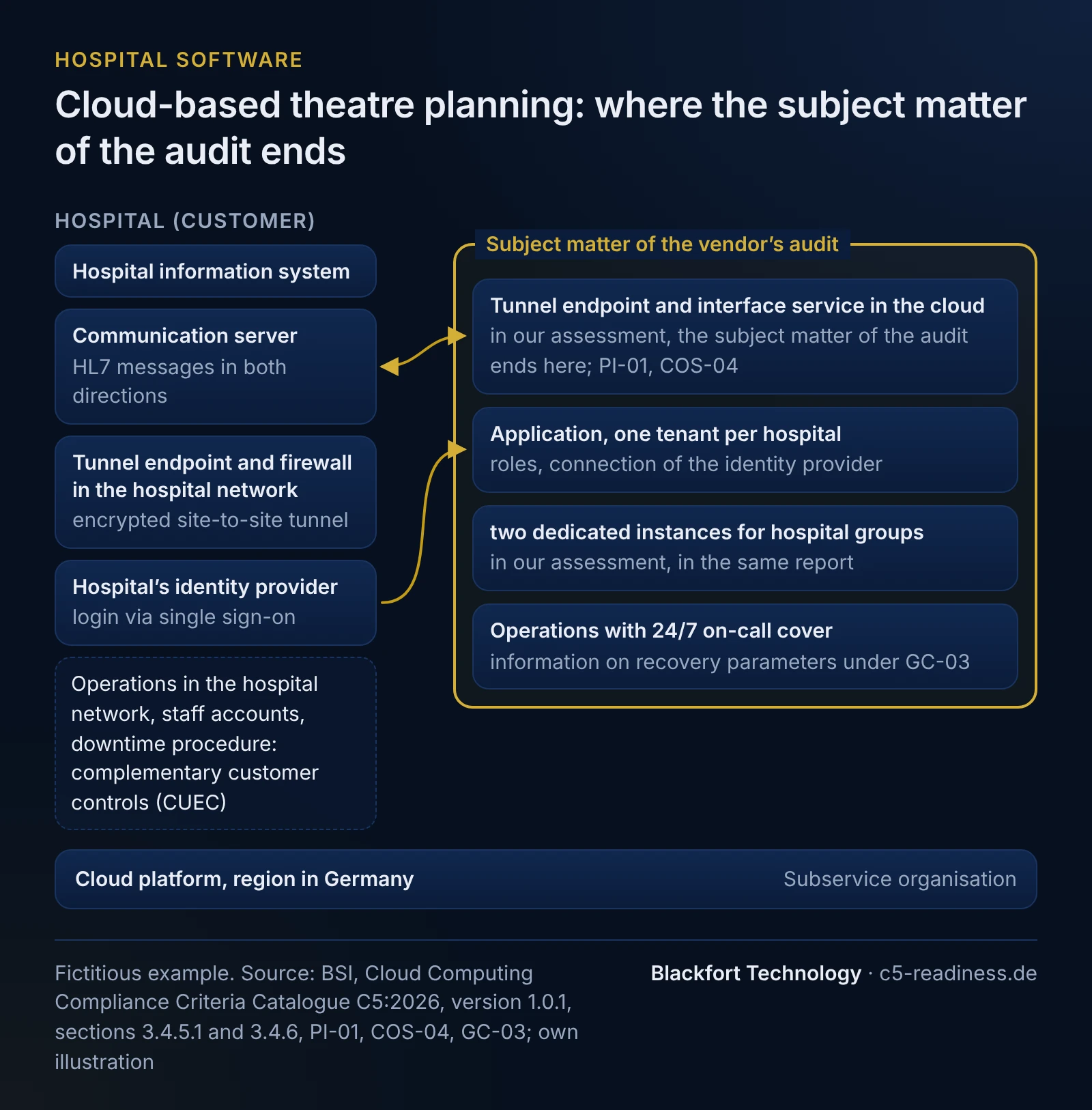
Who is responsible for what: vendor, platform, hospital
| Area | Vendor (subject matter of the audit) | Cloud platform (subservice organisation) | Hospital (complementary customer controls) |
|---|---|---|---|
| HIS connection | Tunnel endpoint in the cloud, interface service, validation of incoming messages | Network services in its own report | Communication server, tunnel endpoint and firewall in the hospital network |
| Login | Connection of the identity provider, roles in the application, accounts of the vendor’s own staff | - | Identity provider, staff accounts, removal when someone leaves |
| Instances | Shared instance and dedicated instances: deployment, patches, separation | Data centres, hardware, virtualisation | - |
| Emergency operation | Recovery of the service, information on recovery parameters | Availability of the platform services | Own downtime procedure when the planning software is unavailable |
| Incidents | Informing the hospital about incidents that affect it | Notifications to the vendor under its own contract | Forwarding the notifications to the responsible department, at night too |
The right-hand column belongs in the system description as complementary customer controls (CUEC) (section 3.4.5.1 no. 7). How to word such obligations so that the hospital can implement and evidence them is shown on the complementary customer criteria page.
Decision 1: Where does the subject matter of the audit end at the HIS interface?
In our assessment, at the tunnel endpoint in the cloud. Everything the vendor operates there belongs in the subject matter of the audit: the tunnel endpoint, the interface service and the rules on which messages it accepts. Two criteria describe what has to be evidenced there:
- PI-01 requires, for interfaces through which customers’ IT systems access the service, among other things standardised communication protocols with adequate authentication, encryption over untrusted networks and mechanisms that validate the integrity of the transmitted data (PI-01.01B nos. 1, 2 and 4).
- COS-04 requires every network perimeter to be controlled by security gateways and cross-network access to be based on a security assessment that takes the customers’ requirements into account (COS-04.01B and .02B).
The communication server, tunnel endpoint and firewall in the hospital network are operated by the hospital. They appear as complementary customer controls in the system description. For COS-04 the catalogue also lists complementary customer criteria, but they only cover security gateways at the perimeters of the virtual networks within the cloud service for which the customer is responsible. The auditor does not test these controls at the hospital, only whether they are fairly presented, and points out in the report that the criteria are only met if the customer controls are effective.
Our recommendation: keep an interface sheet per hospital recording which message types flow in which direction, who operates which endpoint and who renews the tunnel’s credentials and certificates. This sheet is evidence for PI-01 and at the same time the basis for the customer controls.
Decision 2: Login via the hospital’s identity provider as an additional criterion?
For hospital software, two additional criteria are worth a look. PI-01.02AC requires interfaces for the customer’s identity providers with a standardised protocol, PI-01.03AC clear documentation of these interfaces for the customer’s subject matter experts. In the example both exist because the hospitals require single sign-on. In our assessment the vendor can add these two subcriteria to the audit scope with little extra effort. Which additional criteria you include is your decision; if you include only some of them, the system description has to state the rationale for the selection (section 3.4.3). The accounts of hospital staff remain a customer control either way.
Decision 3: Do dedicated instances belong in the same report?
In our assessment, yes, if they are part of the service offered. The system description states the name, type and scope of the cloud services provided (section 3.4.5.1 no. 1). If it lists only the shared instance, the two hospital groups receive a report that does not cover their instance. Clarify three consequences before the audit:
- Population. Patches, changes and access reviews run on all instances. If the auditor draws samples in a type 2 audit, they need the complete list of all cases; your evidence register should therefore show for each control which instances it covers (see evidence register).
- Patch management. OPS-27 requires, among other things, that patches are scheduled within maintenance windows and tested in a non-production environment before they go into production, with the ability to revert to earlier versions (OPS-27.01B nos. 2 and 3). If you agree separate maintenance windows for dedicated instances, you need evidence for each instance that the patch arrived within the agreed time frame (OPS-28).
- Separation. Even a dedicated instance shares the platform, deployment tools and operational access with the others. Its separation therefore belongs in the same documented layer model under OPS-30, with a risk assessment that is reviewed at least annually (OPS-31).
Decision 4: Recovery in 24/7 operations
A hospital plans its operating theatres even when the software fails. For that it needs information from the vendor. GC-03 requires the provider to share information on the recovery parameters with the customers’ subject matter experts on request: maximum tolerable period of downtime and RTO, maximum allowable data loss (RPO), recovery time to start emergency operation, minimum business continuity objective and restore time until normal operation. This information is meant to enable the hospital’s own business impact analysis. What GC-03 and the other general conditions require in detail is shown on the general conditions page. Two points matter particularly for hospital software:
- The hospital’s downtime procedure, for example a printout of the day’s schedule and a procedure for emergency surgery, is its own control and belongs in the system description as a complementary customer control.
- BCM-04.01B requires affected cloud service customers and relevant third parties to be involved in the tests of the business continuity plans, which take place at least annually. Invite a hospital to a recovery test and record its feedback. For how continuity tests as a whole become auditable, see BCM domain.
The same applies to incidents: OPS-24 requires the provider to inform customers about the status of incidents that affect them. As a complementary customer criterion, the catalogue adds that the notifications are received and forwarded to the responsible department. For a hospital this means a contact who can be reached at night too.
Evidence vendors of hospital software should prepare
| Topic | Evidence | Source | Owner | Timing |
|---|---|---|---|---|
| HIS connection | Interface sheet per hospital, configuration of tunnel and security gateway, security assessment | Integration, network operations | Head of integration | status per hospital, changes in the period |
| Single sign-on | Interface documentation, configuration per hospital | Development | Head of development | current status and history |
| Patches on all instances | List of instances, patch levels with dates, test records | Operations, deployment tool | Head of operations | all patches in the period, samples per instance |
| Separation | Layer model, risk assessment, configuration of the dedicated instances | Architecture | Architecture | review at least annually |
| Recovery | Information under GC-03, test record with a hospital involved | Operations, business continuity management | Business continuity manager | test at least annually |
Possible gaps for vendors of hospital software
| Possible gap | Cause | Effect | Remedy |
|---|---|---|---|
| Interfaces only described in project folders | Each HIS connection was implemented as a separate project | No consistent evidence for PI-01 and COS-04, customer controls unclear | Interface sheet as a template, completed for every existing connection |
| Dedicated instance outside the patch cycle | The hospital group’s own maintenance window, patch applied manually later | A sample shows a patch outside the agreed time frame | All instances in the same deployment tool, exceptions with date and approval |
| Recovery parameters not agreed | The contract states an availability figure but no RTO and no minimum business continuity objective | The hospital cannot base its business impact analysis on the service | Prepare the information under GC-03 and reference it in the contract or the operations documentation |
Frequently asked questions
Does the auditor also audit the communication server in the hospital?+
Do we need a separate attestation for dedicated instances?+
Does the attestation also cover installations in the hospital’s data centre?+
Do we have to involve hospitals in continuity tests?+
Is our cloud platform’s C5 attestation enough for the hospitals?+
Read more
- Section 393 SGB V: C5 attestation for healthcare cloud services
- C5 for AI in healthcare: model providers, data flows, scope
- C5 scope: service boundary, platform reports, carve-out
- C5 BCM: business continuity and restore tests under C5:2026
- C5 complementary customer criteria and CUEC explained
- C5 readiness assessment: gap analysis, action plan and timeline
Sources
- BSI: Kriterienkatalog Cloud Computing C5:2026, version 1.1.0 (PDF, German), sections 3.4.3, 3.4.5.1, 3.4.6, GC-03 and PI-01, COS-04, OPS-24, OPS-27, OPS-28, OPS-30, OPS-31, BCM-04, licensed under CC BY-ND 4.0 (retrieved 2026-11-01)
- BSI: Cloud Computing Compliance Criteria Catalogue C5:2026, version 1.0.1 (PDF), sections 3.4.3, 3.4.5.1, 3.4.6, GC-03 and PI-01, COS-04, OPS-24, OPS-27, OPS-28, OPS-30, OPS-31, BCM-04, licensed under CC BY-ND 4.0 (retrieved 2026-11-01)
- BSI: C5 FAQ, question “Was wird bei einer C5-Prüfung geprüft?” (German) (retrieved 2026-11-01)
- Section 393 SGB V (gesetze-im-internet.de, German) (retrieved 2026-11-01)
This content provides general technical and organisational information and does not constitute legal advice (no legal services within the meaning of the German RDG).