
Last updated: 2026-11-06
This page covers the COS (Communication Security) domain of C5:2026, section 5.9 of the catalogue. How criteria and subcriteria are structured in general is explained on the page C5 criteria catalogue.
What is the COS domain about?
COS protects information in networks. The catalogue states the objective as ensuring the protection of information in networks and the corresponding information processing systems (section 5.9). The criteria require technical safeguards against network-based attacks at multiple tiers (COS-01), defined security requirements for connections (COS-02), security zones with monitored transitions (COS-03), security gateways at every network perimeter (COS-04), separate networks for administration (COS-05), separation of customer data traffic in jointly used networks (COS-06), up-to-date documentation of the network topology (COS-07) and policies for data transmission (COS-08).
The domain comprises eight criteria with 20 basic subcriteria, one sharpening and three complementing additional subcriteria. For a SaaS provider on a hyperscaler platform, COS mainly concerns the virtual networks it configures itself. Which encryption methods apply to transmission is governed by the CRY domain; how the data of the protective systems is evaluated in the SIEM, by the OPS domain.
Starting point: a flat network that has grown over time
Fictitious example, not a client. A provider runs a telemonitoring platform for heart patients. Measuring devices in patients’ homes send readings via small mobile gateways that the provider supplies; hospitals and cardiology practices see the readings in a web portal and receive alarms. The service runs as SaaS on the infrastructure of a large cloud provider, in a managed Kubernetes cluster with a managed database.
Before the project, the situation looks like this:
- All services sit in one virtual network with one subnet; the database can be reached from every pod.
- Administrators connect via SSH directly from the office network, allowed by its IP address.
- The security group rules have grown over the years. Nobody knows exactly any more what some open ports are needed for.
- The web application firewall protects the portal, but not the interface for the readings.
- The network diagram in the wiki shows the state of two years ago.
- The logs of the firewall and the web application firewall stay with the platform; the provider’s SIEM does not receive them.
Who is responsible for what: provider, platform, customer?
The boundary runs between the platform’s physical network and the virtual networks the provider configures. Five of the eight criteria contain complementary customer criteria; they are aimed mainly at customers who are themselves responsible for parts of the service, for example virtual machines in an IaaS solution. Our classification for the example:
| Aspect | Provider | Platform (subservice organisation) | Customer (hospital, practice) |
|---|---|---|---|
| Physical network, separation of the platform’s tenants | monitors the platform under SSO (control and monitoring of service providers and suppliers) | operates and separates; outside your audit under the carve-out method | - |
| Virtual networks, subnets, security groups, gateways | defines zones and permitted connections, configures and reviews them (COS-02 to COS-04) | provides the functions | - |
| Administrative access | separates it from the network used by customers, with multi-factor authentication (COS-05) | secures its own management layer | - |
| Measuring device gateways | supplies them; only known devices may connect | - | - |
| Transmission from hospital systems to the service | offers protected interfaces | - | ensures, under the complementary customer criteria for COS-08, that the transmitted data is protected according to its protection needs |
Whichever customer controls you assume belong in the system description as complementary customer controls (CUEC). If customers of a SaaS service do not operate virtual networks of their own, the complementary customer criteria for COS-01, COS-03, COS-04 and COS-06 may have nothing to apply to; the system description should then say so explicitly.
What does an auditable zone model look like?
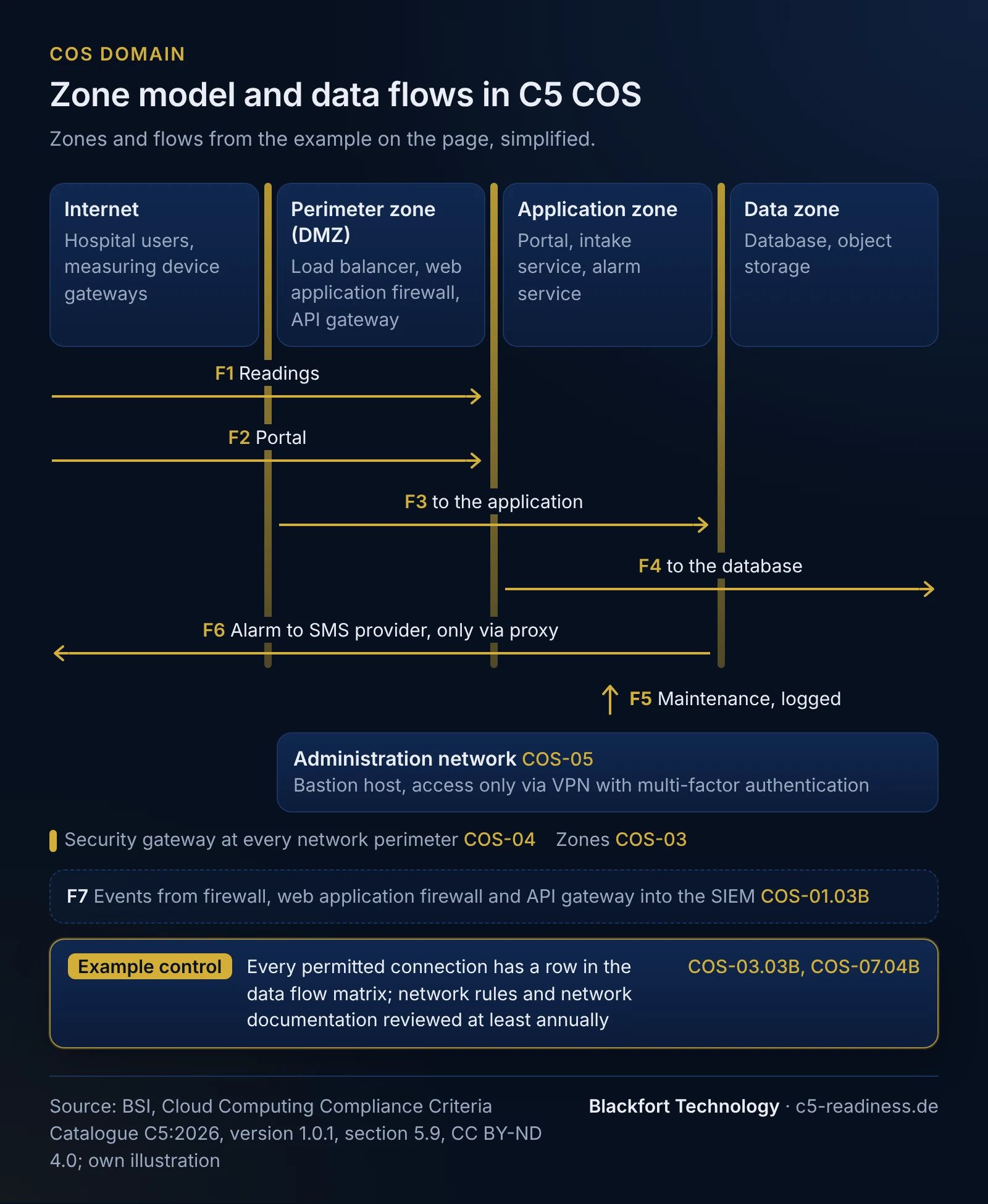
COS-03.01B requires distinguishing between trusted and untrusted networks and separating them, based on a risk assessment, into security zones for internal and external network areas and a DMZ where applicable. COS-04.01B requires security gateways at every network perimeter, COS-05.01B separate networks for administration. The separation may be logical, for example via VLAN, SDN or VRF. Our zone model for the example:
| Zone | Contents | Trust | Inbound permitted | Outbound permitted |
|---|---|---|---|---|
| Internet | Hospital users, measuring device gateways | untrusted | - | only to the perimeter zone |
| Perimeter zone (DMZ) | Load balancer, web application firewall, API gateway for readings | restricted | HTTPS from the internet | only to defined services in the application zone |
| Application zone | Portal, intake service, alarm service | trusted | only from the perimeter zone and the administration network | data zone; internet only via proxy to approved destinations, such as the SMS provider for alarms |
| Data zone | Database, object storage | trusted, highest protection needs | only from named services in the application zone and from the administration network | backups to a second region |
| Administration network | Bastion host, access to management consoles, operations tools | trusted, privileged | only via VPN with multi-factor authentication | application and data zone for maintenance |
| Office network | Workstations, Wi-Fi | restricted | - | internet; no direct connection into production |
Networks the provider uses to create, migrate or orchestrate compute workloads are separated from the customer networks under COS-05.02B. With a managed Kubernetes cluster the platform runs the control plane; the provider describes how it restricts access to it to the administration network. How to run such a container platform ready for audit as a whole is shown on the page Containers and Kubernetes. For the office network, COS-02.01B specifies that the security requirements also cover firewalls, secure Wi-Fi configurations and VPN for remote access.
How do you document data flows under COS-07?
COS-07.01B requires traceable and up-to-date documentation showing how the subnets are allocated, how the network is zoned and segmented, how it connects with third-party and public networks and how data flows between subnets and system components. COS-02.01B requires defining which communication relationships and protocols are permitted. Both can be combined in a data flow matrix, which is at the same time the basis for the gateway rule set. An excerpt for the example:
| Flow | From | To | Protocol | Data | Protection | Owner |
|---|---|---|---|---|---|---|
| F1 | Measuring device gateway (internet) | API gateway (perimeter zone) | HTTPS | Readings, device ID | TLS with device certificate, registered devices only | Head of development |
| F2 | Hospital browsers (internet) | Web application firewall (perimeter zone) | HTTPS | Health data, login data | TLS, web application firewall | Head of operations |
| F3 | Perimeter zone | Portal and intake service (application zone) | HTTPS | as F1 and F2 | defined destinations and ports only | Head of operations |
| F4 | Portal and intake service | Database (data zone) | Database protocol with TLS | Health data | Network rule for these two services only | Head of operations |
| F5 | Administration network | Application and data zone | SSH, database administration | Operational data, health data where needed | VPN with multi-factor authentication, logged | Head of operations |
| F6 | Alarm service | SMS provider (internet) | HTTPS via proxy | Alarm text without diagnosis | Allow list of destinations | Head of development |
| F7 | Firewall, web application firewall, API gateway | SIEM | Log export | Events from the protective systems | via the platform, integrity-protected | Information security officer |
Under COS-07.02B the documentation also includes the partitions, regions, zones or location in which customer data is stored, and under COS-07.03B a representation of the systems derived from the network topology and the asset inventory. Every row of the matrix should correspond to a rule in the gateway and vice versa; only then does the review under COS-03 become manageable.
Example control description for COS-03
COS-03.03B requires reviewing the design and implementation of the connections against the security requirements at least annually and in case of significant changes to the service, COS-03.05B reviewing the business justification for all services, protocols and ports at specified intervals, including the justifications for compensatory measures for protocols considered insecure. Our example control for the provider above (own wording, not catalogue text):
| Field | Example |
|---|---|
| Control ID | K-COS-03-01 Review of network rules and network documentation |
| Mapped to | COS-03.03B, COS-03.04B, COS-03.05B, COS-07.04B |
| Objective | Every permitted connection has an entry in the data flow matrix with justification and owner; there are no rules without an entry; the network documentation matches the configuration. |
| Owner | Head of operations (execution); owners of the data flows (justification); checked by the information security officer |
| Trigger and frequency | every six months for the justification of all ports and protocols; annually for the overall review of design, implementation and documentation; additionally on every change affecting zones or gateways |
| Execution | A script exports the rules of all security groups, gateways and cluster network policies and reconciles them with the data flow matrix. Rules without an entry and entries without a rule go to the owner as a ticket. The owners confirm or re-justify every row. In the annual review, operations also compares the network diagram with the configuration and updates it. |
| Check | The information security officer sees the result of the reconciliation and checks on a sample basis whether justified rules are really needed. |
| Escalation | Deviations and vulnerabilities are assessed under the risk process and tracked as measures (COS-03.04B); a rule without justification is removed after 14 days. |
| Evidence | Dated rule exports, reconciliation reports, tickets with justifications, updated network documentation with review note |
The six-monthly frequency for ports and protocols is our recommendation; the catalogue requires “specified intervals”, which you set in your policy. For a type 2 report the auditor checks whether every defined run took place in the period.
What evidence the auditor wants to see
For COS, evidence comes from configuration exports, network documentation and review records. Examples from our scenario:
| Evidence | Criterion | Source | Owner | Timing |
|---|---|---|---|---|
| Description of the technical safeguards against network-based attacks, forwarding of their data to the SIEM | COS-01.01B to 03B | policy, configuration, SIEM | head of operations | state in the period, sample of events |
| Security requirements for connections with zone model | COS-02.01B | policy | information security officer | version valid in the period |
| Data flow matrix, rule exports, reconciliation reports, justifications | COS-03.02B to 05B, COS-04.01B | configuration, tickets | head of operations, owners | every run in the period |
| Configuration of administrative access with multi-factor authentication | COS-05.01B, COS-05.02B | VPN, identity service, network configuration | head of operations | state at the start and end of the period, changes in between |
| Network documentation with subnets, zones, connections, data flows and storage locations | COS-07.01B to 03B | documentation | head of operations | version valid in the period |
| Review note of the annual review of the network documentation | COS-07.04B | documentation, tickets | head of operations | annual review in the period |
| Data transmission policy with reference to classification and cryptography, review of the safeguards | COS-08.01B, COS-08.02B | policy, logs | information security officer | version and review in the period |
An evidence register maps each subcriterion to its evidence; how to keep one is shown on the page Evidence and documentation.
Possible gaps: cause, effect, remedy
The following gaps follow from the wording of the criteria and the scenario above. If a single subcriterion is not met, the criterion counts as not met, and the auditor reports the deviation (sections 3.4.12 and 3.4.13).
| Possible gap | Cause | Effect | Remedy |
|---|---|---|---|
| Flat network | Everything in one subnet, database reachable for every service. | COS-03.01B requires security zones based on a risk assessment, COS-04.01B security gateways at every perimeter. | Zone model as above, network policies in the cluster, database only for defined services. |
| Administration from the office network | SSH allowed for the office IP. | COS-05.01B requires separate networks for administration, protected by multi-factor authentication. | Administration network with VPN and multi-factor authentication, bastion host, remove the office allowance. |
| Rules without justification | Security groups that have grown over time. | COS-03.05B requires regular review of the business justification for all services, protocols and ports. | Data flow matrix as target state, reconciliation as in K-COS-03-01. |
| Network documentation out of date | Diagram not linked to changes. | COS-07.01B requires up-to-date documentation including data flows, COS-07.04B a review at least once a year. | Generate the diagram from the configuration or maintain it with every network change, annual review note. |
| Protective systems without SIEM connection | Logs stay with the platform. | COS-01.03B requires feeding the data of the technical safeguards into the SIEM so that correlated events trigger countermeasures. | Export the logs of firewall, web application firewall and API gateway into the SIEM, alert rules. |
All criteria of the COS domain
Titles as in the English version 1.0.1, number of subcriteria counted per section 5 (B = basic, AS = sharpening, AC = complementing). The column “What it covers” is our own short description, not catalogue text; the wording of the criteria in the catalogue is binding.
| ID | Title (catalogue) | B/AS/AC | What it covers |
|---|---|---|---|
| COS-01 | Technical Safeguards | 3/0/1 | Detecting and fending off network-based attacks at multiple tiers, with the data forwarded to the SIEM. |
| COS-02 | Security Requirements for Connections in the Cloud Service Provider’s Network | 1/0/0 | Defined rules: when zones and customers are separated, which connections and protocols are permitted, how administration and office networks are secured. |
| COS-03 | Monitoring of Connections in the Cloud Service Provider’s Network | 5/0/0 | Security zones, restricted and monitored transitions, annual review of the configuration and of the justification for all ports. |
| COS-04 | Cross-Network Access | 2/1/0 | Security gateways at every network perimeter and authorisation of cross-network access. |
| COS-05 | Networks for Administration | 2/0/1 | Separate networks protected by multi-factor authentication for administration and orchestration, separated from the customers’ networks. |
| COS-06 | Separation of Data Traffic in Jointly Used Network Environments | 1/0/1 | Separation of customer data traffic at network level according to a documented framework. |
| COS-07 | Documentation of the Network Topology | 4/0/0 | Up-to-date documentation of subnets, zones, connections, data flows and storage locations, reviewed annually. |
| COS-08 | Policies for Data Transmission | 2/0/0 | Policies and safeguards for the transmission of all types of data, with reference to classification and cryptography. |
The additional criteria: COS-01.01AC (no unknown devices in the network), COS-04.01AS (redundant, highly available security gateways), COS-05.01AC (encryption of administration traffic where separation is not physical) and COS-06.01AC (for IaaS and PaaS, physical separation or encryption combined with logical separation). Whether COS-06 applies to a SaaS service depends on whether customers share a network environment; according to the supplementary information, the separation of stored and processed data is the subject of OPS-30 and OPS-31 (tenant separation).
Relationship to ISO/IEC 27001:2022 Annex A
The following mapping is our own, unofficial classification by topic. The BSI has not yet published a cross-reference for C5:2026. The catalogue refers to the BSI website for it (section 3.3). So far the table there covers C5:2020 only, and the BSI says the table for C5:2026 is “scheduled for publication in the near future” (as of 6 November 2026). According to the catalogue, even an official table only shows thematic proximity, not fulfilment of the criteria (section 3.3). The short labels are ours, not titles from the standard. What you can reuse from a certified ISMS overall is covered on the page C5 and ISO 27001.
| C5:2026 | ISO/IEC 27001:2022 Annex A | Topic (short label) | What C5 additionally requires in concrete terms (our assessment) |
|---|---|---|---|
| COS-01 | A.8.20, A.8.16 | Network security and monitoring | Protection at multiple tiers against named types of attack, data into the SIEM |
| COS-02 | A.8.20, A.8.21 | Requirements for network connections | Rules for separating customers, cross-partition communication and office networks |
| COS-03, COS-04 | A.8.20, A.8.22 | Zones and transitions | Annual review, justification of all ports and protocols, gateways at every perimeter |
| COS-05 | A.8.22 | Separation of administration | Separate networks with multi-factor authentication, separation of orchestration networks |
| COS-06 | A.8.22 | Separation in jointly used networks | Documented framework for separation at network level |
| COS-07 | no direct counterpart; close to A.8.20 | Network documentation | Data flows, storage locations, annual review |
| COS-08 | A.5.14 | Information transfer | Reference to classification and cryptography, review on significant changes |
Frequently asked questions
Do I need a separate administration network as a SaaS provider?+
What has to go into the network documentation?+
How often do firewall rules have to be reviewed?+
Does the catalogue prescribe a particular architecture for security gateways?+
What do customers have to do themselves in the COS domain?+
Read more
- C5 criteria catalogue: structure, basic and additional criteria
- C5 CRY: cryptography and key management under C5:2026
- C5 OPS: making operations audit-ready under C5:2026
- C5 AM: asset management and asset inventory under C5:2026
- C5 system description: minimum content, structure and example
- C5 documentation: keeping an evidence register for the audit
- C5 readiness assessment: gap analysis, action plan and timeline
Sources
- BSI: C5:2026 web page with downloads (German) (retrieved 2026-11-06)
- BSI: C5:2026 web page with downloads (retrieved 2026-11-06)
- BSI: Kriterienkatalog Cloud Computing C5:2026, version 1.1.0 (PDF, German), licensed under CC BY-ND 4.0 (retrieved 2026-11-01)
- BSI: Cloud Computing Compliance Criteria Catalogue C5:2026, version 1.0.1 (PDF), section 5.9 COS-01 to COS-08, sections 3.3, 3.4.12 and 3.4.13, licensed under CC BY-ND 4.0 (retrieved 2026-11-01)
- BSI: C5:2026 overview page with downloads (German) (retrieved 2026-11-01)
This content provides general technical and organisational information and does not constitute legal advice (no legal services within the meaning of the German RDG).