

Last updated: 2026-11-01
A C5 audit depends on evidence. This page shows how to organise that evidence in an evidence register, which fields the register needs and what matters for timing and sampling. What belongs in the system description itself is covered on C5 system description. The course of the audit is explained on C5 audit process.
What documentation does a C5 audit need?
Three kinds of documents that have to fit together. In an attestation engagement, the system description describes the service and the controls. Governing documents such as policies and work instructions set out how the controls are meant to operate. Evidence of performance shows that they actually operate: exports, tickets, logs, approvals, test reports.
The catalogue does not require an evidence register. It does describe how the auditor reaches a conclusion: through inquiries combined with observation and inspection of records, the auditor determines whether the described system has been implemented (section 3.4.7). In the report, the auditor states the nature and extent of the tests performed, such as inquiry, observation, inspection or reperformance, and gives abstract descriptions of the documents and files relied on (section 3.4.13, item 4). A register makes sure you can produce these records on request instead of searching for them during the audit.
It also helps management: for its management statement it needs a reasonable basis of its own, in a type 2 audit for example its own monitoring of the controls over the period (section 3.4.5.2). A well-kept register shows where evidence is missing before the auditor finds out.
Which fields does an evidence register need?
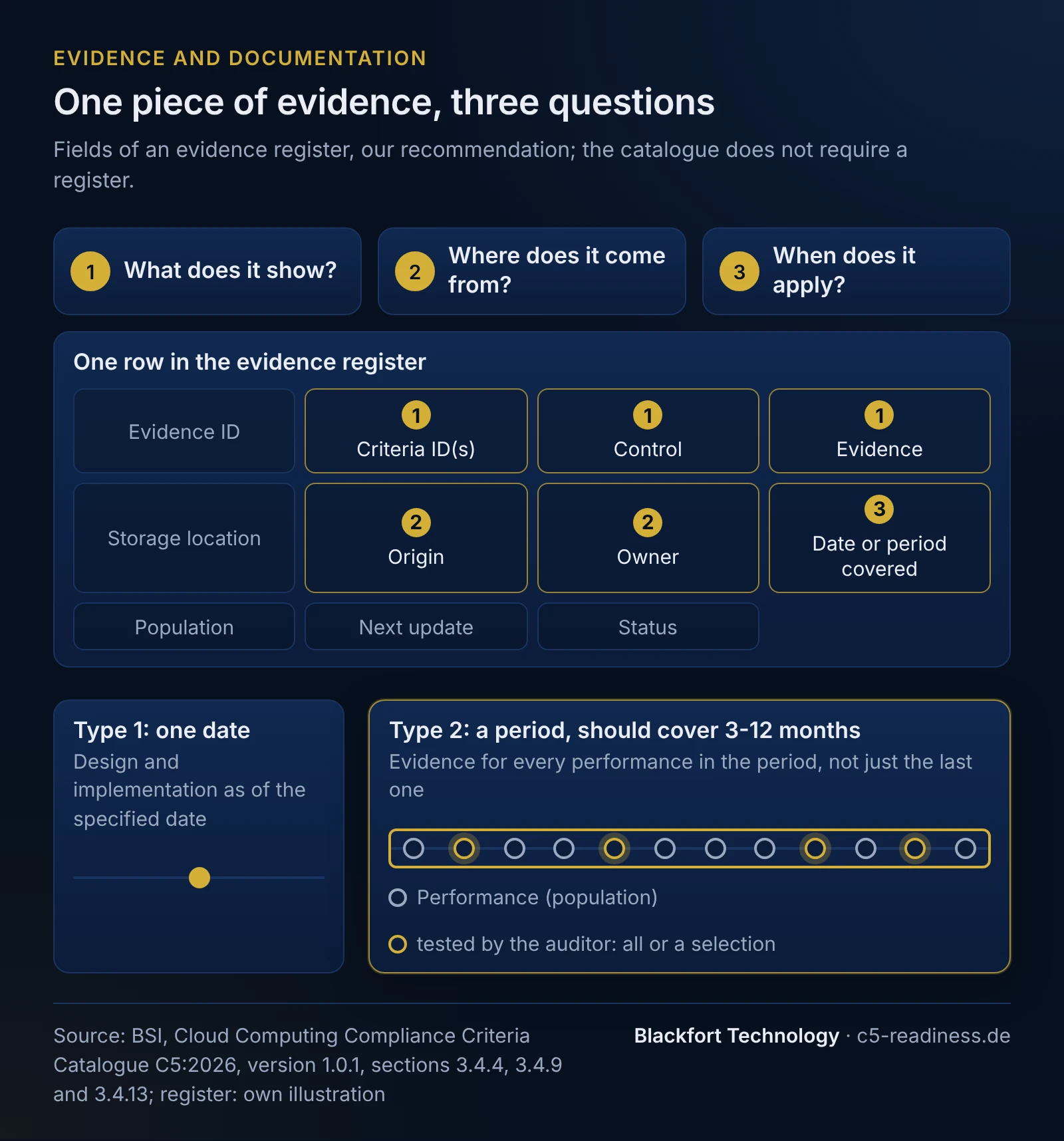
We recommend the following fields as a minimum. This is our recommendation, not a catalogue requirement. Our template contains all of these fields, plus “Created on” and one column each for whether the evidence is relevant for type 1 or type 2.
| Field | Content | Why |
|---|---|---|
| Evidence ID | Sequential number, for example E-014 | Unambiguous reference in auditor requests and in the system description |
| Criteria ID(s) | One or more C5 criteria, down to subcriteria where needed | The auditor assesses each criterion at the level of its subcriteria |
| Control | Your control ID and name from the system description | Evidence and described control have to match |
| Evidence | Type: document, export, ticket, log, timestamped screenshot | Shows whether the record supports design or performance |
| Storage location | Path or system, not the file itself | Evidence stays in the source system or in a protected store |
| Origin | System or person the evidence comes from | The auditor considers whether the information used in the control is reliable (section 3.4.9) |
| Owner | Role that produces the evidence and provides it on request | Contact for inquiries |
| Date or period covered | Date or period the evidence applies to | Type 1 needs the date, type 2 the whole period |
| Population | For recurring controls: where the complete list of all performances in the period comes from | Basis for the auditor’s selection, see below |
| Next update | Date of the next performance or review | Shows gaps before they arise in the period |
| Status | Available, partial, missing | Steering the preparation |
The blank template as CSV and Excel file is on the Templates page.
Example: extract from an evidence register
Fictitious example, not a client. A provider runs a document management system as SaaS for municipal administrations. A type 2 report is planned for the period 1 July 2027 to 31 December 2027 under C5:2026. Extract from the register, criteria titles as in the English catalogue version 1.0.1:
| ID | Criterion | Control and evidence | Origin, owner | Timing and population |
|---|---|---|---|---|
| E-011 | DEV-10 Approvals for Provision in the Production Environment | C-DEV-10-01 approval of every production deployment; evidence: approval note in the merge request and deployment log | Version control and pipeline; head of development | Every production deployment in the period; population: export of all pipeline deployments 1 July-31 December 2027 |
| E-012 | DEV-15 Exceptions to the Change Management Process | C-DEV-15-01 emergency change with subsequent approval; evidence: emergency ticket with justification and approval | Ticket system; head of operations | Every emergency change in the period; population: ticket filter “Emergency”, reconciled with the deployment export from E-011 |
| E-020 | IAM-04 Withdrawal or Adjustment of Access Rights as the Task Area Changes | C-IAM-04-01 revocation on the last working day; evidence: leaver notification from HR and lock log from the identity directory | HR system and identity directory; head of operations | Every leaver in the period; population: HR leaver list |
| E-031 | OPS-08 Data Backup and Recovery - Regular Testing | C-OPS-08-01 quarterly restore test; evidence: test log with result and sign-off | Operations team; head of operations | Two performances in the period (Q3 and Q4 2027) |
| E-044 | SSO-05 Monitoring of Compliance with Requirements | C-SSO-05-01 annual review of the IaaS platform’s C5 report; evidence: review note assessing the assumed controls | Information security management | One performance in the period, based on the current platform report |
| E-052 | BCM-04 Testing Business Continuity | C-BCM-04-01 annual business continuity exercise; evidence: exercise plan, record, action list | Business continuity officer | One performance in the period, planned for October 2027 |
Two things stand out in this extract. E-012 depends on E-011: only if you know all production deployments can you show that every change without a regular approval note has an emergency ticket. And E-052 lies in the future. A date in the register makes sure the exercise really takes place within the period and not after it.
Timing: what type 1 and type 2 require in evidence
In a type 1 audit the auditor assesses the design of the controls as of a specified date, in a type 2 audit also their operating effectiveness over a period (section 3.4.4). For the register this means:
- Type 1: evidence that each control was designed and implemented as of the specified date (section 3.4.9, item 8), such as the current policy, the configuration, a first performance. When type 1 is the right choice is explained on type 1 or type 2.
- Type 2: evidence for the whole period, which should cover three to twelve months. For recurring controls this means evidence for every performance in the period, not just the last one. A quarterly control has two performances in a six-month period.
- Initial audit: if controls are not yet fully executed, such as a restore test, the catalogue allows evidence in the form of planning records or documentation templates; controls not yet running in production can be evidenced in a non-production environment configured like production (section 3.4.11).
Our recommendation: have evidence created when the control is performed, with a date from the system, not afterwards. A log written in December for a control in August does not show that the control ran in August.
Sampling in the type 2 period: what it means for your evidence
In a type 2 audit the auditor tests operating effectiveness under ISAE 3402 (section 3.4.10). In the report the auditor has to state whether the items tested are all items or a selection (sample) of the items in the population, and describe at least the general approach to the extent of testing, for example depending on the number of items or the frequency of the control. Where deviations are found, the auditor states the sample size used and the number and nature of the deviations (section 3.4.13, item 4).
The catalogue does not set sample sizes. The BSI FAQ says that operating effectiveness is determined using a statistical sample with a 95% confidence interval (our translation). The C5:2026 catalogue does not say this. The auditor decides how large the selection is. What matters for you is something else:
- The population has to be complete. The auditor draws the selection from a list of all performances, such as all deployments or all leavers in the period. If cases are missing from it, the selection is worthless. Record in the register which system the list comes from and how you show it is complete.
- Every item has to be evidenced individually. If the auditor picks the leaver of 14 September, you need the notification and lock log for exactly that case. Summary evidence (“all leavers in the quarter processed”) is not enough for this.
- The information has to be reliable. The auditor considers whether the information used in the operation of a control is reliable (section 3.4.9, item 6). Exports with source system, query and timestamp are better than edited spreadsheets.
- Deviations count too. A criterion is not met if one of its subcriteria is not met, and deviations are reported even if the auditor concludes the criterion was achieved overall (sections 3.4.12 and 3.4.13). If you find a missing item yourself, document it with cause and action. The report includes when and how the provider detected it.
Who maintains the register and how often?
One person keeps the register, the specialist teams provide the evidence. Our recommendation: the lead person from information security management checks monthly whether the evidence due has come in and reports gaps to the owners and to management. This creates, along the way, the monitoring on which management can base its statement in a type 2 audit (section 3.4.5.2).
Do not put the evidence itself into the register. It points to the source system or a protected store. Evidence often contains personal data, such as names in leaver lists, or configuration details. Give the auditor only what is needed for the selection, and restrict access to the store.
Typical gaps in an evidence register
| Possible gap | Cause | Effect | Remedy |
|---|---|---|---|
| Evidence without timing | Policy or undated screenshot filed as evidence | Supports neither the date nor the period; in type 2 the evidence of operating effectiveness is missing | Make the field “Date or period covered” mandatory, generate evidence with the system date |
| Incomplete population | Emergency changes or changes outside the pipeline are missing from the export | Auditor’s selection not reliable, unevidenced cases can appear as deviations | Take the population from the technical system and reconcile it against a second source, like E-011 and E-012 in the example |
| Control suspended during the period | No cover arranged for holidays or staff changes | One performance missing, deviation in the report | Monitor the field “Next update”, define a deputy for each control |
| Evidence only shows the policy | Policy filed instead of evidence of performance | Shows how the control should run, not that it ran | Plan at least one piece of evidence of performance per control |
Which controls need evidence in which order depends on your starting point. A C5 readiness assessment shows where evidence is missing and which gaps would block an audit.
Frequently asked questions
Does C5 require an evidence register?+
How much evidence does a control need for type 2?+
Can we create evidence after the fact?+
Does evidence belong in the system description?+
Can we reuse evidence from the ISO 27001 audit?+
Read more
- C5 system description: minimum content, structure and example
- C5 type 2 or type 1 report: differences, period, choice
- BSI C5 audit process: steps, audit standards and timeline
- C5 management statement: what management confirms
- Free C5 templates: scope sheet, evidence register, CUEC matrix
- C5 readiness assessment: gap analysis, action plan and timeline
Sources
- BSI: Kriterienkatalog Cloud Computing C5:2026, version 1.1.0 (PDF, German), licensed under CC BY-ND 4.0 (retrieved 2026-11-01)
- BSI: Cloud Computing Compliance Criteria Catalogue C5:2026, version 1.0.1 (PDF), sections 3.4.4, 3.4.5.2, 3.4.7 to 3.4.13, licensed under CC BY-ND 4.0 (retrieved 2026-11-01)
- BSI: C5 FAQ (German), question on how C5 and IT-Grundschutz audits differ (retrieved 2026-11-01)
This content provides general technical and organisational information and does not constitute legal advice (no legal services within the meaning of the German RDG).