

Last updated: 2026-11-06
This page covers the DEV domain (Procurement, Development and Modification of Information Systems) of C5:2026, section 5.11 of the catalogue. How criteria and subcriteria are structured in general is explained on the page C5 criteria catalogue.
What is the DEV domain about?
DEV sets out how the provider develops, changes and deploys its service and the related system components securely. The domain comprises 15 criteria, DEV-01 to DEV-15, with 32 basic subcriteria and 10 complementing additional subcriteria; there are no sharpening additional subcriteria in DEV. According to the BSI change history, five criteria are new compared with C5:2020: DEV-05, DEV-11, DEV-13, DEV-14 and DEV-15. The operation of the service, such as patch and vulnerability management or backup, is covered by the OPS domain.
Starting point: a SaaS provider with its own pipeline
Fictitious example, not a client. A provider runs a document management system for local authorities as SaaS. Twelve people in two teams develop the service in a Git system; a CI/CD pipeline builds container images, tests them and rolls them out several times a week to a managed Kubernetes on a cloud platform. The team describes network, cluster and databases as code in the same Git system. An external agency develops the mobile app for case workers. The product contains several hundred open source libraries. Several local authorities require a C5 type 2 attestation for a tender.
The starting position is good: much of what DEV requires is already done by the pipeline. What is usually missing are the rules behind it and the evidence that they applied over the whole audit period.
Who is responsible for what: provider, platform, customer?
The DEV criteria apply to everything the provider develops and changes itself, including platforms, virtual infrastructure and other system components, not only to the application (supplementary information on DEV-01). In the example, the boundaries with platform and customer look like this:
| Aspect | Provider | Platform (subservice organisation) | Customer (local authority) |
|---|---|---|---|
| Policies, code, tests and approvals | sets the rules, develops, tests and approves (DEV-01, DEV-03, DEV-06 to DEV-10) | - | tests or approves on its own side where the contract provides for it (complementary customer criteria for DEV-07 and DEV-10) |
| Pipeline, infrastructure code and own configuration on the platform | is responsible for them as its own changes under DEV | provides tools and managed services | - |
| Changes to the managed services themselves | monitors the platform under SSO-05, see SSO | changes the managed services, for example updates of the Kubernetes control plane or the database engine | - |
| Separation of environments and list of software components | protects and separates development, test and production and keeps the list per release (DEV-11 to DEV-13) | provides separate accounts or projects | - |
| Outsourced development | steers the agency and remains responsible for the result (DEV-02) | - | - |
The auditor tests the provider’s own controls; the platform’s controls come in through its report and your monitoring. The complementary customer criteria are general notes in the catalogue and are not exhaustive. Which customer controls your service assumes is for you to decide, and you describe them as complementary customer controls (also called complementary user entity controls, CUEC); how to do that is explained on the page Complementary customer criteria.
How does change management in a CI/CD pipeline become audit-ready?
By mapping every stage of the pipeline to a criterion and making it leave a trail. The catalogue does not require a centralised change management process with a change advisory board; agile methods are expressly permitted as long as they adhere to the defined procedures and technical safeguards (supplementary information on DEV-03). Two clarifications from the catalogue help with the scoping:
- What a change is: anything that can change the configuration, functionality or security of system components in production, that is, infrastructure and source code, and expressly also network configuration and container images.
- Releases count as one change: If you combine many commits into a release, the release is the change within the meaning of DEV-03, not each individual commit.
| Stage in the pipeline | Criteria | What should result from it (our recommendation) |
|---|---|---|
| Create the change, categorise the risk | DEV-03, DEV-06 | merge request with a risk class according to your change policy; for high risk, documented mitigation measures before deployment |
| Version code and configuration | DEV-08, DEV-09 | every change attributed to a person or a system account, rollback to a previous state possible, roles in the Git system according to IAM-01 |
| Test | DEV-05, DEV-07 | scope of testing according to risk class, security features tested against their specification, errors assessed according to defined criteria |
| Approve | DEV-10 | approval by authorised persons or system components before deployment, segregation of duties between author and approver |
| Deploy | DEV-08 | deployment only via the pipeline, log with a reference to the change |
| Exception, emergency change | DEV-15, DEV-03 | defined path for emergencies with subsequent review and documentation |
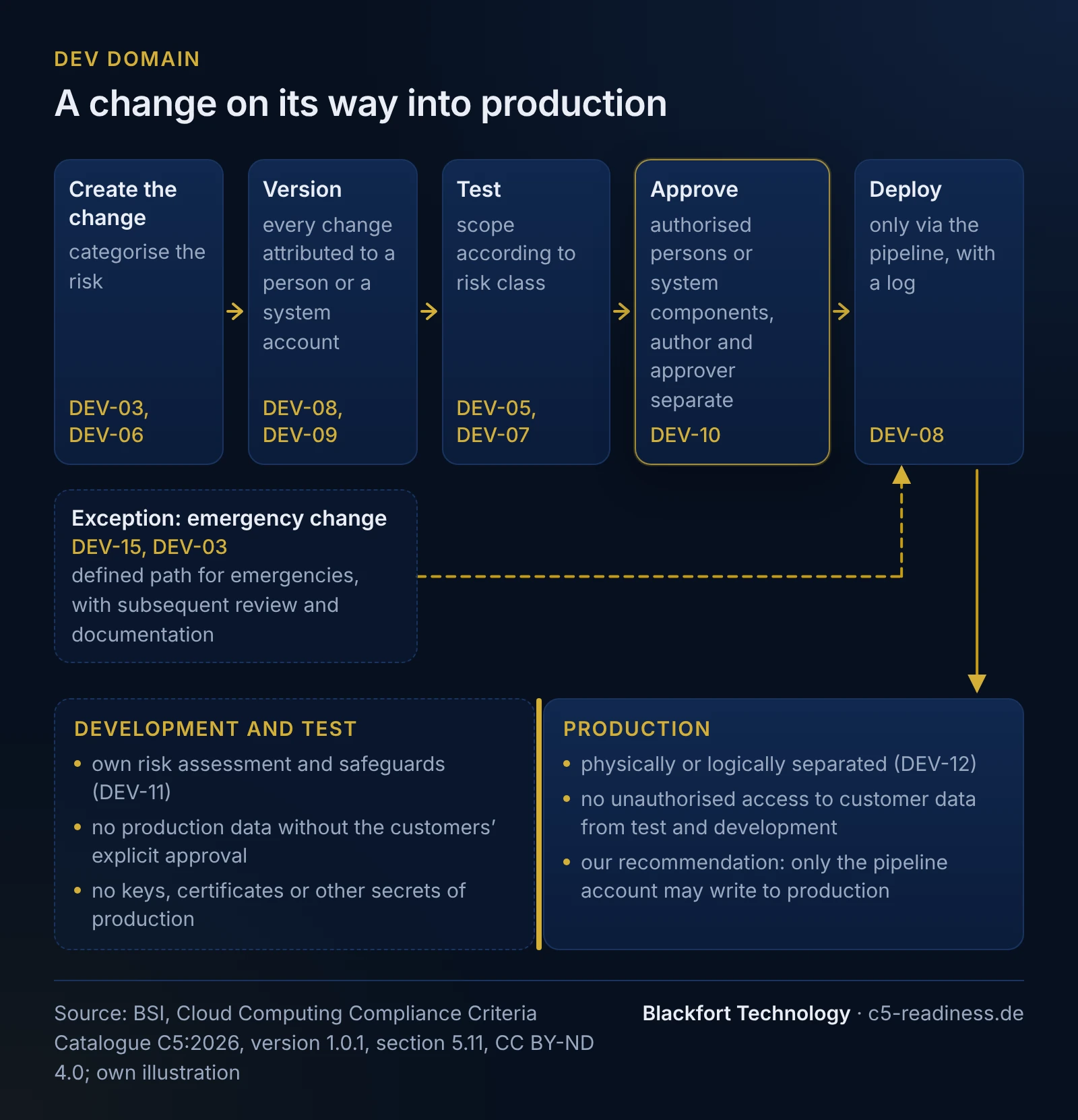
You inform customers about the type and scope of changes and any resulting obligations to cooperate as the contract provides; under DEV-03 this belongs in the policy. For a type 2 report, significant changes to the system of internal control during the period are also included in the system description; how to word them is explained on the page Significant changes and events.
How do you separate development, test and production environments under DEV-12?
Physically or logically, so that test and development allow no unauthorised access to customer data, no spread of malware and no unintended changes to production (DEV-12.01B). Two rules from DEV-12 are easy to overlook:
- No production data in test or development unless the customers have explicitly approved it. For tests with customer data, DEV-07.03B additionally requires the data to be anonymised beforehand.
- No shared secrets: keys, certificates and other secrets of production are not reused in other environments. If this is unavoidable, document and justify the exception via the exception process (SP-03) and risk management (DEV-12.02B).
Our recommendation for the example: a separate account or project on the cloud platform for each environment, separate clusters for production and staging, separate secret stores and a pipeline account that is the only one allowed to write to production. This is easier to evidence than separation via namespaces in a shared cluster. Under DEV-11 the development and test environments themselves need a risk assessment and appropriate safeguards; the necessary parts belong in the backup plan.
Example control description for DEV-10
This is how the approval control could look in the example. The template is our own wording, not catalogue text; the field scheme is explained on the page System description.
| Field | Example |
|---|---|
| Control ID | K-DEV-10-01 |
| Mapped to | DEV-10.01B; also supports DEV-07.01B, DEV-07.02B and DEV-08.02B. DEV-10.02B (involvement of customers) is covered by a separate control. |
| Objective | No change reaches production without passing the mandatory tests and without approval by a second authorised person. |
| Owner | Head of development (control owner); approvals by persons with the “Maintainer” role; configuration of branch protection by the platform team |
| Trigger and frequency | every change to the main branch and every release (ongoing, automated); reconciliation monthly |
| Execution | The merge request contains the risk class according to the change policy. The pipeline runs unit, integration and security tests (static analysis, dependencies, container image). Branch protection requires approval by a person other than the author, for risk class “high” two approvals, one of them by the information security officer. Only the pipeline account may deploy. |
| Check | Each month the head of quality assurance uses a script to reconcile all production deployments from the deployment log with the approved merge requests and examines every deviation. Each quarter the platform team compares the exported branch protection configuration with the target state. |
| Escalation | A deployment without approval or a changed protection rule goes to the information security officer as a ticket within one working day, is assessed under the exception process and appears in the monthly ISMS report to management. |
| Evidence | Merge request history, pipeline logs, deployment log, monthly reconciliation record, configuration exports |
Whether the control covers all mapped subcriteria is for the auditor to assess. A criterion counts as not met if a single subcriterion is not met (section 3.4.12).
What evidence the auditor wants to see
Above all, records from the systems that are created anyway, and for the whole audit period. For a type 2 report it is not enough to demonstrate the pipeline on the day of the audit. Our overview for the example:
| Evidence | Criterion | Source | Owner | Timing |
|---|---|---|---|---|
| Secure development policy and change policy | DEV-01, DEV-03 | ISMS document repository, approved version | head of development, information security officer | valid version with approval date, over the whole period |
| Merge requests with risk class, test result and approval | DEV-06, DEV-07, DEV-10 | export from the Git system | head of development | all changes in the period, as the population for samples |
| Production deployment log | DEV-08 | pipeline and cluster audit log | platform team | complete for the period |
| Roles and branch protection in the Git system | DEV-08.01B, DEV-09 | configuration export with change history | platform team | reference date plus all changes in the period |
| List of emergency changes with subsequent review | DEV-15 | ticket system | head of operations | all cases in the period |
| List of software components or SBOM per release | DEV-13 | pipeline artefact | head of development | per release |
| Separation concept and account structure of the environments | DEV-11, DEV-12 | architecture documentation, export of the account structure | platform team | reference date plus changes |
| Participation in role-based training | DEV-04 | learning platform | information security officer | per person at the intended interval |
| Contract, risk assessment and acceptance records for the agency | DEV-02 | procurement, ticket system | product management | contract before the start, acceptance per delivery |
How to keep such records in an evidence register is shown on the page Evidence and documentation. For an initial engagement, the catalogue allows evidence from a non-production environment configured like production for controls that have not yet operated in production (section 3.4.11).
Possible gaps: cause, effect, remedy
We derive the following gaps from the requirements of the catalogue. They are not auditor findings, but they show where a pipeline that works well day to day may not yet be enough for an audit.
| Possible gap | Cause | Effect | Remedy |
|---|---|---|---|
| Administrators can bypass branch protection or deploy directly | emergency rights from the early days, personal access to the cluster | changes without approval are possible, DEV-08 and DEV-10 cannot be evidenced | direct access only via an emergency role with logging, every use reviewed as an emergency change under DEV-15 |
| Infrastructure and network changes run outside the process | the change policy only names application code; configuration is changed in the platform console | some changes without testing and approval, although DEV-03 covers infrastructure, network and containers | change infrastructure only via code and the pipeline, restrict console rights to read access, detect deviations by reconciliation |
| Staging runs with a copy of the production database | realistic test data is missing | customer data outside production without approval, breach of DEV-12.01B and DEV-07.03B | generate synthetic or anonymised test data, exceptions only with the customers’ explicit approval |
| The same secrets in staging and production | shared configuration file, one certificate for all environments | a compromise of the test environment endangers production, DEV-12.02B not met | generate secrets per environment and store them separately, document unavoidable exceptions under SP-03 |
| List of software components only for your own code | base images and embedded tools not covered | for a known vulnerability it cannot be determined which services are affected, DEV-13 incomplete | generate an SBOM automatically per image and store it per release; the state of the art is set out in the BSI Technical Guideline TR-03183-2 |
Plan the remedy before a type 2 period starts: a control that is only introduced in the middle of the period provides no evidence for the weeks before. How to put gaps across several domains into a sensible order is shown on the page Prioritising measures.
All criteria of the DEV domain
Titles as in the English version 1.0.1, number of subcriteria counted per section 5 (B = basic, AS = sharpening, AC = complementing). The column “What it covers” is our own short description, not catalogue text; the wording of the criteria in the catalogue is binding.
| ID | Title (catalogue) | B/AS/AC | What it covers |
|---|---|---|---|
| DEV-01 | Policies for the Development/Procurement of System Components | 3/0/1 | Rules for secure development over the whole life cycle, including the aim of keeping the provider’s access to customer data low. |
| DEV-02 | Outsourcing of the Development | 2/0/2 | What has to be agreed by contract with an external development service provider and assessed as a risk beforehand. |
| DEV-03 | Policies for Changes to System Components | 1/0/0 | The change policy: risk categorisation, tests, approvals, segregation of duties, customer information and emergencies. |
| DEV-04 | Safety Training and Awareness Programme Regarding Continuous Software Delivery and Associated Systems, Components or Tools | 2/0/0 | Role-based training for everyone who develops and deploys, including external personnel. |
| DEV-05 | Design Documentation for Security Features | 1/0/0 | Security features such as encryption or authentication are documented and specified on the basis of a security analysis. |
| DEV-06 | Risk Assessment, Categorisation and Prioritisation of Changes | 2/0/1 | Every change is categorised by risk, also in combination with concurrent changes. |
| DEV-07 | Testing Changes | 5/0/1 | Tests according to risk, full tests of the security features and strict rules for customer data in tests. |
| DEV-08 | Logging of Changes | 2/0/1 | Every change in production is recorded and can be attributed to a person or a system account. |
| DEV-09 | Version Control | 3/0/2 | A protected version control system for code, configurations and third-party products, with the ability to roll back. |
| DEV-10 | Approvals for Provision in the Production Environment | 2/0/1 | Authorised persons or system components approve changes before deployment; customers according to the contract. |
| DEV-11 | Protection of Development and Test Environments | 1/0/0 | The non-production environments also need a risk assessment and safeguards. |
| DEV-12 | Separation of Environments | 2/0/0 | Production separated from test and development, without production data and without shared secrets. |
| DEV-13 | Transparency about Software Components | 2/0/0 | An up-to-date list of software components, for example as an SBOM, so that affected services can be identified when vulnerabilities arise. |
| DEV-14 | Secure Use of Third Party Hardware and Software | 3/0/1 | Rules for third-party and open source software, a list of dependencies and retrieval only from trusted sources. |
| DEV-15 | Exceptions to the Change Management Process | 1/0/0 | A regulated path for exceptions and emergency changes that limits the risks. |
Relationship to ISO/IEC 27001:2022 Annex A
If you hold an ISO 27001 certificate, you will find many DEV topics in Annex A of the standard. The following mapping is our own, unofficial classification by topic. The BSI has not yet published a cross-reference for C5:2026. The catalogue refers to the BSI website for it (section 3.3). So far the table there covers C5:2020 only, and the BSI says the table for C5:2026 is “scheduled for publication in the near future” (as of 6 November 2026). According to the catalogue, even an official table only shows thematic proximity, not fulfilment of the criteria (section 3.3). The short labels are ours, not titles from the standard. What a certificate brings for C5 overall is covered on the page C5 and ISO 27001.
| C5:2026 | ISO/IEC 27001:2022 Annex A | Topic (short label) | What C5 additionally requires in concrete terms (our assessment) |
|---|---|---|---|
| DEV-01, DEV-05 | A.8.25, A.8.26, A.8.27, A.8.28 | secure development and architecture | aim of keeping the provider’s access to customer data low; documented security features based on a security analysis |
| DEV-02 | A.8.30 | outsourced development | contract and prior risk assessment; not for external personnel in your own processes |
| DEV-03, DEV-06, DEV-10, DEV-15 | A.8.32 | changes | risk categorisation of every change, approval before deployment, regulated path for emergency changes |
| DEV-04 | A.6.3 | training | role-based training on continuous delivery, including for external personnel |
| DEV-07 | A.8.29, A.8.33 | tests and test data | customer data in tests only with approval and anonymised |
| DEV-08, DEV-09 | A.8.4, A.8.9 | source code and configuration | every change in production attributed to a person or a system account |
| DEV-11, DEV-12 | A.8.31 | separated environments | no production data without the customers’ approval, no shared production secrets |
| DEV-13, DEV-14 | A.5.21, A.8.8 | supply chain and vulnerabilities | list of software components that lets you find affected services when vulnerabilities arise; Annex A does not expressly name such a list |
Frequently asked questions
Do we need a change advisory board for C5?+
May an automated pipeline approve changes itself?+
May we use production data for tests?+
Does the list of software components have to be an SBOM?+
Does DEV-02 apply if we bring freelance developers into our team?+
Read more
- C5 OPS: making operations audit-ready under C5:2026
- C5 SSO: controlling and monitoring service organisations under C5:2026
- C5 IAM: identity and access management under C5:2026
- C5 Kubernetes: running a container platform ready for audit
- C5 system description: minimum content, structure and example
- C5 documentation: keeping an evidence register for the audit
- C5 readiness assessment: gap analysis, action plan and timeline
Sources
- BSI: C5:2026 web page with downloads (German) (retrieved 2026-11-06)
- BSI: C5:2026 web page with downloads (retrieved 2026-11-06)
- BSI: Kriterienkatalog Cloud Computing C5:2026, version 1.1.0 (PDF, German), sections 3.3, 3.4.11, 3.4.12 and 5.11 (DEV-01 to DEV-15), licensed under CC BY-ND 4.0 (retrieved 2026-11-01)
- BSI: Cloud Computing Compliance Criteria Catalogue C5:2026, version 1.0.1 (PDF), sections 3.3, 3.4.11, 3.4.12 and 5.11 (DEV-01 to DEV-15), licensed under CC BY-ND 4.0 (retrieved 2026-11-01)
- BSI: C5:2026 change history (Excel), sheet “Change History” (retrieved 2026-11-01)
- BSI: “C5:2026” page with downloads (retrieved 2026-11-01)
This content provides general technical and organisational information and does not constitute legal advice (no legal services within the meaning of the German RDG).