

Last updated: 2026-11-06
This page covers the AM (asset management) domain of C5:2026, section 5.4 of the catalogue. How criteria and subcriteria are structured in general is explained on the page C5 criteria catalogue.
What is the AM domain about?
AM governs how the cloud service provider records and protects its assets. The catalogue states as its objective to identify the organisation’s own assets and to ensure an appropriate level of protection throughout their lifecycle (section 5.4). According to the supplementary information on AM-01, assets are the objects in the provider’s area of responsibility that are required for the information security of the service, for example firewalls, load balancers, web servers, application and database servers. They consist of hardware objects, which expressly include virtual infrastructure resources, and software objects such as containers, operating systems, databases, microservices and application programming interfaces.
The domain comprises twelve criteria, AM-01 to AM-12, with 26 basic subcriteria, 2 sharpening and 9 complementing additional subcriteria. According to the change history, six criteria are new: AM-01, AM-03, AM-04, AM-10, AM-11 and AM-12. The asset inventory is also the basis for other domains, for example for the risk assessment (AM-02.03B refers to OIS-07), the network topology (COS-07.03B) and container management (OPS-34.02B refers to AM-02, AM-03 and AM-09).
A note for bilingual teams: in the English version 1.0.1, the complementing subcriterion on keeping the inventory up to date is AM-01.02AC, in the German version 1.1.0 it is AM-02.01AC. The content is the same.
Starting point: inventory in a console and a spreadsheet
Fictitious example, not a client. A provider runs a platform through which building authorities and architecture firms exchange building applications, plans and approvals. Around 45 employees; the service runs as SaaS on the infrastructure of a large cloud provider: a managed Kubernetes cluster with microservices, a managed database, an object storage for plans and documents. Administrators sign in with FIDO2 security keys.
Before the project, the situation looks like this:
- The cloud resources can be seen in the platform’s console, laptops and security keys are listed in an IT spreadsheet. There is no common inventory.
- Which resource contains which data and who is responsible for it is recorded nowhere; some test resources have no recognisable purpose.
- The software list is limited to the provider’s own microservices. Which libraries, images and database version run underneath is known only to the operations team.
- Changes to the spreadsheet are overwritten, without history.
- A security key of an administrator who has left has not been returned for weeks.
Who is responsible for what: provider, platform, customer?
For a SaaS service on third-party infrastructure, AM is split along the boundary between virtual and physical resources. Our classification for the example:
| Aspect | Provider | Platform (subservice organisation) | Customer (building authority, architecture firm) |
|---|---|---|---|
| Virtual resources: cluster, database instance, storage, networks | inventories and classifies them (AM-02, AM-03, AM-09); may use the platform’s tools for this if it considers them suitable based on its framework | provides inventory functions | - |
| Software: microservices, images, libraries, database system | maintains the software inventory with dependencies (AM-04) | is responsible for the software of the managed services | - |
| Physical servers and data media of the data centres | describes which controls it assumes at the subservice organisation and monitors them as described in the SSO domain | commissioning, decommissioning, storage and transport of its own hardware (topics of AM-06, AM-07, AM-10, AM-11); outside your audit under the carve-out method | - |
| End user devices and security keys of personnel | inventories them where the risk assessment calls for it, commits personnel to secure use and return (AM-08, AM-12) | - | - |
| Protection needs of customer data | classifies assets by the protection needs of the data they process | - | ensures, under the complementary customer criteria for AM-09, that the protection need of its information is adequately determined |
How the data centres themselves are secured belongs to the PS domain. Whether individual hardware criteria are applicable to your service and how you include subservice organisations is defined with the scope and justified in the system description. You may not exclude a criterion there because your controls are missing.
What does a classification scheme under AM-09 look like?
AM-09 requires assets to be classified by the protection needs of the data they process, store or transmit. The protection need is determined by the people responsible for the assets according to a uniform, documented scheme (AM-09.03B). The scheme provides levels of protection for confidentiality, integrity, availability and authenticity, aligned with the recovery objectives in the business continuity and disaster recovery plans (AM-09.04B). Our scheme for the example:
| Level | Confidentiality | Integrity and authenticity | Availability (link to recovery plans) | Examples |
|---|---|---|---|---|
| high | personal data and building documents of customers, keys and credentials | changes to plans and approvals must be traceable and unaltered | recovery within 4 hours, data loss at most 15 minutes | database, object storage, identity service, administrators’ security keys |
| medium | internal operational data, logs without content data | errors are noticed and corrected | recovery within 24 hours | monitoring, ticket system, build pipeline |
| normal | public or non-critical information | no particular requirements | recovery within 5 working days | website, documentation for customers |
The target values in the availability column are example values that must come from the provider’s own business continuity and disaster recovery plans; how to set them is shown in the BCM domain. You review the levels at least annually and in case of significant changes to the service (AM-09.02B). If a provider does not classify its assets individually, according to the supplementary information on AM-09 all assets may be treated as requiring the highest level of protection. For small services this is a possible route, but in our assessment a demanding one, because the strictest measures then apply everywhere.
What does an audit-ready asset register look like?
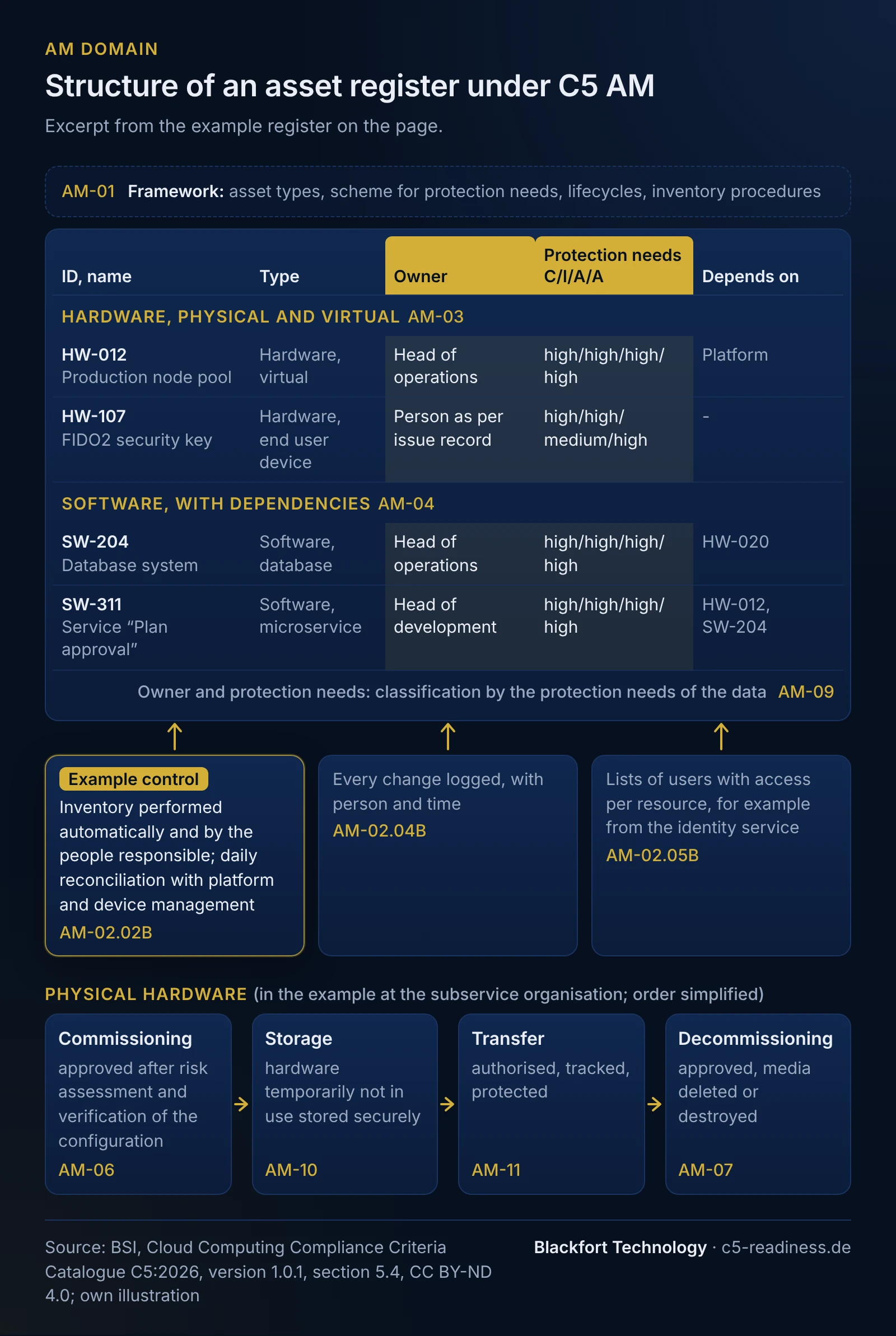
AM-03.01B and AM-04.01B define what an entry must achieve: identify the asset, provide visibility into its lifecycle or dependencies and enable the provider to control it and perform a risk assessment. The supplementary information lists possible fields for this, such as name, function, model, location, owner and information security requirements, for software the version and the parent resource. An asset owner is the individual or role responsible for managing and protecting the asset, not the legal owner. The catalogue speaks of the asset inventory; the asset register is the work product with which you maintain it. An excerpt from our register for the example (protection needs as C/I/A/A in the order confidentiality, integrity, availability, authenticity; the first A stands for availability, the second for authenticity):
| ID | Type | Name and function | Location | Owner | Protection needs C/I/A/A | Status | Depends on |
|---|---|---|---|---|---|---|---|
| HW-012 | Hardware, virtual | Production node pool, runs the microservices | Region Germany, two zones | Head of operations | high/high/high/high | in operation | Platform (subservice organisation) |
| HW-031 | Hardware, virtual | Object storage for building documents | Region Germany | Head of operations | high/high/medium/high | in operation | Platform |
| HW-107 | Hardware, end user device | FIDO2 security key for administration | with the person | Person as per issue record | high/high/medium/high | issued | - |
| SW-204 | Software, database | Database system of the managed database, major version as per platform | on HW-020 | Head of operations | high/high/high/high | in operation, end of support as per vendor recorded | HW-020 |
| SW-311 | Software, microservice | Service “Plan approval”, container image version 2.14 | on HW-012 | Head of development | high/high/high/high | in operation | HW-012, SW-204 |
| HW-044 | Hardware, virtual | Test resource without recognisable purpose | Region Germany | open | open | under clarification, deletion planned | - |
Three points make the register audit-ready. First, recording: performed automatically and/or by the people responsible, so that the inventory is complete, accurate, valid and consistent (AM-02.02B). Second, the change log: changes to the recorded information are logged (AM-02.04B); a spreadsheet that can be overwritten is not enough for this. Third, the link to access rights: AM-02.05B requires lists of the users with access to a resource and their rights; these may come from the identity service, as described on the page IAM. Containers that you operate yourself are inventoried with their lifecycle; the details are in the OPS domain. The software list for third-party components (SBOM) belongs to DEV.
Example control description for AM-02
A register is only as good as its reconciliation with reality. Our example control for the provider above (own wording, not catalogue text):
| Field | Example |
|---|---|
| Control ID | K-AM-02-01 Reconciliation of the asset register with platform and device management |
| Mapped to | AM-02.01B to AM-02.04B, AM-09.01B, AM-09.03B |
| Objective | Every asset in scope is in the register with owner and protection needs; new, changed and deleted resources are updated within one week, every change is logged. |
| Owner | Head of operations (cloud resources and software), IT (end user devices); checked by the information security officer |
| Trigger and frequency | daily automated reconciliation; weekly handling of deviations; review of the entire register once a quarter |
| Execution | A script reads all resources from the platform and all devices from device management every day and compares them with the register. New resources without an entry, entries without a resource and entries without owner or protection needs are passed as a ticket to the responsible team. The team completes the entry in the register, which stores every change with person and time. |
| Check | The information security officer reviews the list of open deviations weekly and, each quarter, a sample of entries against the actual configuration. |
| Escalation | If a ticket is still open after one week, it goes to the head of operations; a resource without an owner after two weeks is locked and deleted after consultation. Deviations are assessed in the risk register. |
| Evidence | Reports of the daily reconciliation, tickets with handling time, change log of the register, records of the samples |
Automated monitoring of the inventory process corresponds to the complementing subcriterion AM-01.02AC (AM-02.01AC in the German version). Whether you include it is your decision; as a way of working we recommend the reconciliation even without including it, because it is what makes the basic subcriteria verifiable in the first place.
What evidence the auditor wants to see
For AM, the register and its history are the central evidence, together with procedures and records for the lifecycle steps. Examples from our scenario:
| Evidence | Criterion | Source | Owner | Timing |
|---|---|---|---|---|
| Asset management framework with asset types, scheme, lifecycles and inventory procedures | AM-01.01B | ISMS documentation | information security officer | version valid in the period |
| Asset register with owner, protection needs and change history | AM-02.01B to 04B, AM-03.01B, AM-04.01B | register, reconciliation reports | head of operations, IT | reference date on request, changes in the period |
| Lists of users with access per resource | AM-02.05B | export from identity service and platform | operations | reference date on request |
| Policy for the secure use of assets | AM-05.01B, AM-05.02B | document repository | information security officer | version valid in the period |
| Issue records and commitments for laptops and security keys, return records | AM-08.01B to 03B | device management, HR system | IT | sample of joiners and leavers |
| Classification scheme and record of the review of the levels | AM-09.02B to 04B | ISMS documentation | information security officer, asset owner | annual review and occasions in the period |
| Configuration of end user devices: encryption, anti-malware, blocking of removable media | AM-12.01B | device management | IT | state at the start and end of the period |
An evidence register maps each subcriterion to its evidence; how to maintain it is shown on the page Evidence and documentation.
Possible gaps: cause, effect, remedy
The following gaps follow from the wording of the criteria and the scenario above. If a single subcriterion is not met, the criterion counts as not met, and the auditor reports the deviation (sections 3.4.12 and 3.4.13).
| Possible gap | Cause | Effect | Remedy |
|---|---|---|---|
| No common inventory | Cloud resources in the console, devices in a spreadsheet. | AM-02.01B requires an inventory of hardware and software assets in accordance with the framework; two unconnected sources do not evidence complete recording. | One register with automated recording from both sources, as in K-AM-02-01. |
| Entries without owner and protection needs | Purely technical recording. | AM-02.03B requires the information needed for risk management, AM-09.01B classification by the protection needs of the data. | Mandatory fields for owner and protection needs, deviation ticket if values are missing. |
| Changes without history | The spreadsheet is overwritten. | AM-02.04B requires changes to the recorded information to be logged. | Maintain the register in a system with a change log. |
| Software inventory without dependencies | Only the provider’s own microservices recorded. | AM-04.01B requires an inventory of all software assets with visibility into which other assets use them. | Add images, runtime environments and database system, derive dependencies from the deployment. |
| Security key not returned after leaving | Return not linked to the leaving process. | AM-08.02B requires provable return; if this is not possible by the date of leaving, the provider removes the access rights no later than the date of leaving under AM-08.03B. | Return as a step in the leaving process (see HR), block the key in the identity service. |
All criteria of the AM domain
Titles as in the English version 1.0.1, number of subcriteria counted per section 5 of the English version (B = basic, AS = sharpening, AC = complementing). In the German version 1.1.0, AM-01 has one and AM-02 one complementing subcriterion (AM-02.01AC there corresponds to AM-01.02AC here). The column “What it covers” is our own short description, not catalogue text; the wording of the criteria in the catalogue is binding.
| ID | Title (catalogue) | B/AS/AC | What it covers |
|---|---|---|---|
| AM-01 | Asset Management Framework | 1/0/2 | The documented framework: which assets, which types, which scheme for protection needs, which lifecycles, which inventory procedure. |
| AM-02 | Asset Inventory | 5/0/0 | The inventory itself: completely recorded, with information for risk management, change log and lists of users with access. |
| AM-03 | Hardware Asset Inventory | 1/0/0 | What a hardware entry must contain, for physical and virtual resources. |
| AM-04 | Software Asset Inventory | 1/0/1 | What a software entry must contain, including dependencies on other assets. |
| AM-05 | Policy for the Proper and Secure Use of Assets | 2/0/0 | Rules for handling assets over the lifecycle, from approval to deletion of data. |
| AM-06 | Commissioning of Hardware | 2/0/0 | Approval of physical hardware for production after risk assessment and verification of the secure configuration. |
| AM-07 | Decommissioning of Hardware | 2/1/1 | Approved decommissioning with permanent deletion or destruction of the media. |
| AM-08 | Commitment to Proper Use, Safe and Secure Handling and Return of Assets | 3/0/0 | Commitment of personnel before use, return on leaving, removal of rights if the return is missing. |
| AM-09 | Asset Classification and Labelling | 4/0/4 | Classification by the protection needs of the data, uniform scheme for four protection objectives, annual review. |
| AM-10 | Protection of Hardware on Hold | 1/1/0 | Secure storage of inactive production hardware. |
| AM-11 | Transfer of Hardware | 3/0/0 | Authorised, tracked and protected transport of production hardware. |
| AM-12 | Removable Media and Endpoint Devices | 1/0/1 | Controls for managed endpoints and removable media, for example encryption, anti-malware and restricted use of removable media. |
Among the additional criteria, AM-07.01AS (decommissioning also for development, test and staging environments), AM-04.01AC (information on how long a software asset will receive security updates) and AM-09.03AC and AM-09.04AC (logging and monitoring take the protection needs of the assets into account) are particularly tangible for SaaS providers.
Relationship to ISO/IEC 27001:2022 Annex A
The following mapping is our own, unofficial classification by topic. The BSI has not yet published a cross-reference for C5:2026. The catalogue refers to the BSI website for it (section 3.3). So far the table there covers C5:2020 only, and the BSI says the table for C5:2026 is “scheduled for publication in the near future” (as of 6 November 2026). According to the catalogue, even an official table only shows thematic proximity, not fulfilment of the criteria (section 3.3). The short labels are ours, not titles from the standard. What you can reuse overall from a certified ISMS is shown on the page C5 and ISO 27001.
| C5:2026 | ISO/IEC 27001:2022 Annex A | Topic (short label) | What C5 additionally requires in concrete terms (our assessment) |
|---|---|---|---|
| AM-01 to AM-04 | A.5.9 | Inventory | separate requirements for hardware and software entries, change log, dependencies, virtual resources |
| AM-05, AM-08 | A.5.10, A.5.11 | Acceptable use and return | removal of rights no later than the date of leaving if the return is missing |
| AM-06 | no direct counterpart; close to A.8.9 | Approval of hardware | approval process with risk assessment |
| AM-07 | A.7.14 | Disposal and reuse | approval by authorised personnel |
| AM-09 | A.5.12, A.5.13 | Classification and labelling | four protection objectives including authenticity, aligned with recovery objectives |
| AM-10, AM-11 | A.7.8, A.7.9, A.7.10 | Storage and transport | chain-of-custody tracking during transport |
| AM-12 | A.7.10, A.8.1 | Removable media and endpoint devices | prohibition of removable media except for unavoidable administration |
Frequently asked questions
Do virtual machines and containers belong in the inventory?+
May I use the cloud platform’s inventory?+
Do laptops and smartphones belong in it?+
Does every asset have to be classified individually?+
Why does the subcriterion on keeping the inventory up to date have a different ID in the German version?+
Read more
- C5 criteria catalogue: structure, basic and additional criteria
- C5 OPS: making operations audit-ready under C5:2026
- C5 IAM: identity and access management under C5:2026
- C5 DEV: development and change management under C5:2026
- C5 scope: service boundary, platform reports, carve-out
- C5 documentation: keeping an evidence register for the audit
- C5 readiness assessment: gap analysis, action plan and timeline
Sources
- BSI: C5:2026 web page with downloads (German) (retrieved 2026-11-06)
- BSI: C5:2026 web page with downloads (retrieved 2026-11-06)
- BSI: Kriterienkatalog Cloud Computing C5:2026, version 1.1.0 (PDF, German), section 5.4 (AM-02.01AC), licensed under CC BY-ND 4.0 (retrieved 2026-11-01)
- BSI: Cloud Computing Compliance Criteria Catalogue C5:2026, version 1.0.1 (PDF), section 5.4 AM-01 to AM-12 with supplementary information, sections 3.3, 3.4.12 and 3.4.13, licensed under CC BY-ND 4.0 (retrieved 2026-11-01)
- BSI: C5:2026 change history (Excel), new criteria in the AM domain (retrieved 2026-11-01)
- BSI: C5:2026 overview page with downloads (German) (retrieved 2026-11-01)
This content provides general technical and organisational information and does not constitute legal advice (no legal services within the meaning of the German RDG).