

Last updated: 2026-11-06
This page covers container operations as a focus topic of C5:2026. The OPS domain as a whole, including vulnerability scans and patch management, is covered on OPS domain. Which new focus topics the catalogue sets overall is explained on C5:2026.
What do containers mean under C5:2026?
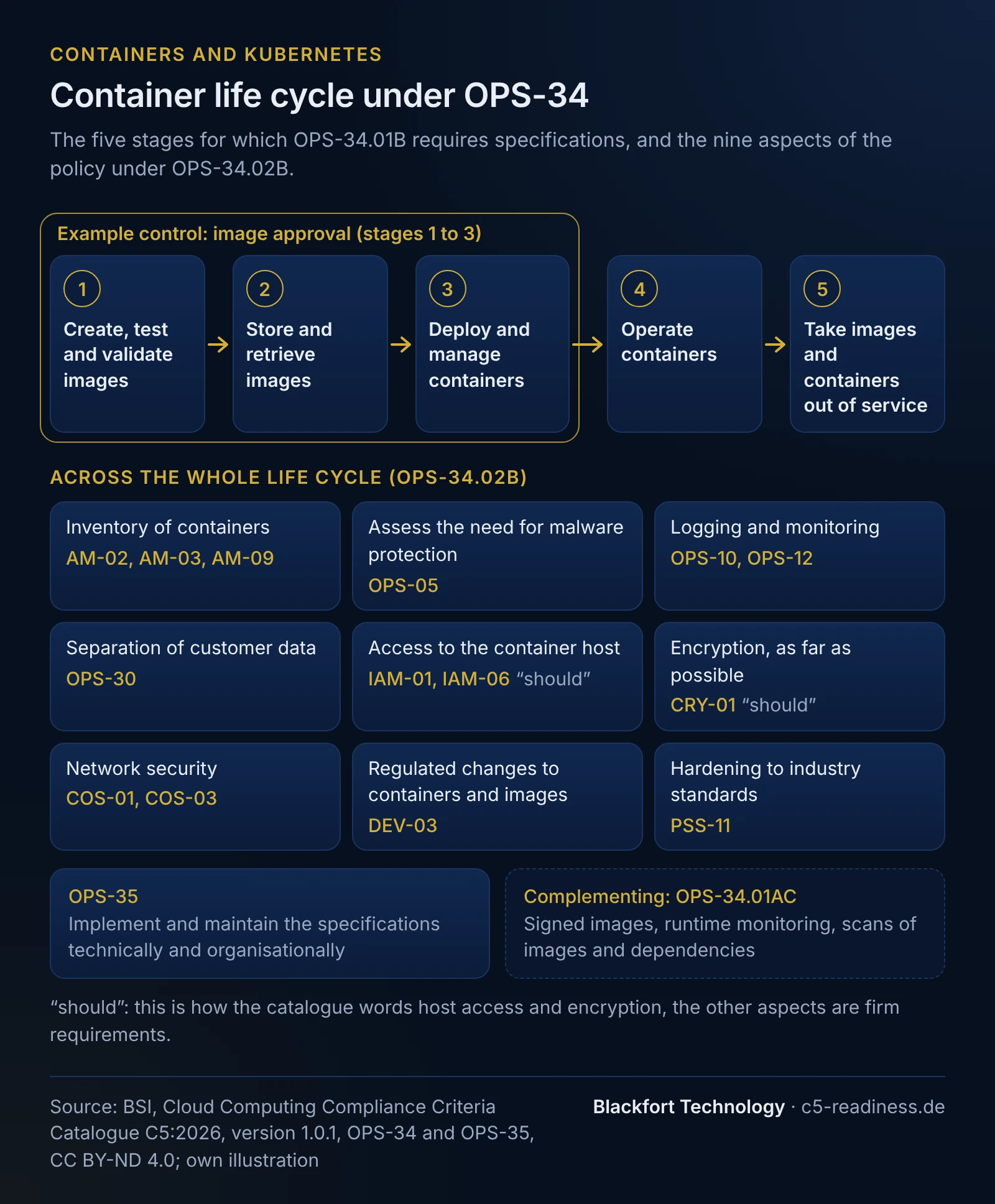
The catalogue explicitly names container management as one of its new focus topics (section 1.1). At the core are two new basic criteria in the OPS domain: OPS-34 “Container Management - Policies and Procedures” and OPS-35 “Container Management - Implementation”. OPS-34.01B requires specifications for the entire container life cycle with at least five stages: creation, testing and validation of images, their storage and retrieval, deployment and management of containers, their operation, and decommissioning of images and containers. OPS-35 requires the provider to implement and maintain these specifications technically and organisationally.
OPS-34.02B lists nine aspects the policy has to address along the life cycle. Most refer to criteria in other domains, and OPS-34 bundles them for containers:
- inventory of containers according to a documented process (AM-02, AM-03, AM-09),
- assessing the need for malware protection (OPS-05),
- logging and monitoring along the life cycle (OPS-10, OPS-12),
- separation of customer data based on a risk assessment (OPS-30),
- access to the container host according to a roles and rights framework (IAM-01, IAM-06),
- encryption of stored and transmitted data, as far as possible (CRY-01),
- network security, such as detecting unexpected data flows (COS-01, COS-03),
- changes to containers and images following a regulated process (DEV-03),
- hardening according to industry standards so that no unnecessary services run (PSS-11).
For host access and encryption the catalogue says “should”, the other points are worded as firm requirements. Containers also appear elsewhere: IAM-06.08B requires activities of privileged users on containers and images to be logged according to OPS-10, and COS-05.02B separates the networks the provider uses to create and orchestrate workloads from the customers’ networks. The term Kubernetes does not appear in the catalogue. The criteria are technology-neutral and apply to any orchestration.
Starting point: an HR SaaS on managed Kubernetes
Fictitious example, not a client. A provider runs software for HR administration and payroll for mid-sized companies. The service consists of around 40 microservices in a managed Kubernetes cluster of a large cloud provider (hyperscaler), plus a managed database and a container registry from the same hyperscaler. Images are built in a build pipeline, and a GitOps tool deploys them to the cluster. The platform team has five people.
This is the situation before the project:
- Teams pull base images themselves from public registries, each team at its own version.
- The registry holds several thousand images, including some with no running container. Only the cluster itself shows which image runs in production.
- Two administrators have cluster admin rights via a static configuration file. Their commands on the cluster are not logged separately.
- For troubleshooting, developers occasionally open a shell in running production containers.
- There is no written rule on when an image is deleted.
Technically this is a common setup. For the audit, the policy under OPS-34 is missing, and without it the auditor can assess neither the suitability of the design nor, for type 2, the operating effectiveness over the period.
Who is responsible for what: provider, platform, customer?
With managed Kubernetes, the platform runs the cluster’s control plane and the provider runs everything it deploys on it. OPS-34 and OPS-35 are addressed to the provider, and the catalogue lists no complementary customer criteria for them. Our classification for the example:
| Aspect | Provider | Platform (subservice organisation) | Customer (company with HR data) |
|---|---|---|---|
| Policy for the container life cycle | writes and maintains it (OPS-34), implements it (OPS-35) | - | - |
| Cluster control plane (API server, cluster database) | configures access, logging and versions as far as the service allows | runs, hardens and patches it | - |
| Nodes and container hosts | chooses node images and update rules, restricts host access | supplies node images and updates | - |
| Own images, registry content, deployments | responsible for creation, approval, inventory, operation and deletion | provides registry and scanning function | - |
| Networks for orchestration | separates them from customer traffic (COS-05.02B) | provides the network functions | - |
| Containers that customers run themselves | not offered in this SaaS; otherwise functions under PSS-11 | - | otherwise own images according to their own requirements (complementary customer criteria for PSS-11) |
If you use the carve-out method for the platform, its controls are outside your audit, but responsibility for the criteria stays with you (see C5 scope). If you let customers run their own containers, for example as PaaS, PSS-11 is added: customers must be able to restrict the selection of images, and images you provide need information on their origin and hardening according to industry standards. According to the supplementary information, PSS-11 is typically not applicable to SaaS. You justify this in the system description.
Example control description for image approval (OPS-34, OPS-35)
The first three stages of the life cycle can be combined in one control: no image goes into production unless it was built, checked and approved. Our example control for the provider above (own wording, not catalogue text):
| Field | Example |
|---|---|
| Control ID | K-OPS-34-01 Image approval and admission to the cluster |
| Mapped to | OPS-34.01B nos. 1 to 3, OPS-34.02B nos. 1, 8 and 9, OPS-35.01B; with signing also OPS-34.01AC no. 1 |
| Objective | The production cluster runs only images that were built in the pipeline from an approved base image, checked and recorded in the inventory. |
| Responsible | Head of platform team (execution); check by the information security officer |
| Trigger and frequency | every build of a production image and every deployment; monthly review of exceptions |
| Execution | Teams build only on hardened base images from the company’s own registry. The pipeline checks every image for known vulnerabilities and for deviations from the hardening specification, signs it and records digest, base image, version and responsible team in the inventory. An admission rule in the cluster rejects images without a valid signature or from external registries. The head of the platform team approves exceptions with an expiry date in the ticket. |
| Check | A daily comparison between running containers and the inventory reports images without an entry. The information security officer reviews the list of exceptions and rejected deployments every month. |
| Escalation | If an image runs without an inventory entry or without a valid exception, a ticket with a deadline of one working day goes to the responsible team. If it is not resolved by then, the head of the platform team decides whether to shut it down. Every case is recorded as a deviation. |
| Evidence | Pipeline logs with check result and signature, inventory export, log of the admission rule, exception tickets, monthly review record |
Under the catalogue, signing is an additional criterion (complementing), OPS-34.01AC no. 1. For the basic criteria, another effective approval is enough. We still recommend signing, because the admission rule in the cluster enforces it technically and the evidence is then produced automatically. If you include it, you also have to store the signing key securely under CRY-10 (see CRY domain). The scans themselves belong to OPS-25. What a scan control looks like is shown on OPS domain.
What evidence the auditor wants to see
Container evidence is produced almost entirely by machines, in pipeline, registry and cluster. What matters is that you retain it over the whole audit period, since a cluster only shows its current state. Examples from the scenario:
| Evidence | Criterion | Origin | Responsible | Time reference |
|---|---|---|---|---|
| Policy for the container life cycle with the five stages and nine aspects | OPS-34.01B, OPS-34.02B | ISMS document repository | Information security officer | version valid in the period, with approval date |
| Inventory of images and running containers with origin and owner | OPS-34.02B no. 1, AM-02 | Registry, cluster, inventory tool | Platform team | snapshots on request, change history over the period |
| Hardening specification for base images and pipeline check results | OPS-34.02B no. 9, OPS-26.02B, OPS-26.03B | Specification repository, pipeline logs | Platform team | sample of builds from the period |
| Configuration and log data on the provision of the images | OPS-26.04B | Pipeline, GitOps repository | Platform team | retained over the whole period |
| Logs of privileged access to cluster, containers and images | IAM-06.08B, OPS-34.02B no. 5 | Control plane audit log, SIEM | Operations | continuous, sample |
| Change records for deployments | OPS-34.02B no. 8, DEV-03 | Merge requests with approval, GitOps history | Team leads | sample from the period |
| Network policies between namespaces and separation of orchestration networks | OPS-34.02B no. 7, COS-05.02B | Export of network policies, network diagram | Platform team | state at start and end of the period, changes in between |
| Deletion log for images and containers | OPS-34.01B no. 5 | Registry clean-up job | Platform team | every run in the period |
Which evidence you keep for which subcriterion and when belongs in an evidence register. How to maintain one is shown on evidence and documentation.
Possible gaps: cause, effect, remedy
The following gaps follow from the wording of the criteria and the scenario. If a subcriterion is not met, the criterion counts as not met and the auditor reports the deviation (sections 3.4.12 and 3.4.13).
| Possible gap | Cause | Effect | Remedy |
|---|---|---|---|
| No policy for the life cycle | Pipeline and cluster are well set up but described nowhere. | OPS-34.01B requires documented, communicated policies and procedures under SP-01. Without them, the yardstick for OPS-35 is missing as well. | Write the policy along the five stages and nine aspects, refer to the existing tools, approve it under SP-01. |
| Inventory only in the cluster | Only the Kubernetes API shows what is running, without history and without owners. | OPS-34.02B no. 1 requires an inventory according to a documented process. The auditor cannot trace samples from the period. | Transfer images and deployments with digest, version, team and period into an inventory that records changes. |
| Shell in production containers | Troubleshooting happens directly in running containers. | Changes to containers then bypass the process under DEV-03 (OPS-34.02B no. 8), and privileged activities must be logged under IAM-06.08B. | Access only through a time-limited right with a ticket, logs to the SIEM, separate debug containers without write access to production data for troubleshooting. |
| Base images without hardening | Each team pulls its own images from public sources. | OPS-34.02B no. 9 and OPS-26.01B require hardening according to generally accepted industry standards, and for immutable images a consistent check (OPS-26.03B). | Shared hardened base images in the company’s own registry, checks in the pipeline, sourcing of third-party software under DEV-14 (see DEV domain). |
| No decommissioning | Old images stay in the registry indefinitely. | OPS-34.01B no. 5 also requires specifications for decommissioning. Unmaintained images can also be redeployed at any time. | Define a retention rule, automatically delete or block images that are no longer used, log deletion runs. |
The order in which you close such gaps is a question of prioritising measures across all domains.
Criteria related to containers
Criterion titles as in the English catalogue version 1.0.1, subcriteria counted according to section 5 (B = basic, AS = additional (sharpening), AC = additional (complementing)). The selection outside OPS-34 and OPS-35 is our classification. The column “What it is about” is our own short description, not catalogue text. The wording of the criteria in the catalogue is binding.
| ID | Title (catalogue) | B/AS/AC | What it is about |
|---|---|---|---|
| OPS-34 | Container Management - Policies and Procedures | 2/0/1 | Rules for the whole life cycle of images and containers, with signing, runtime monitoring and scans as additions. |
| OPS-35 | Container Management - Implementation | 1/0/0 | Implement and maintain the rules from OPS-34 technically and organisationally. |
| OPS-26 | Managing Vulnerabilities, Incidents and Crashes - System Hardening | 6/1/0 | Hardening of all system components, with separate rules for immutable images. |
| IAM-06 | Privileged Access Rights | 9/0/4 | Admin rights personalised and time-limited, with a subcriterion of its own on logging for containers and images. |
| COS-05 | Networks for Administration | 2/0/1 | Separate networks for administration and for orchestrating workloads. |
| AM-03 | Hardware Asset Inventory | 1/0/0 | Inventory of hardware. If customers run containers, the provider inventories those as well. |
| PSS-11 | Images for Virtual Machines and Containers | 1/0/2 | Only if customers run containers: selection can be restricted, origin labelled, images hardened. |
How additional criteria such as OPS-34.01AC come into the audit scope is explained on C5 criteria catalogue. OPS-34 and OPS-35 are new in C5:2026 with no predecessor. There are no C5:2020 controls you could renumber for them.
Relationship to ISO/IEC 27001:2022 Annex A
The following mapping is our own, unofficial classification by topic. The BSI has not yet published a cross-reference for C5:2026. The catalogue refers to the BSI website for it (section 3.3). So far the table there covers C5:2020 only, and the BSI says the table for C5:2026 is “scheduled for publication in the near future” (as of 6 November 2026). According to the catalogue, even an official table only shows thematic proximity, not fulfilment of the criteria (section 3.3). The short labels are ours.
| C5:2026 | ISO/IEC 27001:2022 Annex A | Topic (short label) | What C5 additionally requires in concrete terms (our assessment) |
|---|---|---|---|
| OPS-34, OPS-35 | A.8.9, A.8.32 | Configuration and changes | a policy of its own for the container life cycle with five stages and nine aspects |
| OPS-34.02B no. 1 | A.5.9 | Inventory | containers and images explicitly in the inventory |
| OPS-26 | A.8.9 | Hardening | consistent checks for immutable images, retention of provisioning data |
| IAM-06.08B | A.8.2, A.8.15 | Privileged rights and logging | logging of privileged activities on containers and images |
| COS-05.02B | A.8.22 | Segregation of networks | orchestration networks separated from customer networks |
Frequently asked questions
Do OPS-34 and OPS-35 also apply if I use managed Kubernetes?+
Do I have to sign container images?+
Does PSS-11 apply to a SaaS service?+
Is Kubernetes mentioned in the C5 catalogue?+
What changes compared with C5:2020?+
Read more
- C5 OPS: making operations audit-ready under C5:2026
- C5 tenant separation: evidencing separation of customer data
- C5 DEV: development and change management under C5:2026
- C5 IAM: identity and access management under C5:2026
- C5 CRY: cryptography and key management under C5:2026
- C5 scope: service boundary, platform reports, carve-out
- C5 documentation: keeping an evidence register for the audit
- C5 readiness assessment: gap analysis, action plan and timeline
Sources
- BSI: C5:2026 web page with downloads (German) (retrieved 2026-11-06)
- BSI: C5:2026 web page with downloads (retrieved 2026-11-06)
- BSI: Kriterienkatalog Cloud Computing C5:2026, version 1.1.0 (PDF, German), licensed under CC BY-ND 4.0 (retrieved 2026-11-01)
- BSI: Cloud Computing Compliance Criteria Catalogue C5:2026, version 1.0.1 (PDF), section 1.1, OPS-26, OPS-34, OPS-35, IAM-06, COS-05, AM-03, PSS-11, sections 3.3, 3.4.12 and 3.4.13, licensed under CC BY-ND 4.0 (retrieved 2026-11-01)
- BSI: C5:2026 change history (Excel), new criteria OPS-34 and OPS-35 (retrieved 2026-11-01)
This content provides general technical and organisational information and does not constitute legal advice (no legal services within the meaning of the German RDG).