
Last updated: 2026-11-06
This page covers the SSO domain (Control and Monitoring of Service Providers and Suppliers) of C5:2026, section 5.12 of the catalogue. How criteria and subcriteria are structured in general is explained on the page C5 criteria catalogue.
What is the SSO domain about?
SSO requires a control system for all service organisations that contribute to the development or operation of the service. The domain comprises eight criteria, SSO-01 to SSO-08, with 21 basic subcriteria, two sharpening and five complementing additional subcriteria. According to the BSI change history, three criteria are new compared with C5:2020: SSO-03, SSO-07 and SSO-08. The term supply chain does not appear in the subcriteria; the requirements on it are found there under service organisations and suppliers. The supplementary information on SSO-07 expressly assigns the criterion to the supply chain.
Two terms need to be kept apart. Service organisations are all partners, vendors or other third parties that provide you with services for the development or operation of the cloud service. Subservice organisations are only a subset of them: service organisations whose services are relevant to your customers’ understanding and at which you assume controls, the complementary subservice organisation controls (CSOC). For subservice organisations you choose the carve-out or inclusive method, see C5 scope; the criteria in SSO apply to all service organisations.
Starting point: a SaaS provider with many service organisations
Fictitious example, not a client. A provider runs a platform for video consultations used by medical practices and therapy centres. Around 30 employees, one product. The service runs on a cloud platform in Germany. In addition there are a relay service for video connections, an SMS and email service for sending appointment links, a service provider for the support hotline, a monitoring service, an agency for the further development of the app and a penetration tester. Until now, purchasing and contracts were handled by each team. The platform provider has a C5 report, the others have SOC 2 reports in some cases, ISO 27001 certificates in others, and nothing at all in some.
For a C5 attestation the provider now needs a system that treats all these relationships in the same way: classified by risk, bound by contract, monitored and evidenced.
Who is responsible for what: provider, platform, customer?
Responsibility stays with the provider. Even if it excludes a subservice organisation’s controls from the audit under the carve-out method, it remains responsible for the development and operation of the service meeting the criteria and monitors the subservice organisation under SSO-05 (section 3.4.6). Our classification for the example:
| Aspect | Provider | Platform and other subservice organisations | Customer (practice, therapy centre) |
|---|---|---|---|
| Policy, risk assessment, contracts, directory | defines and maintains them for all service organisations (SSO-01 to SSO-04) | - | - |
| Controls at subservice organisations | defines which controls it assumes (CSOC) and monitors them (SSO-05) | implements the assumed controls; under carve-out outside your audit, under the inclusive method tested by the auditor as well | - |
| Other service organisations | binds them by contract and monitors them | comply with the contractually agreed requirements | - |
| Exit | plans the exit strategy for very high dependency (SSO-06) | - | - |
| Transparency and data access | informs about service organisations and types of data (SSO-07), obtains customer authorisation for service organisations handling customer data (SSO-03.02B) | - | stays informed about the subservice organisations and decides on its own measures according to its protection needs (complementary customer criteria only for SSO-05); authorises service organisations handling customer data (under SSO-03.02B) |
Under carve-out, the subservice organisations’ controls appear as information in the system description, and the auditor only checks whether these assumptions are fairly presented. If your service assumes that customers cooperate, describe this as complementary customer controls (complementary user entity controls, CUEC).
What does a control system for service organisations under SSO look like?
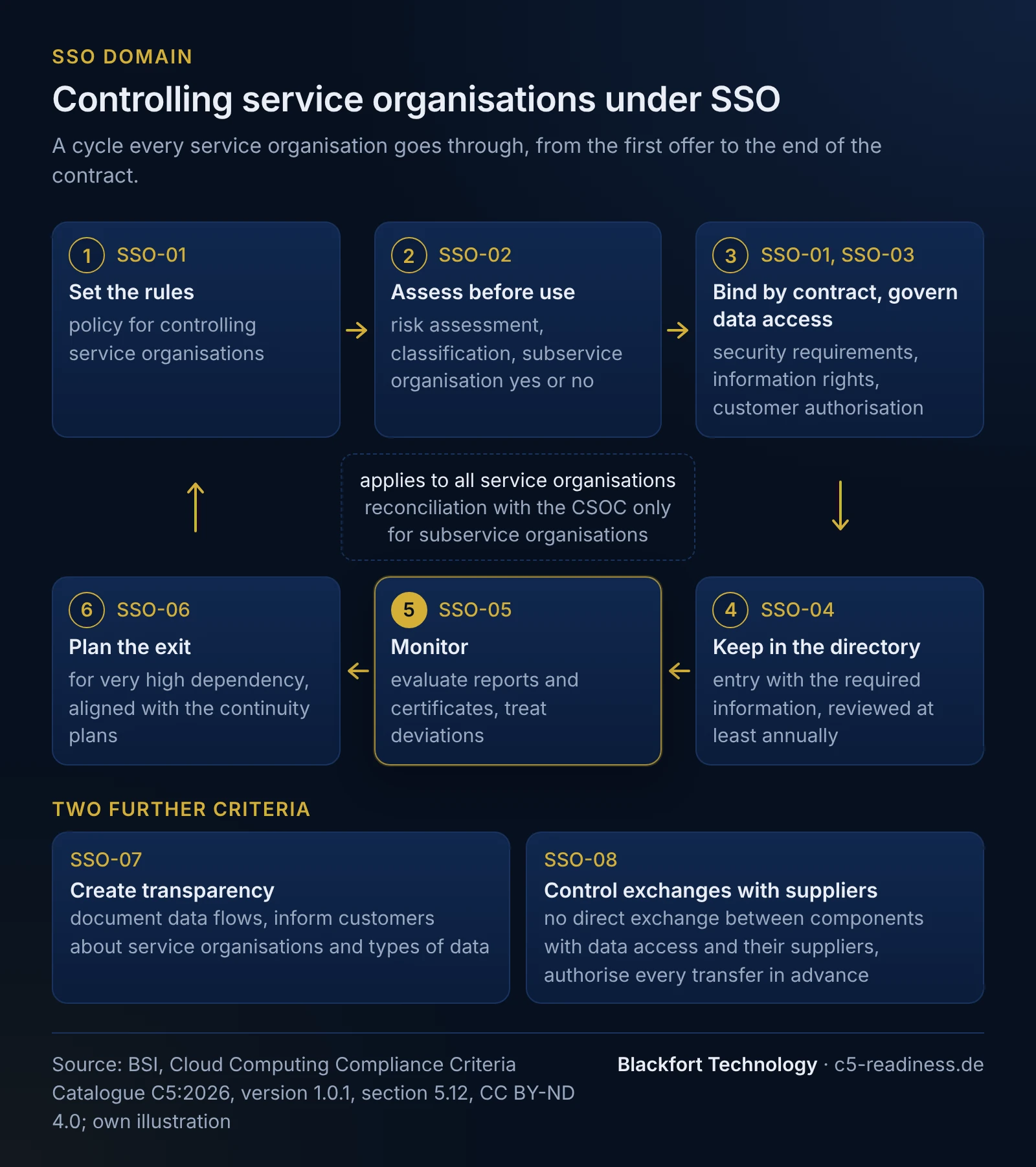
A cycle that every service organisation goes through, from the first offer to the end of the contract. The policy under SSO-01 sets the rules; the other criteria are the stages. The right-hand column is our recommendation of what should result at each stage.
| Stage | Criterion | Result |
|---|---|---|
| Set the rules | SSO-01 | Policy with risk assessment, classification, security requirements, contract specifications, monitoring and applying these requirements to their subcontractors |
| Assess before use | SSO-02 | Risk assessment per service organisation, classification, decision “subservice organisation yes or no” with reasons, expected CSOC |
| Bind by contract, govern data access | SSO-01, SSO-03 | Contract with security requirements and information rights; access to customer data only after a risk assessment; customer authorisation |
| Keep in the directory | SSO-04 | Entry with the required information, reviewed at least annually |
| Monitor | SSO-05 | Evaluation of reports, certificates and incident notifications at an interval based on the classification; for subservice organisations reconciliation with the CSOC; treatment of deviations |
| Plan the exit | SSO-06 | Exit strategy for very high dependency, aligned with the operational continuity plans |
| Create transparency | SSO-07 | Documented data flows and interfaces; customer information about service organisations and types of data |
| Control exchanges with suppliers | SSO-08 | No direct exchange between components with data access and their suppliers; authorisation of every transfer |
SSO-01.01B no. 2 requires the determination of whether a service organisation is a subservice organisation as part of the policy; how to make it for each service organisation under section 3.4.6, complete the directory and evaluate your service organisations’ reports is shown on the page Subservice inventory. What of this goes into the system description is governed by minimum content item 8, see system description. Whether you have to name individual service organisations in the system description and what to do if a service organisation cannot provide an audit report is answered in the questions and answers on the page Subservice inventory.
Example control description for SSO-02
The assessment before use is where gaps arise most easily, because teams buy services themselves. This is how the control could look in the example; the template is our own wording, not catalogue text.
| Field | Example |
|---|---|
| Control ID | K-SSO-02-01 |
| Mapped to | SSO-02.01B; supports SSO-01.01B no. 2 and SSO-04.01B. The annual review under SSO-02.02B is covered by a separate control. |
| Objective | No service organisation is used for the development or operation of the service before a documented risk assessment and classification exist. |
| Owner | Information security officer as control owner; responsible team lead (request); procurement (order only after approval) |
| Trigger and frequency | every new service organisation and every significant extension of an existing service, for example new data access or a new region |
| Execution | The team lead submits a request in the ticket system with the service, types of data, access, locations and subcontractors used. Following the method of the service organisation policy, the information security officer assesses protection needs, impact of a failure or breach, dependency and alternatives, classifies the service organisation as “low”, “medium”, “high” or “very high”, decides “subservice organisation yes or no” with reasons and, for subservice organisations, defines the expected CSOC. Contract clauses and monitoring interval follow from the classification. |
| Check | Procurement only places an order with an approved ticket. Each quarter the information security officer reconciles the accounts payable vendor list and the third-party applications connected to the identity service with the directory. |
| Escalation | A service organisation without an assessment is assessed retrospectively within ten working days; until then its use is suspended if it processes customer data. Every case appears in the ISMS report to management. |
| Evidence | Ticket with risk assessment and approval date before the start of the contract, order, reconciliation records |
Whether the control covers the mapped subcriteria is for the auditor to assess. SSO-02.01B names eight aspects of the risk assessment; check your method against the wording in the catalogue.
What evidence the auditor wants to see
Documents setting out the rules and evidence that every stage was actually gone through during the period. Our overview for the example:
| Evidence | Criterion | Source | Owner | Timing |
|---|---|---|---|---|
| Policy for controlling and monitoring service organisations | SSO-01 | ISMS document repository | information security officer | valid version with approval date |
| Risk assessment and classification per service organisation | SSO-02 | ticket system or risk register | information security officer | date before the start of use, annual review |
| Contracts with security requirements, information and audit rights | SSO-01, SSO-03 | contract repository | procurement, legal department | valid version in the period |
| Customer authorisation for service organisations handling customer data | SSO-03.02B | customer contracts, list of authorised service organisations | sales, data protection | before processing starts |
| Directory with record of the annual review | SSO-04 | directory, review record | information security officer | current version and review in the period |
| Evaluations of reports and certificates, deviations with measures | SSO-05 | evaluation records, register of measures | information security officer, business owners | per service organisation at the defined interval |
| Annual review of the confidentiality agreements | SSO-05.07B | review record | legal department | at least once a year |
| Exit strategy for service organisations with very high dependency | SSO-06 | BCM documentation | head of operations | valid version, aligned with the BCP |
| Data flow diagram and customer information on service organisations | SSO-07 | architecture documentation, customer portal or contract annex | product management | reviewed at least annually |
Possible gaps: cause, effect, remedy
We derive the gaps from the requirements of the catalogue; they are not auditor findings.
| Possible gap | Cause | Effect | Remedy |
|---|---|---|---|
| The directory only contains the large contracts | tools such as monitoring, messaging or the ticket system are ordered by teams by credit card | SSO-04 incomplete, data flows under SSO-07 missing, the system description may omit a subservice organisation | reconciliation with the accounts payable vendor list, the identity service and the data flow diagram; orders only after assessment (control above) |
| Risk assessment only after the contract starts | assessment is done retrospectively for the audit | SSO-02.01B requires the assessment before use; for type 2 the evidence of the sequence is missing | make the assessment a mandatory step in procurement, document the date |
| Reports are available but not evaluated | reports are requested for filing | deviations and the complementary user entity controls (CUEC) in the service organisation’s report go unnoticed, SSO-05 not evidenced | evaluation with a record and measures, take the service organisation’s CUEC into your own controls, see Subservice inventory |
| No exit strategy for the cloud platform | switching is considered unrealistic | SSO-06 assumes a very high dependency for SaaS on another provider’s IaaS or PaaS; the strategy is missing | exit strategy with costs, roles, success criteria and triggers, aligned with the BCP, see BCM |
| Customers do not know the service organisations | list only in the data processing agreement, without types of data and subcontractors | SSO-07.01B not met | publish the list of service organisations with types of data and a note on their subcontractors or keep it in the contract, review it annually |
All criteria of the SSO domain
Titles as in the English version 1.0.1, number of subcriteria counted per section 5 (B = basic, AS = sharpening, AC = complementing). The column “What it covers” is our own short description, not catalogue text; the wording of the criteria in the catalogue is binding.
| ID | Title (catalogue) | B/AS/AC | What it covers |
|---|---|---|---|
| SSO-01 | Policies and Procedures for Controlling and Monitoring Service Organisations | 1/0/2 | The service organisation policy; as an additional criterion, the obligation of subservice organisations to provide independent audit reports regularly. |
| SSO-02 | Risk Assessment of Service Organisations | 2/0/0 | Assessment of every service organisation before use, reviewed at least annually. |
| SSO-03 | Data Processing of Service Organisations | 2/1/0 | Access by suppliers and subservice organisations to customer data only after a risk assessment, service organisations only with customer authorisation. |
| SSO-04 | Directory of Service Organisations | 2/0/0 | A directory of all contributing service organisations with fixed information; completed on the page Subservice inventory. |
| SSO-05 | Monitoring of Compliance with Requirements | 7/0/3 | Ongoing monitoring according to risk, reconciliation with the CSOC, treatment of deviations and informing customers of adverse changes. |
| SSO-06 | Contract Termination Strategy for Service Organisations | 2/0/0 | Exit strategy for service organisations on which the service depends very heavily. |
| SSO-07 | Ensuring Transparency within Service Organisations | 2/1/0 | Document data flows to service organisations and inform customers about service organisations and types of data. |
| SSO-08 | Controlling Exchanges with Suppliers of Functional Components | 3/0/0 | Components with access to customer data exchange nothing directly with their suppliers; every transfer is authorised in advance. |
Linked with other domains: outsourced development is also governed by DEV (DEV-02), the involvement of service organisations in continuity tests by BCM (BCM-04).
Relationship to ISO/IEC 27001:2022 Annex A
The following mapping is our own, unofficial classification by topic. The BSI has not yet published a cross-reference for C5:2026. The catalogue refers to the BSI website for it (section 3.3). So far the table there covers C5:2020 only, and the BSI says the table for C5:2026 is “scheduled for publication in the near future” (as of 6 November 2026). According to the catalogue, even an official table only shows thematic proximity, not fulfilment of the criteria (section 3.3). The short labels are ours, not titles from the standard.
| C5:2026 | ISO/IEC 27001:2022 Annex A | Topic (short label) | What C5 additionally requires in concrete terms (our assessment) |
|---|---|---|---|
| SSO-01, SSO-02 | A.5.19, A.5.20 | suppliers and contracts | risk assessment before use, determination of whether a subservice organisation exists, review at least annually |
| SSO-03 | A.5.20 | data access by suppliers | access to customer data only after a risk assessment, service organisations handling customer data only with customer authorisation |
| SSO-04, SSO-05 | A.5.22 | monitoring of suppliers | directory with defined information, for subservice organisations reconciliation with the expected controls (CSOC); Annex A does not expressly name a directory with fixed fields |
| SSO-06 | A.5.23 | cloud services and exit | exit strategy for very high dependency, aligned with the operational continuity plans |
| SSO-07 | A.5.21 | ICT supply chain | documented data flows, informing customers about service organisations and types of data |
| SSO-08 | no direct counterpart | exchange with suppliers of components | no direct exchange between components with data access and their suppliers, authorisation of every transfer |
Frequently asked questions
Does SSO apply only to subservice organisations?+
Which reports from a service organisation does the catalogue recognise?+
Do we need an exit strategy for every service organisation?+
Read more
- C5 subservice inventory: example and report review
- C5 scope: service boundary, platform reports, carve-out
- C5 system description: minimum content, structure and example
- C5 DEV: development and change management under C5:2026
- C5 BCM: business continuity and restore tests under C5:2026
- C5 complementary customer criteria and CUEC explained
- C5 readiness assessment: gap analysis, action plan and timeline
Sources
- BSI: C5:2026 web page with downloads (German) (retrieved 2026-11-06)
- BSI: C5:2026 web page with downloads (retrieved 2026-11-06)
- BSI: Kriterienkatalog Cloud Computing C5:2026, version 1.1.0 (PDF, German), sections 1.2, 3.3, 3.4.5.1, 3.4.6 and 5.12 (SSO-01 to SSO-08), licensed under CC BY-ND 4.0 (retrieved 2026-11-01)
- BSI: Cloud Computing Compliance Criteria Catalogue C5:2026, version 1.0.1 (PDF), sections 1.2, 3.3, 3.4.5.1, 3.4.6 and 5.12 (SSO-01 to SSO-08), licensed under CC BY-ND 4.0 (retrieved 2026-11-01)
- BSI: C5:2026 change history (Excel), sheet “Change History” (retrieved 2026-11-01)
- BSI: C5 FAQ, question “Wie geht der Kriterienkatalog mit Unterauftragnehmern um?” (how does the criteria catalogue deal with subcontractors?), German (retrieved 2026-11-01)
This content provides general technical and organisational information and does not constitute legal advice (no legal services within the meaning of the German RDG).