

Last updated: 2026-11-06
This page covers the HR (personnel) domain of C5:2026, section 5.3 of the catalogue. How criteria and subcriteria are structured in general is explained on the page C5 criteria catalogue.
What is the HR domain about?
HR governs the personnel process from an information security perspective. The catalogue states as its objective that personnel understands its responsibilities, is aware of its responsibilities regarding information security, and that the organisation’s assets are protected in the event of changes in responsibilities or termination (section 5.3). The criteria range from verification before employment through employment terms, training, disciplinary measures and non-disclosure agreements to remote working.
The domain comprises eight criteria, HR-01 to HR-08, with 28 basic subcriteria, one sharpening and six complementing additional subcriteria. According to the change history, HR-07 and HR-08 on remote working are new compared with C5:2020; on-site office workplaces, by contrast, are covered by PS-08, see the PS domain. HR applies to internal and external personnel. According to the supplementary information, external personnel within the meaning of HR-01 is personnel that works according to the provider’s processes and procedures and has potential access to customer data. Personnel of service organisations working according to their own processes and procedures is not covered by HR-01; you manage these service providers through the SSO domain.
The counterpart to HR lies in IAM: granting and removing access rights on joining, change and leaving, with their deadlines, are covered on the page IAM domain. This page covers what has to happen before and alongside.
Starting point: a growing provider with external developers
Fictitious example, not a client. A provider runs a platform that housing companies use to manage their properties, tenancy agreements and communication with tenants. Around 50 employees, most of them working mainly from home. Four developers from a service provider work in the provider’s own team, in the same Git system and following the same processes. The service runs as SaaS on the infrastructure of a large cloud provider.
Before the project, the situation looks like this:
- When hiring, the specialist department looks through the CV. Whether someone will later receive administrator rights in production plays no role in the verification.
- Employment contracts contain a general confidentiality clause. The external developers have signed nothing except their employer’s framework contract.
- New employees receive a laptop and accounts on their first day; the security policies are in the wiki.
- Everyone takes the same e-learning course once a year. Whether anyone has understood anything is not recorded.
- Whoever leaves hands in the laptop. Nobody explains which obligations continue to apply after leaving.
- For working from home there is a wiki page without concrete requirements; some people read work e-mails on private phones.
Who is responsible for what: provider, platform, customer?
HR lies with the provider. In the HR domain, no criterion contains complementary customer criteria. The boundary to service providers matters. Our classification for the example:
| Aspect | Provider | Platform (subservice organisation) | Customer (housing company) |
|---|---|---|---|
| Own personnel | verifies, commits, trains, governs leaving and remote working (HR-01 to HR-08) | - | - |
| External developers working according to the provider’s processes | treats them like own personnel: verification, commitment, training (HR-01.02B, HR-02, HR-03) | - | - |
| Personnel of the platform | concludes a non-disclosure agreement with the service provider when the contract is agreed (HR-06.02B); monitors it under SSO | verifies and trains its own personnel according to its own processes; outside your audit under the carve-out method | - |
| Customer employees using the service | - | - | the customer’s own matter, not subject to HR |
The distinction by the processes in which someone works corresponds to the delimitation in DEV-02: whoever is integrated into your processes belongs to your personnel; whoever delivers according to their employer’s processes is a service provider.
How do you assign roles to risk classes?
HR-01.01B requires identifying, for the production environment, the roles that can access cloud service customer data, cloud service derived data, cloud service provider data, account data or system components. HR-01.04B requires classifying security-sensitive positions according to their level of risk, expressly including IT administration. The intensity of the assessment is in proportion to the business context, the sensitivity of the information and the risks (HR-01.06B). Our scheme for the example:
| Risk class | Roles in the example | Verification before employment (example) |
|---|---|---|
| high | administration of production, database, identity service, security team | identity, CV, degrees; whether and which further measures under HR-01.02B (certificate of good conduct, susceptibility to blackmail) are permissible is clarified legally by HR beforehand, see below |
| medium | development with access to pipeline and configuration, support with view of customer data | identity, CV, degrees |
| low | roles without access to these data and system components, for example sales or accounting | not covered by HR-01.02B; identity in the usual hiring process |
The five measures listed in HR-01.02B (identity, professional experience, degrees, certificate of good conduct or national equivalent, susceptibility to blackmail) apply only to the extent permitted by local legislation and as considered appropriate by the provider. The supplementary information points out that some checks are restricted or prohibited in some jurisdictions, that consent may be required and that, depending on local regulations, a creditworthiness check may only be permissible for positions with significant financial responsibility. Which check is permitted in your case has to be clarified legally in the individual case. Encryption and monitoring of access can reduce the extent of the verification, but cannot replace it completely.
What does the personnel process look like from joining to leaving?
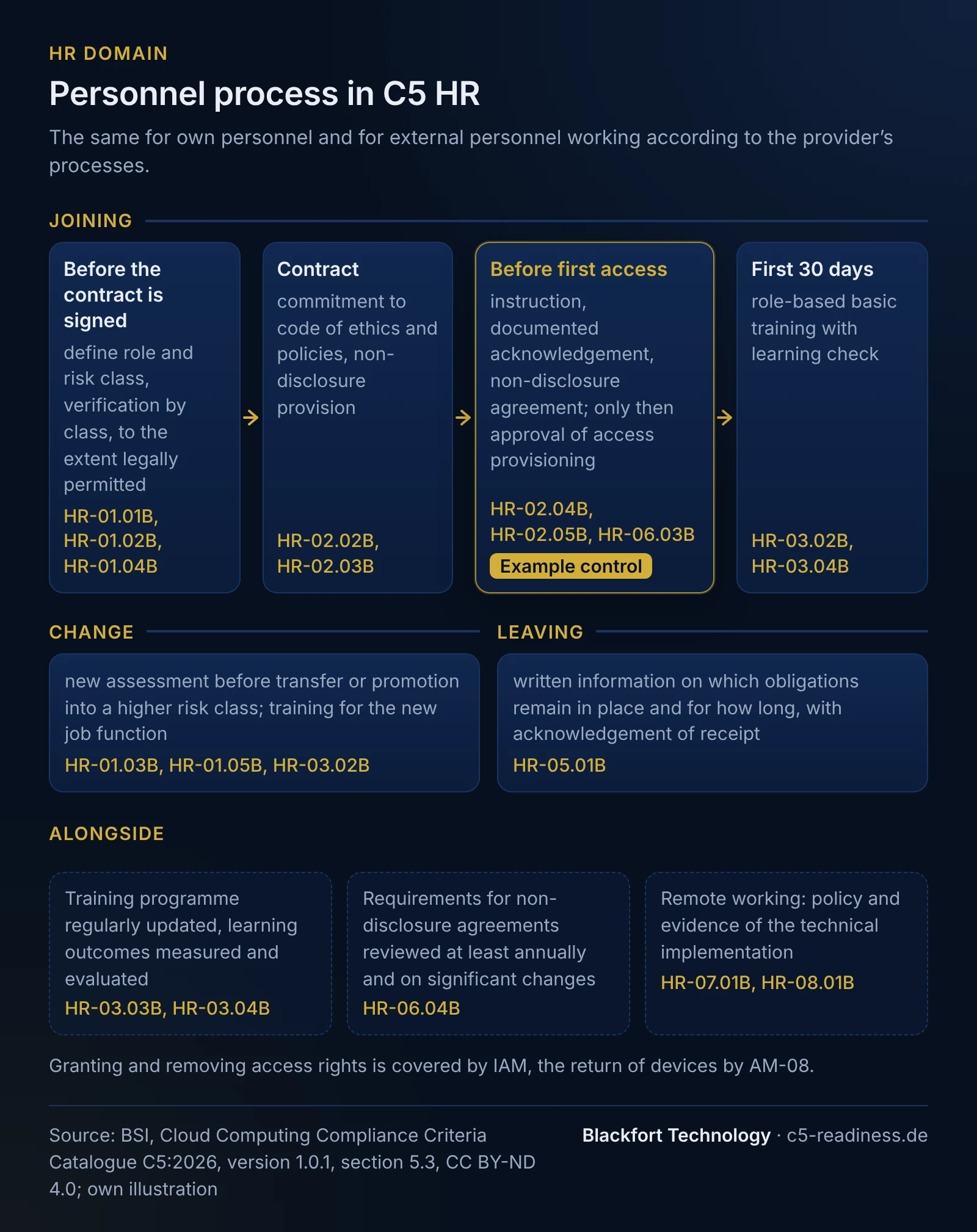
The criteria mainly define what has to be done before first access. Our process for the example, the same for own and external personnel:
| Point in time | Step | Who | Criterion |
|---|---|---|---|
| before the contract is signed | define role and risk class, carry out and document the verification by class | HR department, business unit | HR-01.01B, HR-01.02B, HR-01.04B |
| contract | commitment to the code of ethics, the information security policy and the rules based on it; non-disclosure provision that also covers anonymised and decontextualised information; reference to possible disciplinary measures | HR department, procurement for external staff | HR-02.02B, HR-02.03B, HR-04.03B |
| before first access | instruction on code of ethics and policies, documented acknowledgement, non-disclosure agreement; only then does HR approve access provisioning | HR department, information security officer | HR-02.04B, HR-02.05B, HR-06.03B |
| first 30 days | role-based basic training with learning check | information security officer | HR-03.02B, HR-03.04B |
| on change | new assessment before transfer or promotion into a higher risk class; training for the new job function; assess risks arising from the change | HR department, business unit | HR-01.03B, HR-01.05B, HR-03.02B |
| on leaving | written information on which obligations from the contract and the non-disclosure agreement remain in place and for how long, with acknowledgement of receipt | HR department | HR-05.01B |
Two processes from other domains run alongside: the return of laptops and security keys, with removal of access rights no later than the date of leaving if the return is late (AM-08, see Asset management), and the adjustment of rights within the deadlines of IAM-04. You review the requirements for the non-disclosure agreements under HR-06.04B at least annually and in case of significant changes to the service. If the review shows that the requirements need to be adapted, you update the agreements. HR-06.03B requires the non-disclosure agreement before access authorisation only for internal personnel; that the process above also requires it from external staff is our recommendation. For external personnel, HR-02.03B requires the non-disclosure provision in the terms. The two language versions differ here: the English version 1.0.1 names “anonymised and decontextualised information”, the German version 1.1.0 anonymised and pseudonymised information.
How do you build a role-based training programme?
HR-03 requires a target group-oriented programme that all internal and external personnel undergo regularly and when changing job function, aligned with risk classification and technical responsibilities (HR-03.02B). The content is regularly updated based on changed policies and the threat situation, and learning outcomes are measured and evaluated (HR-03.03B, HR-03.04B). The sharpening HR-03.02AS turns this into “at least annually”. Our programme for the example:
| Target group | Focus | Frequency | Learning check |
|---|---|---|---|
| everyone | policies, handling customer data, current threats such as phishing, correct behaviour in security incidents, remote working | on joining and annually | short test, evaluation per target group |
| development | secure development, handling secrets in code and pipeline | on joining, annually, on moving into the team | test and evaluation of findings from code reviews |
| administration and operations | handling production system components, privileged access, emergency procedures | on joining, annually, before taking on privileged rights | test, participation in an exercise |
| support | view of customer data only with a ticket, recognising social engineering on the phone | on joining and annually | test, simulated calls |
The measurement does not have to assess each person individually: for the complementing HR-03.03AC, the supplementary information expressly allows evaluation at an aggregated level per target group, also to protect employee data. We recommend feeding the results into the revision of the programme every year.
Example control description for HR-02
The most delicate moment is the first working day: laptop and accounts are handed out quickly, commitment and instruction are not. Our example control for the provider above (own wording, not catalogue text):
| Field | Example |
|---|---|
| Control ID | K-HR-02-01 No access before verification, commitment and instruction |
| Mapped to | HR-01.02B, HR-02.04B, HR-02.05B, HR-06.03B |
| Objective | Nobody, internal or external, receives access to customer data or production system components before the verification by risk class is complete, the instruction on code of ethics and policies has been given and acknowledged, and the non-disclosure agreement has been concluded. |
| Owner | HR department (execution, approval); procurement (documents of external staff); checked by the information security officer |
| Trigger and frequency | event-driven on every joining and every start of an assignment of external staff; monthly reconciliation |
| Execution | In the HR system, every joining has a checklist with four mandatory fields: verification by class, signed non-disclosure agreement, instruction, documented acknowledgement. Only when all four are set is the access provisioning ticket automatically forwarded to operations. Laptop and an account without access to production and customer data are available from the first day. |
| Check | Each month the information security officer reconciles all new accounts with access to production or customer data with the checklists and checks that the approval date precedes the date of the first authorisation. |
| Escalation | If the reconciliation finds an account with access but without a complete checklist, operations removes the access immediately, the information security officer records a deviation and informs the head of the department. |
| Evidence | Checklists with timestamps, signed agreements, acknowledgements, access provisioning tickets, monthly reconciliation record |
Whether the control covers the subcriteria is for the auditor to assess; for a type 2 report the auditor checks, using a sample of the joiners in the period, whether it was effective.
What evidence the auditor wants to see
HR evidence contains personal data. Define which records the auditor sees and in what form; for disciplinary measures, the supplementary information on HR-04.04B expressly accepts anonymised evidence. Examples from our scenario:
| Evidence | Criterion | Source | Owner | Timing |
|---|---|---|---|---|
| List of roles with access and their risk class | HR-01.01B, HR-01.04B | HR policy, role catalogue | HR department, information security officer | state in the period |
| Documentation of the verification per joiner and per promotion | HR-01.02B, HR-01.05B | HR system (checklist, without the content of the documents) | HR department | sample of joiners and changes in the period |
| Contract templates for employees and external staff with commitment and non-disclosure provision | HR-02.01B to 03B | HR department, procurement | HR department | version valid in the period |
| Instruction, acknowledgement and non-disclosure agreement before first access | HR-02.04B, HR-02.05B, HR-06.03B | HR system, tickets | HR department | sample, date before first authorisation |
| Training plan per target group, participation, evaluation of learning outcomes | HR-03.01B to 04B | learning platform | information security officer | all runs in the period |
| Policy on disciplinary measures, anonymised cases | HR-04.01B to 04B | HR department | HR department | version and cases in the period |
| Information on continuing obligations on leaving | HR-05.01B | HR system, acknowledgement of receipt | HR department | sample of leavers in the period |
| Requirements for non-disclosure agreements with review | HR-06.01B, HR-06.04B | ISMS documentation | information security officer | annual review in the period |
| Remote working policy and evidence of the technical implementation | HR-07.01B, HR-08.01B | policy, device management configuration | information security officer, IT | state in the period |
An evidence register maps each subcriterion to its evidence; how to maintain it is shown on the page Evidence and documentation.
Possible gaps: cause, effect, remedy
The following gaps follow from the wording of the criteria and the scenario above. If a single subcriterion is not met, the criterion counts as not met, and the auditor reports the deviation (sections 3.4.12 and 3.4.13).
| Possible gap | Cause | Effect | Remedy |
|---|---|---|---|
| External developers without verification and commitment | Internally they count as the service provider’s personnel. | Whoever works according to the provider’s processes is external personnel within the meaning of HR-01; HR-02.05B requires documented acknowledgement before first access, HR-02.03B the non-disclosure provision for external personnel as well. | Take external staff through the same joining process, agreements with the individuals themselves. |
| Access on the first day | Accounts are handed out with the laptop. | HR-02.04B and HR-02.05B require instruction and documented acknowledgement before access. | Link the approval of access provisioning to the complete checklist, as in K-HR-02-01. |
| One training for everyone | One e-learning course for the whole company. | HR-03.02B requires a role-based programme that takes risk classification and technical responsibilities into account; HR-03.04B requires measuring learning outcomes. | Target groups by risk class, learning check per target group, annual evaluation. |
| Obligations after leaving not communicated | Leaving consists only of returning devices. | HR-05.01B requires that personnel provably knows which obligations remain in place and for how long. | Leaving letter with acknowledgement of receipt as a fixed step. |
| Private devices in remote working | No binding policy. | HR-07.01B requires, among other things, remote access security requirements and the provision of organisation-approved equipment with prohibition of unregulated personal devices; HR-08.01B the technical implementation. | Policy under SP-01, access only from managed devices, technically enforced. |
All criteria of the HR domain
Titles as in the English version 1.0.1, number of subcriteria counted per section 5 (B = basic, AS = sharpening, AC = complementing). The column “What it covers” is our own short description, not catalogue text; the wording of the criteria in the catalogue is binding.
| ID | Title (catalogue) | B/AS/AC | What it covers |
|---|---|---|---|
| HR-01 | Verification of Qualification and Trustworthiness | 6/0/1 | Identify roles with access, classify them by risk and verify personnel before employment and before promotion within the permissible scope. |
| HR-02 | Employment Terms and Conditions | 5/0/0 | Contracts that commit to code of ethics and policies and contain a non-disclosure provision; instruction and acknowledgement before first access. |
| HR-03 | Security Training and Awareness Programme | 4/1/5 | Role-based training for everyone, regularly updated, with measured learning outcomes. |
| HR-04 | Disciplinary Measures | 4/0/0 | Defined, proportionate disciplinary measures for violations, communicated and documented. |
| HR-05 | Responsibilities in the Event of Termination or Change of Employment | 1/0/0 | Provable information on which obligations apply after leaving or a change, and for how long. |
| HR-06 | Non-disclosure Agreements | 6/0/0 | Agreements with personnel and service organisations based on defined requirements, reviewed annually and renewed where needed. |
| HR-07 | Remote Working - Policy | 1/0/0 | Rules for information, access, communication and devices when working off-site. |
| HR-08 | Remote Working - Implementation | 1/0/0 | The technical and organisational measures that enable personnel to comply with these rules. |
The additional criteria go deeper into two topics: HR-01.01AC requires the provider to define in the human resource policy positions that require regular assessment, and to review the assessment for this personnel annually; HR-03.01AC to HR-03.05AC cover monitoring of training completion, target group-oriented measurement with quantitative and qualitative aspects, and feedback into the programme.
Relationship to ISO/IEC 27001:2022 Annex A
The following mapping is our own, unofficial classification by topic. The BSI has not yet published a cross-reference for C5:2026. The catalogue refers to the BSI website for it (section 3.3). So far the table there covers C5:2020 only, and the BSI says the table for C5:2026 is “scheduled for publication in the near future” (as of 6 November 2026). According to the catalogue, even an official table only shows thematic proximity, not fulfilment of the criteria (section 3.3). The short labels are ours, not titles from the standard. What you can reuse overall from a certified ISMS is shown on the page C5 and ISO 27001.
| C5:2026 | ISO/IEC 27001:2022 Annex A | Topic (short label) | What C5 additionally requires in concrete terms (our assessment) |
|---|---|---|---|
| HR-01 | A.6.1 | Screening of personnel | Risk classes for roles, assessment before promotion |
| HR-02 | A.6.2 | Employment terms | Documented acknowledgement before first access, non-disclosure also of decontextualised information |
| HR-03 | A.6.3 | Awareness and training | Role-based by risk class, measured learning outcomes |
| HR-04 | A.6.4 | Disciplinary process | Documentation of cases |
| HR-05 | A.6.5 | Obligations after termination | Information on the duration of continuing obligations |
| HR-06 | A.6.6 | Non-disclosure agreements | Annual review of the requirements, risk assessment if no agreement is reached |
| HR-07, HR-08 | A.6.7, A.8.1 | Remote working and endpoint devices | Prohibition of unregulated personal devices |
Frequently asked questions
Do I have to require a certificate of good conduct from administrators?+
Does HR also apply to freelancers and service providers?+
How often does training have to take place?+
Does every person have to pass a test?+
What has to be documented when someone leaves?+
Read more
- C5 criteria catalogue: structure, basic and additional criteria
- C5 IAM: identity and access management under C5:2026
- C5 AM: asset management and asset inventory under C5:2026
- C5 SSO: controlling and monitoring service organisations under C5:2026
- C5 documentation: keeping an evidence register for the audit
- C5 readiness assessment: gap analysis, action plan and timeline
Sources
- BSI: C5:2026 web page with downloads (German) (retrieved 2026-11-06)
- BSI: C5:2026 web page with downloads (retrieved 2026-11-06)
- BSI: Kriterienkatalog Cloud Computing C5:2026, version 1.1.0 (PDF, German), licensed under CC BY-ND 4.0 (retrieved 2026-11-01)
- BSI: Cloud Computing Compliance Criteria Catalogue C5:2026, version 1.0.1 (PDF), section 5.3 HR-01 to HR-08 with supplementary information, sections 3.3, 3.4.12 and 3.4.13, licensed under CC BY-ND 4.0 (retrieved 2026-11-01)
- BSI: C5:2026 change history (Excel), new criteria HR-07 and HR-08 (retrieved 2026-11-01)
- BSI: C5:2026 overview page with downloads (German) (retrieved 2026-11-01)
This content provides general technical and organisational information and does not constitute legal advice (no legal services within the meaning of the German RDG).