

Last updated: 2026-11-06
This page covers the SIM domain (Security Incident Management) of C5:2026, section 5.13 of the catalogue. How criteria and subcriteria are structured in general is explained on the page C5 criteria catalogue.
What is the SIM domain about?
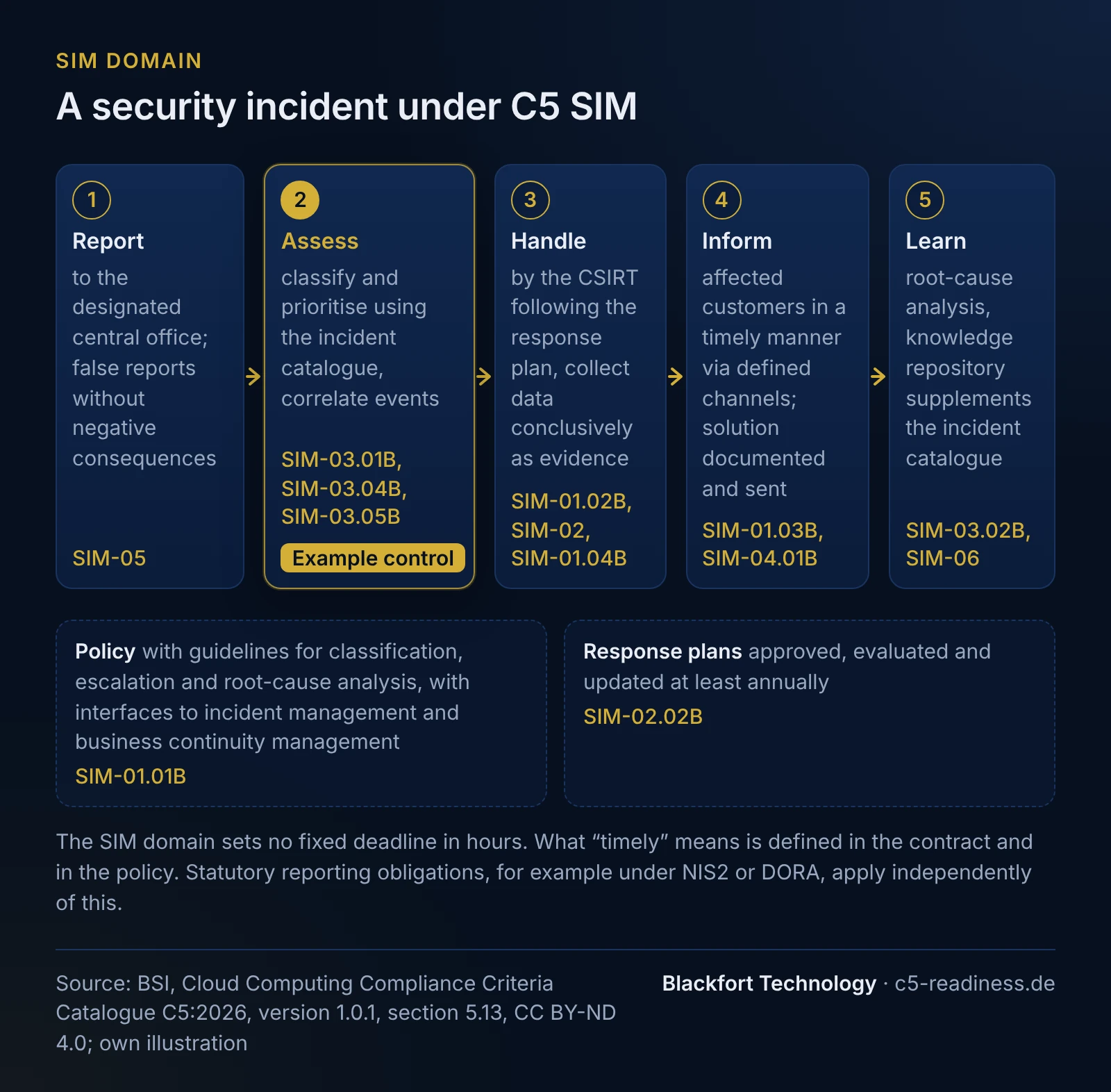
SIM requires a consistent approach with which the provider captures, evaluates, communicates and handles security incidents (objective in section 5.13). This includes a policy with guidelines on classification, prioritisation, escalation and root-cause analysis, a CSIRT, response plans, informing the affected customers, the personnel’s duty to report and a learning process with a knowledge repository.
The domain comprises six criteria, SIM-01 to SIM-06, with 22 basic subcriteria and 5 complementing additional subcriteria; there are no sharpening ones. SIM-02 on response plans is new. The former criteria SIM-02 to SIM-05 from C5:2020 are therefore now called SIM-03 to SIM-06; map old controls by their topic, not by their number.
Disruptions and crashes without a security dimension are covered by the OPS domain; there, OPS-19 governs when a disruption is passed on as a security incident. The policy under SIM-01.01B expressly creates interfaces to incident management and to business continuity management, see BCM.
Starting point: a SaaS provider with on-call duty but no incident process
Fictitious example, not a client. A provider runs software for processing incoming invoices for medium-sized companies: documents are uploaded, read automatically and passed to accounting in an approval workflow. The service runs on the infrastructure of a large cloud service provider. Around 45 employees, an operations team with on-call duty around the clock, logs flow into a central logging system with alerts.
Before the project, the situation looks like this:
- Alerts end up as disruptions in the ticket system. Whether something is a security incident is decided by the person on call at their own discretion.
- There is no CSIRT. During a suspicious login in the previous year, operations, development and management worked together in a chat channel.
- Customers are informed when sales considers it necessary, by email to the known contact person.
- Logs are overwritten after 30 days; how to secure data of a suspicious system is not described anywhere.
- What was learned from an incident is noted, if at all, in the closing comment of the ticket.
For the audit, the provider needs a defined process that leaves traces for every incident in the period: classification, handling, informing customers, root-cause analysis.
Who is responsible for what: provider, platform, customer?
SIM is the provider’s responsibility. The platform, in the example a subservice organisation, handles incidents in its own infrastructure according to its own procedure; the customer plays its part in reporting events and receiving notifications. Our classification for the example:
| Aspect | Provider | Platform (subservice organisation) | Customer (company) |
|---|---|---|---|
| Incidents in its own service | detects, classifies and handles them with the CSIRT (SIM-01 to SIM-03) | - | - |
| Incidents in the platform’s infrastructure | receives the platform’s reports, assesses the impact on its own service and monitors the platform under SSO-05, see SSO | handles them according to its own procedure and informs its customers (outside your audit under the carve-out method) | - |
| Reporting channels for security events | designates the central office and communicates the reporting mechanisms to personnel, customers and service organisations (SIM-05) | knows the provider’s reporting channel | reports identified events in a timely manner to previously designated personnel of the provider |
| Information on incidents and their resolution | informs affected customers via defined channels and sends the documentation of the solution (SIM-01.03B, SIM-04) | - | ensures that notifications arrive and are passed on to the responsible unit |
| Lessons from incidents | maintains the knowledge repository and the evaluation (SIM-06) | - | takes communicated findings into its ISMS and reviews its own measures |
SIM-01, SIM-04, SIM-05 and SIM-06 contain complementary customer criteria, SIM-02 and SIM-03 do not. The customer controls you assume, for example an up-to-date contact address for security notifications, belong in the system description as complementary customer controls (also called complementary user entity controls, CUEC). The auditor does not test them at the customer, only whether they are fairly presented.
How and when do you inform affected customers?
The catalogue requires that customers affected by security incidents are informed “in a timely and appropriate manner”, via communication channels that have been identified and defined beforehand (SIM-01.03B). After processing, the solution is documented in accordance with the contractual agreements and sent to the affected customers (SIM-04.01B); information on security incidents or confirmed security breaches is made available to all affected customers (SIM-04.02B). The SIM domain sets no fixed deadline in hours.
You therefore define yourself what “timely” means for your service: in the contract with the customers and in the policy under SIM-01. We recommend setting the deadline per class of the incident catalogue and naming the channel, for example a security contact address that the customer maintains in the service. If you include the complementing subcriterion SIM-04.02AC, you also regulate in the contract which data the customer receives in the event of an incident for its own analysis.
Statutory reporting obligations, for example under the NIS2 Directive as transposed into national law (see C5 and NIS2) or under DORA in the financial sector (see C5 and DORA), apply independently of these catalogue requirements; whether and with which deadlines they affect your service has to be assessed legally in the individual case. For a type 2 report, significant events in the period, for example unauthorised access by third parties to customer data, also belong in the system description, see Significant changes and events.
Example control description for SIM-03
With seven basic subcriteria, SIM-03 is the most extensive criterion in the domain. It requires that subject matter experts classify and prioritise events that could constitute a security incident and analyse their root cause (SIM-03.01B), that the results are documented, shared and used in the learning process (SIM-03.02B), and that classification is based on a maintained catalogue of incident types, which is also used to correlate events (SIM-03.04B, SIM-03.05B). Documents and evidence on incidents are archived in a secure and tamper-proof manner (SIM-03.06B). Our example control for the provider above (own wording, not catalogue text):
| Field | Example |
|---|---|
| Control ID | K-SIM-03-01 Classification, handling and root-cause analysis of security events |
| Mapped to | SIM-03.01B to SIM-03.07B; preservation of evidence under SIM-01.04B; information under SIM-01.03B and SIM-04.01B |
| Objective | Every event that could be a security incident is classified and prioritised according to the incident catalogue; every incident is investigated down to its cause, documented and archived in a tamper-proof manner. |
| Owner | Head of the CSIRT (execution); checked by the information security officer |
| Trigger and frequency | event-driven: every security alert from the logging system, every report from personnel, customers or service organisations to the central reporting office and every incident report from the platform |
| Execution | The on-call person classifies the event according to the incident catalogue (four classes from “no incident” to “critical”) within 30 minutes (internal target time). From class “high” upwards, they convene the CSIRT, which works according to the response plan and secures data of suspicious systems following the procedure for preserving evidence. Affected customers are informed via the stored security contact address, within the contractually agreed deadline per class. After closure, the CSIRT prepares a root-cause analysis within ten working days and enters the incident, measures and affected assets in the knowledge repository. |
| Check | Each month the information security officer reviews all tickets with a security dimension: is the class plausible, is there a root-cause analysis for incidents, were the customers informed within the deadline, is the evidence in the archive? Deviations go into the learning process under SIM-06 as a measure. |
| Escalation | Class “critical”: management is informed immediately; if no CSIRT member can be reached after 60 minutes, the second on-call level takes over. If external assistance is needed, the CSIRT selects a service based on competence and trustworthiness or following the recommendation of a national cybersecurity authority (SIM-03.03B). |
| Evidence | Tickets with class, priority and timestamps, minutes of the CSIRT meetings, preservation logs, customer notifications, root-cause analyses, entries in the knowledge repository, monthly review record |
Target times and classes are our example values, not catalogue requirements. Whether the control covers all subcriteria is for the auditor to assess; for a type 2 report the auditor also tests whether it operated effectively throughout the period.
What evidence the auditor wants to see
For SIM, the evidence comes mainly from the incidents and events in the period. If there was no incident, you evidence the process through the policy, the plans and the handling of events that turned out to be harmless; agree early with the auditor how they will deal with this. Examples from our scenario:
| Evidence | Criterion | Source | Owner | Timing |
|---|---|---|---|---|
| Policy for security incident management with classification, escalation and interfaces | SIM-01.01B | ISMS document repository | information security officer | version valid in the period with approval date |
| Designation of the CSIRT with members and deputies | SIM-01.02B | organisation chart, on-call schedule | management | version valid in the period |
| Defined communication channels with customers | SIM-01.03B | contract templates, contact directory in the service | customer service | version valid in the period |
| Procedure for the conclusive collection of data | SIM-01.04B | operations manual | head of the CSIRT | version valid in the period |
| Approved response plans with evaluation | SIM-02.01B, SIM-02.02B | document repository | head of the CSIRT | every evaluation, at least annually |
| Incident catalogue and tickets with classification and root-cause analysis | SIM-03.01B to SIM-03.05B | ticket system, knowledge repository | head of the CSIRT | all incidents, sample of the events in the period |
| Closing documentation sent to affected customers | SIM-04.01B, SIM-04.02B | ticket system with the message sent | customer service | all incidents involving customers in the period |
| Informing personnel and business partners of the duty to report | SIM-05.01B to SIM-05.03B | training records, contracts, customer portal | information security officer, procurement | version valid in the period, training sessions in the period |
| Evaluation of incidents and derived measures | SIM-06.01B to SIM-06.04B | knowledge repository, report to management | information security officer | every evaluation in the period |
An evidence register records which evidence belongs to which subcriterion; how to maintain one is shown on the page Evidence and documentation.
Possible gaps: cause, effect, remedy
The following gaps follow from the wording of the criteria and the scenario above. If a single subcriterion is not met, the criterion counts as not met, and the auditor reports the deviation (sections 3.4.12 and 3.4.13).
| Possible gap | Cause | Effect | Remedy |
|---|---|---|---|
| No designated CSIRT | Incidents are handled by whoever happens to be available. | SIM-01.02B requires an established CSIRT; without a designation, handling under SIM-03 cannot be traced either. | Designate a CSIRT with roles, deputies and availability and anchor it in the on-call schedule. |
| Informing customers at discretion | No defined channel, no rule on who informs and when. | SIM-01.03B requires identified and defined channels; without them, “timely” cannot be evidenced. | A security contact per customer in the service, deadlines per incident class in contract and policy. |
| Evidence gets lost | Logs are overwritten, systems are rebuilt immediately. | SIM-01.04B requires procedures for the conclusive collection of data, SIM-03.06B tamper-proof archiving. | Preservation procedure for logs, images and timestamps, archive with write protection. |
| Response plans out of date | The plan was written once and never evaluated. | SIM-02.02B requires evaluation and updating at least annually or as necessary. | Annual evaluation in the ISMS calendar, additionally after every organisational change. |
| No learning from incidents | Root-cause analyses are missing or stay in the ticket. | SIM-03.02B and SIM-06.02B to SIM-06.04B require documented analyses and a knowledge repository that supplements the incident catalogue. | Knowledge repository with incident, measures and affected assets, evaluation in the report to management. |
How to put these gaps in order together with those of other domains is shown on the page Prioritising measures.
All criteria of the SIM domain
Titles as in the English version 1.0.1, number of subcriteria counted per section 5 (B = basic, AS = sharpening, AC = complementing). The column “What it covers” is our own short description, not catalogue text; the wording of the criteria in the catalogue is binding.
| ID | Title (catalogue) | B/AS/AC | What it covers |
|---|---|---|---|
| SIM-01 | Policy for Security Incident Management | 4/0/0 | Policy, CSIRT, communication channels with customers and conclusive collection of data. |
| SIM-02 | Security Incident Response Plans | 2/0/0 | Approved plans for all stages from identification to lessons learned, evaluated at least annually. |
| SIM-03 | Processing of Security Incidents | 7/0/3 | Classification, prioritisation, root-cause analysis, incident catalogue, external assistance and archiving. |
| SIM-04 | Documentation and Reporting of Security Incidents | 2/0/2 | Documentation of the solution for affected customers and information on security breaches. |
| SIM-05 | Duty of the Personnel to Report Security Incidents to a Central Body | 3/0/0 | Duty to report for personnel and business partners, false reports without negative consequences, known reporting channels. |
| SIM-06 | Evaluation and Learning Process | 4/0/0 | Measuring and monitoring incidents, knowledge repository and advanced safeguards derived from it. |
The complementing subcriteria of SIM-03 require annual exercises or tests such as Red Team training (SIM-03.01AC), a qualified forensic team, in-house or contracted (SIM-03.02AC), and monitoring of whether incident management runs in line with the policy (SIM-03.03AC). With SIM-04.01AC, customers can actively approve solutions, or the solution counts as approved after a certain period.
Relationship to ISO/IEC 27001:2022 Annex A
The following mapping is our own, unofficial classification by topic. The BSI has not yet published a cross-reference for C5:2026. The catalogue refers to the BSI website for it (section 3.3). So far the table there covers C5:2020 only, and the BSI says the table for C5:2026 is “scheduled for publication in the near future” (as of 6 November 2026). According to the catalogue, even an official table only shows thematic proximity, not fulfilment of the criteria (section 3.3). The short labels are ours, not titles from the standard.
| C5:2026 | ISO/IEC 27001:2022 Annex A | Topic (short label) | What C5 additionally requires in concrete terms (our assessment) |
|---|---|---|---|
| SIM-01, SIM-02 | A.5.24 | Planning incident management | designated CSIRT, defined channels with customers, plans evaluated at least annually |
| SIM-03 | A.5.25, A.5.26, A.5.28 | Assessment, response, preservation of evidence | incident catalogue for customer data, selection of external assistance, tamper-proof archiving |
| SIM-04 | A.5.26; no direct counterpart for informing customers | Response to incidents | documentation of the solution to every affected customer |
| SIM-05 | A.6.8 | Reporting of events | false reports without negative consequences, reporting channels also for customers and service organisations |
| SIM-06 | A.5.27 | Learning from incidents | knowledge repository with affected assets, feedback into the incident catalogue |
Frequently asked questions
How quickly do I have to inform customers about a security incident under C5?+
Do I need my own CSIRT as a small provider?+
What counts as a security breach within the meaning of SIM-04?+
What does the auditor test if there was no security incident in the period?+
Do false alarms have to be documented?+
Read more
- C5 criteria catalogue: structure, basic and additional criteria
- C5 OPS: making operations audit-ready under C5:2026
- C5 BCM: business continuity and restore tests under C5:2026
- C5 SSO: controlling and monitoring service organisations under C5:2026
- C5 significant events and changes in a type 2 report
- C5 system description: minimum content, structure and example
- C5 documentation: keeping an evidence register for the audit
- C5 readiness assessment: gap analysis, action plan and timeline
Sources
- BSI: C5:2026 web page with downloads (German) (retrieved 2026-11-06)
- BSI: C5:2026 web page with downloads (retrieved 2026-11-06)
- BSI: Kriterienkatalog Cloud Computing C5:2026, version 1.1.0 (PDF, German), licensed under CC BY-ND 4.0 (retrieved 2026-11-01)
- BSI: Cloud Computing Compliance Criteria Catalogue C5:2026, version 1.0.1 (PDF), section 5.13 SIM-01 to SIM-06 with supplementary information, sections 3.3, 3.4.12 and 3.4.13, licensed under CC BY-ND 4.0 (retrieved 2026-11-01)
- BSI: C5:2026 change history (Excel), sheet “Change History”, SIM-01 to SIM-06 (retrieved 2026-11-01)
- BSI: C5:2026 overview page with downloads (German) (retrieved 2026-11-01)
This content provides general technical and organisational information and does not constitute legal advice (no legal services within the meaning of the German RDG).