

Last updated: 2026-11-06
This page covers the OPS (Operations) domain of C5:2026, section 5.6 of the catalogue. How criteria and subcriteria are structured in general is explained on the page C5 criteria catalogue.
What is the OPS domain about?
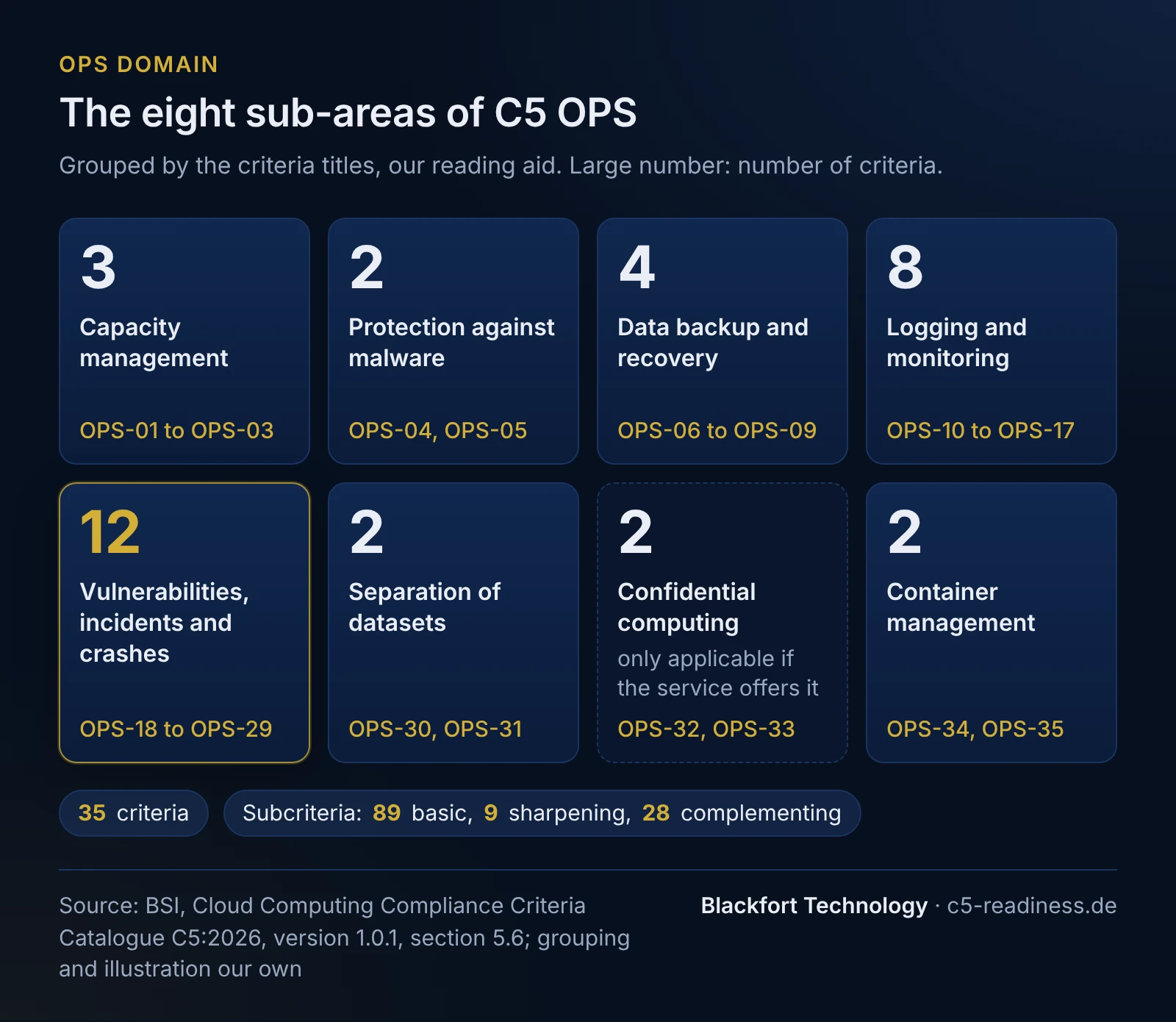
OPS requires the ongoing operation of the service to be planned, monitored and secured in a verifiable way. With 35 criteria, 89 basic subcriteria, 9 sharpening and 28 complementing additional subcriteria, it is the most extensive domain. The criteria titles fall into eight sub-areas; the grouping is our reading aid:
| Sub-area | Criteria | Core (own summary) |
|---|---|---|
| Capacity management | OPS-01 to OPS-03 | plan demand in advance, monitor provision in line with the contract, enable customers to control their resources |
| Protection against malware | OPS-04, OPS-05 | policy and implementation, update signatures at least daily, regular evaluation |
| Data backup and recovery | OPS-06 to OPS-09 | encrypted backup in line with RTO and RPO, monitoring, restore test at least annually, remote location |
| Logging and monitoring | OPS-10 to OPS-17 | what is logged, handling of derived data, SIEM, retention, accountability, protection of the logging systems |
| Vulnerabilities, incidents and crashes | OPS-18 to OPS-29 | vulnerability management with time frames, penetration tests, scans, hardening, patch management, third-party libraries, incidents and crashes |
| Separation of datasets | OPS-30, OPS-31 | tenant separation along a documented layer model |
| Confidential computing | OPS-32, OPS-33 | only applicable if the service offers confidential computing |
| Container management | OPS-34, OPS-35 | policies and implementation for the life cycle of images and containers |
Eleven OPS criteria are new in C5:2026 without a predecessor, among them patch management (OPS-27, OPS-28), third-party libraries (OPS-29), data separation as a policy (OPS-30) as well as confidential computing and containers. Several previous criteria have new numbers: OPS-19 to OPS-23 in C5:2020 became OPS-22 to OPS-26, and OPS-24 became OPS-31. You therefore have to update references in old control descriptions.
Starting point: a SaaS provider before its first audit
Fictitious example, not a client. A provider runs a portal through which medical practices place laboratory orders and receive findings. The service runs on the infrastructure of a large cloud provider in a managed Kubernetes cluster, with a managed database and object storage. Logs go to a SIEM service of a specialised service provider. The operations team consists of five people with weekly on-call duty.
Before the project, the situation looks like this:
- The database creates snapshots automatically; a restore was last carried out two years ago because of an error, not as a planned test.
- A vulnerability scanner checks the cluster nodes, but not the container images and the libraries used.
- The team handles critical findings quickly; there are no fixed time frames per severity.
- The SIEM collects logs; the rules have not been adjusted since its introduction.
- Usage data of the practices is analysed for product analytics; nobody knows exactly how much of this is covered by the contract.
Who is responsible for what: provider, platform, customer?
In OPS, provider and platform share many tasks, and for several criteria the catalogue explicitly names obligations of the customers to contribute. Our classification for the example:
| Aspect | Provider | Platform (subservice organisation) | Customer (practice, laboratory) |
|---|---|---|---|
| Capacity | plans demand, configures scaling, monitors the SLA | provides computing power and scaling functions | reflects its demand in the SLA and monitors the agreement (complementary customer criteria on OPS-01, OPS-02) |
| Data backup | defines scope, retention and encryption, tests the restore | provides snapshot and replication functions | requests results of the restore tests (on OPS-08) |
| Logging | determines events, consolidates logs in the SIEM, evaluates them | delivers logs of the managed services | assigns unique user IDs so that incidents can be attributed (on OPS-15) |
| Vulnerabilities and patches | scans and patches its own images, nodes and libraries | patches the managed services and the cluster’s control plane | checks components in its own area of responsibility, for example its own interface clients (on OPS-18, OPS-25) |
| Containers | is responsible for images, deployment and runtime of its own containers | runs the managed cluster | - |
| SIEM as a service | remains responsible for OPS-13 and monitors the service provider | - | - |
The platform and the SIEM service provider are subservice organisations. If you use the carve-out method for them, their controls are outside your audit, but responsibility for the criteria remains with you; monitoring runs through the SSO domain. How to choose the method is explained on the page C5 scope.
Example control description for OPS-25
OPS-25 requires that system components in the area of responsibility of the cloud service provider “are subject to vulnerability scans at least once a month”, including a comparison against up-to-date vulnerability databases such as CVE or EUVD (OPS-25.01B). The severity is assessed according to defined criteria, measures are initiated within defined time frames, and the results are used to update the SIEM rules (OPS-25.02B to 04B). The time frames themselves are set by the policy under OPS-18; there the catalogue requires, among other things, that for vulnerabilities assessed to be “high”, engagement begins within one working day (OPS-18.03B). Our example control (own wording, not catalogue text):
| Field | Example |
|---|---|
| Control ID | K-OPS-25-01 Monthly vulnerability scan with monitoring of time frames |
| Mapped to | OPS-25.01B to OPS-25.04B; time frames from the policy under OPS-18 |
| Objective | Vulnerabilities in all system components in the provider’s area of responsibility are identified every month and addressed within the time frames of the policy under OPS-18. |
| Owner | Head of operations (execution and remediation); checked by the information security officer |
| Trigger and frequency | scheduled scan on the first working day of each month for nodes, container images in the registry and application dependencies; additionally for every new image in the build pipeline |
| Execution | The scanner compares the software components against up-to-date vulnerability databases. Every finding automatically creates a ticket with CVSS score and time frame according to the policy. For findings with known exploitation, operations adjusts the detection rules in the SIEM within one working day. |
| Check | Each month the information security officer checks whether the scan covered all components from the inventory and compares open tickets with their time frames. The result feeds into the quarterly assessment of the procedures under OPS-23. |
| Escalation | Time frame exceeded for “critical” or “high”: immediate notification of the head of operations and management; if a vulnerability is deliberately not remediated, a risk assessment under OPS-18.05B with compensating measures and a review date is required. |
| Evidence | Monthly scan reports with coverage list, tickets with timestamps, change log of the SIEM rules, monthly control record |
As an example of a risk-based framework with CVSS time frames, the supplementary information on OPS-25 gives around 24 to 48 hours for “critical” and one month for “low”; the complementing subcriterion OPS-25.01AC requires such a risk-based framework, the figures themselves are an example, not a requirement. The software component data can be, but does not have to be, obtained using an SBOM.
What evidence the auditor wants to see
OPS produces a lot of evidence on a fixed cycle. For a type 2 report, every cycle must be evidenced without gaps throughout the audit period. Examples from the scenario:
| Evidence | Criterion | Source | Owner | Timing |
|---|---|---|---|---|
| Capacity forecast and reconciliation with the SLA | OPS-01, OPS-02 | monitoring, capacity report | head of operations | per planning cycle, for example quarterly |
| Updates of the malware signatures | OPS-05.02B | anti-malware console | operations | at least daily, sample across the audit period |
| Monitoring of backup runs with error tickets | OPS-07 | monitoring, ticket system | operations | ongoing |
| Record of the restore test with RTO and RPO comparison and disposal of the test data | OPS-08.01B to 05B | test record | head of operations | at least once a year |
| Logging concept with time sources | OPS-10.01B | document repository | information security officer | version valid during the audit period |
| SIEM integration and rule changes | OPS-13, OPS-25.04B | SIEM configuration, change log | operations | ongoing |
| Penetration test report and test plan | OPS-22 | external testing provider | information security officer | at least annually and in case of significant changes |
| Hardening specifications and deviation reports | OPS-26 | configuration check | operations | ongoing |
| Patch tickets with test and rescan | OPS-27, OPS-28 | ticket system, scanner | operations | per patch |
| Quarterly assessment of the procedures for vulnerabilities and incidents | OPS-23.02B | assessment record | information security officer | at least quarterly |
How to manage this evidence per subcriterion and due date is shown on the page Evidence and documentation.
Possible gaps: cause, effect, remedy
The following gaps follow from the wording of the criteria and the scenario. If a single subcriterion is not met, the criterion counts as not met, and the auditor reports the deviation (sections 3.4.12 and 3.4.13).
| Possible gap | Cause | Effect | Remedy |
|---|---|---|---|
| Snapshots without a planned restore test | The platform backs up automatically, so the topic is considered done. | OPS-08 requires tests at least annually that allow an assessment against contractual agreements, RTO and RPO, thoroughly documented including the safe disposal of the restored data; an unplanned restore after an error two years ago does not meet this. | Plan an annual test, define target values beforehand, record the result and the disposal. |
| Scan without container images and libraries | The scanner was set up for virtual machines. | OPS-25.01B applies to all system components in the provider’s area of responsibility, and OPS-29 requires a procedure for updates of third-party and open-source libraries. | Add scanning of the registry and the dependencies to the pipeline, check coverage against the inventory. |
| No fixed time frames per severity | The team works by gut feeling. | OPS-18 requires defined time frames and itself specifies that engagement with “critical” vulnerabilities begins in a timely manner, even outside working hours, and with “high” ones within one working day; without time frames the auditor cannot audit OPS-25.03B. | Write time frames per severity into the policy and monitor them in the ticket system. |
| SIEM without link to the scan results | SIEM and vulnerability management run separately. | OPS-25.04B requires the scan results to be used for the SIEM rules so that active exploitation of known vulnerabilities is detected. | Add the step to the control, as in the example above. |
| Usage data without contractual statement of purpose | Product analytics have grown over time. | OPS-11.02B requires the contract to specify all purposes for which cloud service derived data are collected and used, except for those purposes that are inherent to the general operation of all cloud services. | Survey the purposes, amend the contract annex, stop analyses that are not covered. Data protection questions in this context need to be examined separately. |
Which gaps actually block the audit and in which order you close them is clarified by prioritising measures across all domains.
All criteria of the OPS domain
Titles as in the English version 1.0.1, number of subcriteria counted per section 5 (B = basic, AS = sharpening, AC = complementing). The column “What it covers” is our own short description, not catalogue text; the wording of the criteria in the catalogue is binding.
| ID | Title (catalogue) | B/AS/AC | What it covers |
|---|---|---|---|
| OPS-01 | Capacity Management - Planning | 3/0/1 | Plan capacities for staff and technology in advance so that commitments to customers hold even in bottlenecks. |
| OPS-02 | Capacity Management - Monitoring | 2/0/1 | Monitor that resources are available as agreed, and inform customers of bottlenecks relevant to the contract. |
| OPS-03 | Capacity Management - Controlling of Resources | 2/0/0 | Customers can control their allocated resources depending on the service model and are informed of significant security changes to them. |
| OPS-04 | Protection Against Malware - Policies and Procedures | 1/0/0 | Rules on where and how protection programmes run, from the server to the staff’s end devices. |
| OPS-05 | Protection Against Malware - Implementation | 3/1/3 | Protection on the production systems, daily updates and regular evaluation of the reports. |
| OPS-06 | Data Backup and Recovery - Policies and Procedures | 1/1/0 | What is backed up, how often, how long and in encrypted form, aligned with contracts, RTO and RPO. |
| OPS-07 | Data Backup and Recovery - Monitoring | 2/0/1 | Monitor backup runs and fix errors promptly. |
| OPS-08 | Data Backup and Recovery - Regular Testing | 5/0/2 | Test restores at least annually, assess them against target values and document them thoroughly. |
| OPS-09 | Data Backup and Recovery - Storage | 5/0/0 | Backups at a remote location with the same level of protection and encrypted transfer. |
| OPS-10 | Logging and Monitoring - Policies and Procedures | 1/0/0 | Which events are logged, who is responsible, how long logs are retained and which time source applies. |
| OPS-11 | Logging and Monitoring - Policies and Procedures for Handling Cloud Service Derived Data and Account Data | 2/0/2 | Use operational and account data only for operations and name all further purposes in the contract. |
| OPS-12 | Logging and Monitoring - Access, Retention and Deletion | 1/0/0 | Enforce access, retention and deletion of logs technically. |
| OPS-13 | Logging and Monitoring - Security Information and Event Management | 2/0/3 | Feed relevant logs into a SIEM with correlation, alerting and automated response. |
| OPS-14 | Logging and Monitoring - Retention of the Logging Data | 3/0/0 | Retain logs immutably and in a centrally analysable form, and transfer them securely. |
| OPS-15 | Logging and Monitoring - Accountability | 3/0/2 | Attribute access unambiguously per tenant and enable forensic analyses with a chain of custody. |
| OPS-16 | Logging and Monitoring - Configuration | 2/0/0 | Access to the logging systems only with multiple factors, changes through the change process. |
| OPS-17 | Logging and Monitoring - Availability of the Monitoring Software | 2/0/2 | Detect and report failures of the logging and monitoring systems themselves. |
| OPS-18 | Managing Vulnerabilities - Policies and Procedures | 5/0/0 | Identify vulnerabilities, assess them using CVSS and address them within fixed time frames, with rules for exceptions. |
| OPS-19 | Managing Incidents and Crashes - Policies and Procedures | 1/0/0 | Rules for classification, escalation and the handling of crash dumps. |
| OPS-20 | Managing Incidents - Implementation | 1/0/0 | Record, classify and handle incidents in operations. |
| OPS-21 | Managing Crashes - Implementation | 1/0/0 | Record and handle crashes of components or of the service. |
| OPS-22 | Managing Vulnerabilities, Incidents and Crashes - Penetration Tests | 8/3/5 | Risk-based penetration tests at least annually, every relevant component at least once every three years, with root cause analysis. |
| OPS-23 | Managing Vulnerabilities, Incidents and Crashes - Measurements, Analyses and Assessments of Procedures | 2/0/0 | Measure your own procedures and assess them at least quarterly. |
| OPS-24 | Involvement of Cloud Service Customers in the Event of Incidents | 2/0/1 | Inform affected customers about the status of incidents and the measures taken. |
| OPS-25 | Managing Vulnerabilities, Incidents and Crashes - Vulnerability Scans | 4/2/1 | Scans at least once a month with comparison against vulnerability databases and feedback into the SIEM. |
| OPS-26 | Managing Vulnerabilities, Incidents and Crashes - System Hardening | 6/1/0 | Harden production systems according to recognised standards, document the specifications and monitor deviations. |
| OPS-27 | Managing Vulnerabilities - Patch Management Policies and Procedures | 4/1/0 | Plan patches, test them beforehand, be able to roll back and scan again after installation. |
| OPS-28 | Managing Vulnerabilities - Patch Management Implementation | 1/0/0 | Implement the patch procedure technically and organisationally. |
| OPS-29 | Managing Vulnerabilities, Incidents and Crashes - Externally Sourced Components | 1/0/0 | Track and install updates and vulnerabilities in third-party and open-source libraries on an ongoing basis. |
| OPS-30 | Separation of Datasets - Policies and Procedures | 1/0/0 | Define tenant separation on a risk basis along a documented layer model. |
| OPS-31 | Separation of Datasets - Implementation | 3/0/0 | Implement the separation on shared resources and review the risk assessment at least annually. |
| OPS-32 | Confidential Computing - Policies and Procedures | 3/0/1 | Only if confidential computing is offered: document purpose, technology and limits and communicate them to customers. |
| OPS-33 | Confidential Computing - Remote Attestation | 3/0/2 | Only if confidential computing is offered: remote attestation with a verification interface for customers. |
| OPS-34 | Container Management - Policies and Procedures | 2/0/1 | Rules for the entire life cycle of images and containers, from creation to decommissioning. |
| OPS-35 | Container Management - Implementation | 1/0/0 | Implement the container rules technically and organisationally. |
Security incidents in the narrower sense are covered by the SIM domain; OPS-19 defines when an operational incident is escalated there.
Relationship to ISO/IEC 27001:2022 Annex A
The following mapping is our own, unofficial classification by topic. The BSI has not yet published a cross-reference for C5:2026. The catalogue refers to the BSI website for it (section 3.3). So far the table there covers C5:2020 only, and the BSI says the table for C5:2026 is “scheduled for publication in the near future” (as of 6 November 2026). According to the catalogue, even an official table only shows thematic proximity, not fulfilment of the criteria (section 3.3). The short labels are ours, not titles from the standard.
| C5:2026 | ISO/IEC 27001:2022 Annex A | Topic (short label) | What C5 additionally requires in concrete terms (our assessment) |
|---|---|---|---|
| OPS-01 to OPS-03 | A.8.6 | Capacity | reference to the SLA and informing customers of bottlenecks |
| OPS-04, OPS-05 | A.8.7 | Malware | signature updates at least daily |
| OPS-06 to OPS-09 | A.8.13 | Data backup | annual restore test against RTO and RPO, remote location with the same protection |
| OPS-10 to OPS-17 | A.8.15, A.8.16, A.8.17 | Logging, monitoring, clock synchronisation | SIEM with defined capabilities, purpose limitation of derived data in the contract |
| OPS-18, OPS-22, OPS-25, OPS-27 to OPS-29 | A.8.8 | Technical vulnerabilities and patches | time frames per severity, monthly scans, penetration tests with a multi-year plan |
| OPS-19 to OPS-21, OPS-24 | A.5.24, A.5.26 | Incidents and disruptions | rules for crash dumps, informing customers |
| OPS-23 | A.5.27 (partly) | Learning from incidents | quarterly assessment of the procedures |
| OPS-26 | A.8.9 | Configuration and hardening | checking immutable images in a defined procedure |
| OPS-30 to OPS-35 | no direct counterpart | Tenant separation, confidential computing, containers | criteria of their own in C5:2026 |
Frequently asked questions
How often does data recovery have to be tested?+
How often does C5 require vulnerability scans and penetration tests?+
Do I need a SIEM for C5?+
Do the confidential computing criteria apply to every service?+
What do I have to do if the platform takes over parts of operations?+
Read more
- C5 criteria catalogue: structure, basic and additional criteria
- C5 IAM: identity and access management under C5:2026
- C5 CRY: cryptography and key management under C5:2026
- C5 DEV: development and change management under C5:2026
- C5 BCM: business continuity and restore tests under C5:2026
- C5 Kubernetes: running a container platform ready for audit
- C5 tenant separation: evidencing separation of customer data
- C5 confidential computing: OPS-32 and OPS-33 in C5:2026
- C5 documentation: keeping an evidence register for the audit
- C5 readiness assessment: gap analysis, action plan and timeline
- C5 AM: asset management and asset inventory under C5:2026
Sources
- BSI: C5:2026 web page with downloads (German) (retrieved 2026-11-06)
- BSI: C5:2026 web page with downloads (retrieved 2026-11-06)
- BSI: Kriterienkatalog Cloud Computing C5:2026, version 1.1.0 (PDF, German), sections 3.3, 3.4.6, 3.4.12, 3.4.13 and 5.6 (OPS-01 to OPS-35), licensed under CC BY-ND 4.0 (retrieved 2026-11-01)
- BSI: Cloud Computing Compliance Criteria Catalogue C5:2026, version 1.0.1 (PDF), sections 3.3, 3.4.6, 3.4.12, 3.4.13 and 5.6, licensed under CC BY-ND 4.0 (retrieved 2026-11-01)
- BSI: C5:2026 change history (Excel), sheet “Change History”, mapping of OPS from C5:2020 to C5:2026 (retrieved 2026-11-01)
- BSI: C5:2026 overview page with downloads (German) (retrieved 2026-11-01)
This content provides general technical and organisational information and does not constitute legal advice (no legal services within the meaning of the German RDG).