

Last updated: 2026-11-01
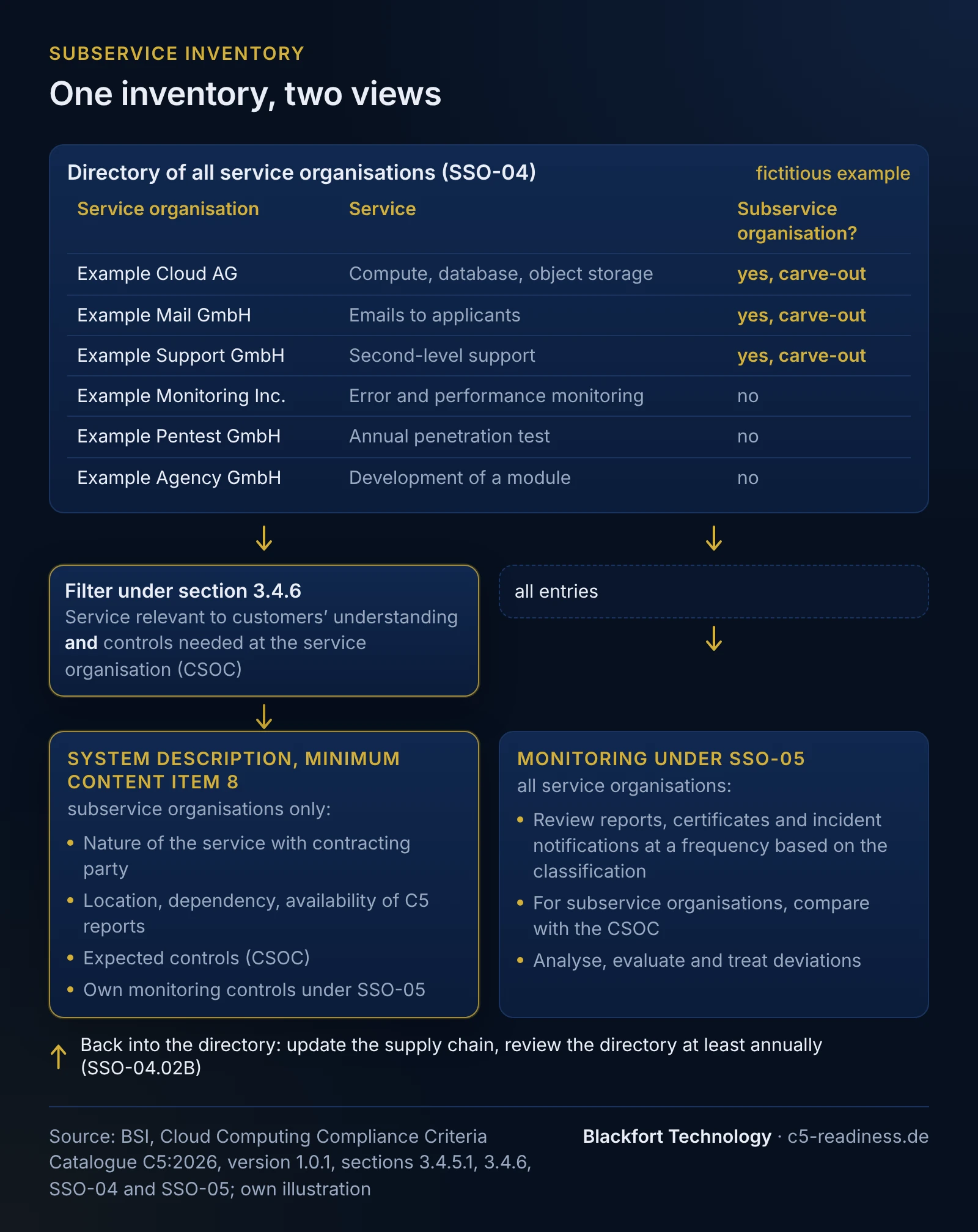
The inventory is a work product, not a catalogue term. The catalogue requires a directory of service organisations (SSO-04) and, in the system description, details on the subservice organisations (section 3.4.5.1 no. 8 and 3.4.6). We recommend keeping both in one table, because the subservice organisations are a subset of the service organisations. How the control system for service organisations works as a whole is explained on the page SSO domain; a blank template is on the page C5 templates.
Which details belong in the subservice inventory?
The details from two places in the catalogue, plus the fields you need for monitoring. The column “Source” shows where a detail comes from; the completion notes are our recommendation.
| Field | Source | Completion note |
|---|---|---|
| Company name of the contracting party | SSO-04.01B no. 1; 3.4.5.1 no. 8 | the company the contract is with, not the brand |
| Address of the head office, applicable legal jurisdiction | SSO-04.01B nos. 2 and 3 | for groups, the contracting company |
| Locations of processing and storage | SSO-04.01B no. 4; 3.4.5.1 no. 8 | internally as precise as needed, in the system description country level is sufficient; include backups, logs and support access |
| Contact at the service organisation and at your organisation | SSO-04.01B nos. 5 and 6 | a group or role rather than an individual, so the entry stays correct when staff change |
| Description of the service | SSO-04.01B no. 7; 3.4.5.1 no. 8 | what it does for your service and which data it sees in doing so |
| Classification based on the risk assessment | SSO-04.01B no. 8; SSO-02 | result of your method; the monitoring frequency follows from it |
| Subservice organisation yes or no, with justification | 3.4.6; SSO-01.01B no. 2 | check both characteristics, see step 2 |
| Carve-out or inclusive method | 3.4.6 | only for subservice organisations; for the decision see C5 scope |
| Complexity, uniqueness and dependency | 3.4.5.1 no. 8; 3.4.6 | level “Low”, “Medium”, “High” or “Very high” with a justification, as given as an example in the catalogue |
| Availability of C5 audit reports | 3.4.5.1 no. 8 | type, period, catalogue revision; other reports and certificates in a separate column |
| Expected controls at the subservice organisation (CSOC) | 3.4.5.1 no. 8; 3.4.6 | types of controls needed in combination with your controls, with the criteria IDs concerned |
| Own monitoring controls under SSO-05 | 3.4.5.1 no. 8 | how, how often and by whom you monitor the subservice organisation |
| Beginning of service usage | SSO-04.01B no. 9 | date on which the service organisation first worked for the service |
| Proof of compliance with contractually agreed requirements | SSO-04.01B no. 10 | reference to review records and reports |
| Subcontractors of the service organisation | SSO-02.01B nos. 7 and 8; SSO-07.01B | whether it uses subcontractors itself and which data they process, that is, the next tier of the supply chain |
| Last and next review | our own addition | date, so that the frequency under SSO-05.03B stays visible |
The template on the page C5 templates contains all of these fields, including the details under SSO-04. The catalogue does not require a single central register (supplementary information on SSO-04); you can also keep individual details in your contract register and refer to them from there.
Step 1: find all service organisations
The directory covers all service organisations that contribute services to delivering the cloud service, including small tools. A query in purchasing alone misses tools that teams order themselves. Our recommendation for the sources to build the list from:
- supplier list and credit card statements for the last twelve months,
- data processing agreements,
- data flow diagram and architecture documentation, including backup, logging, monitoring and email delivery,
- third-party applications connected to the identity service and pipeline integrations,
- outbound connections from the production environment.
Service organisations that contribute nothing to the development or operation of the service, such as payroll accounting, do not belong in the directory.
Step 2: Is a service organisation a subservice organisation?
A service organisation is a subservice organisation if two characteristics are present together; the catalogue says they “apply in combination” (section 3.4.6):
- Its service is likely to be relevant to your customers’ understanding of how the service is built and how you meet the criteria; this is the case, for example, if it contributes to or has access to system components, may access confidential information or exchanges information with the service.
- You need controls at the service organisation, the complementary subservice organisation controls (CSOC), to meet the criteria with reasonable assurance in combination with your own controls.
Characteristic 1 alone is therefore not enough. If your own controls, including your monitoring of the service organisation, meet the applicable criteria with reasonable assurance, it is not a subservice organisation, even if it sees customer data. For some cases the catalogue sets the direction:
- Data centres operated by third parties: generally subservice organisations, in particular for the criteria on physical security (PS).
- Infrastructure or platform of another cloud service provider: likewise, for example for operations (OPS).
- Cleaning companies, advertising agencies: typically not subservice organisations.
For all other service organisations, your own assessment decides. Our recommendation for characteristic 2: note the criteria concerned for each service organisation and ask, criterion by criterion, whether your own controls meet it without a control at the service organisation. Examples are encryption with keys that only you manage, technically removing personal content before transfer, or time-limited, logged test accounts. If a gap remains that only the service organisation can close, it is a subservice organisation, and exactly these controls are the CSOC. Record the result and the justification in the inventory; the auditor has to be able to follow the classification.
The classification has consequences. For each subservice organisation, the system description contains the details under minimum content item 8, and you choose carve-out or inclusive; the trade-off is on the page C5 scope. Under SSO-05 you have to monitor all service organisations, and even with carve-out you remain accountable for your service meeting the applicable criteria (section 3.4.6). How the control system for service organisations is built as a whole is explained on the page SSO domain.
A completed example
Fictitious example, not a client; all company names are made up. A provider runs applicant management software as SaaS for medium-sized companies. Application documents, CVs and communication with applicants are held in the service. The directory has six entries.
Part A: directory and classification
| Service organisation | Service | Subservice organisation? | Method | Location (country) | Dependency |
|---|---|---|---|---|---|
| Example Cloud AG | Compute, managed database, object storage | yes: operation on a third-party platform, controls on physical security and platform operations needed | carve-out | Germany | Very high: entire operation, switching not possible within one month; exit strategy under SSO-06 |
| Example Mail GmbH | Sending emails to applicants (name, job title, appointment link) | yes: transmits customer data, controls on confidentiality and deletion at the email delivery service needed | carve-out | Ireland | Medium: standard interface, switching possible within a few weeks |
| Example Support GmbH | Second-level support with read access to customer tenants | yes: access to confidential information, controls on personnel security and access at the service organisation needed | carve-out | Germany | Medium: product knowledge, onboarding a replacement takes about two months |
| Example Monitoring Inc. | Error and performance monitoring of the application | no: the provider technically removes personal content before transfer and checks this itself; no controls needed at the service organisation | - | USA | Low |
| Example Pentest GmbH | Annual penetration test | no: access only through the provider’s time-limited, logged test accounts | - | Germany | Low |
| Example Agency GmbH | Development of the careers page module following its own processes | no: acceptance and testing by the provider before deployment (DEV-02); steered through DEV-02 and SSO | - | Germany | Medium |
Part B: details on the subservice organisations
| Subservice organisation | Audit reports | Expected controls (CSOC), examples | Own monitoring under SSO-05 |
|---|---|---|---|
| Example Cloud AG | C5 type 2, twelve-month period; also ISO/IEC 27001 | Access to data centres (PS), power and air conditioning, hardening and patching of the platform services (OPS), deletion and disposal of storage media, logging of privileged access by platform staff | Review of each new report by the information security officer within four weeks of receipt, comparison of the CSOC and the CUEC; quarterly review of status notices and security advisories |
| Example Mail GmbH | no C5 report; SOC 2 Type 2 | Encryption in transit, access to delivery logs for authorised staff only, deletion of the logs after the agreed period | Annual review of the SOC 2 report against the CSOC; if there are gaps, own questionnaire with evidence |
| Example Support GmbH | no C5 report; ISO/IEC 27001 | Screening and commitment of staff, training, access only through accounts provided by the provider, reporting of incidents within 24 hours | Own annual on-site audit, quarterly account review by the provider, review of incident reports |
What goes from Part A and Part B into the system description is set by minimum content item 8: for each subservice organisation the nature of the service with contracting party, location, dependency and availability of C5 reports, plus the expected controls and your monitoring controls. The other service organisations stay in the internal directory. How the sections of the description are structured is shown on the page System description.
How do you review your subservice organisations’ audit reports?
With a fixed review scheme and a record for each report. According to the BSI FAQ, an unmodified audit opinion does not mean there are no deviations; only the review shows what the report covers for your service. The supplementary information on SSO-05 lists review points, among them scope and period, modifications of the opinion and deviations, the service organisation’s complementary user entity controls (CUEC), disclosed subservice organisations and stated security incidents. Our review scheme builds on this:
| Review point | What to look for | What follows |
|---|---|---|
| Report type and criteria | C5, SOC 2, ISAE 3402 or certificate; for C5, type and catalogue revision | According to the catalogue, results from certification audits are to be assessed differently from those of an ISAE 3000 audit (section 3.3); for the CSOC you may then need further evidence |
| Scope | Are the services and regions you use included? | Services not included are an open point in your monitoring |
| Period | Does the report period cover your audit period, and how large is the gap? | Have the service organisation confirm the gap in writing and review status notices for the gap |
| Audit opinion and deviations | Modifications, deviations in controls that correspond to your CSOC, management’s response | Analyse, evaluate and treat the deviation under SSO-05.05B; document the consequences for your criteria |
| Comparison with your CSOC | Is every expected control in the report, and was it tested without deviation? | Reasonable assurance under SSO-05.04B; if a control is missing, your own audit or other evidence |
| CUEC of the service organisation | Which controls does it assume on your side? | Map each CUEC to one of your own controls, such as configuration, keys and permissions in your platform account |
| Subservice organisations of the service organisation | Which does it name, are there new ones? | Update the supply chain in the directory, check customer information under SSO-07 |
| Security incidents | Incidents stated in the report | Assess the impact on your service; if a change has a significant adverse effect on your level of security, inform customers without undue delay (SSO-05.06B) |
For analysing C5 reports in a structured manner, the catalogue mentions an Excel-based evaluation guideline published by the BSI. The BSI FAQ currently refers to documents for C5:2020 for this, with an update for C5:2026 announced (retrieved 1 November 2026). You receive the report itself from the service organisation; according to the BSI FAQ, the provider as owner decides on the conditions under which it is passed on. Customers read a C5 report with a different aim, namely for their own risk decision; here the subject is your monitoring under SSO-05.
A review record for the platform report in the example could look like this (fictitious values): compute, database and object storage services included, region included; the report period ends three months before the end of your own audit period, written confirmation requested; one deviation in the disposal of storage media with management’s response and correction in the following month, assessment: no effect on your own criteria because data is stored encrypted; 14 CUEC in the report, twelve mapped to your own controls, two open and recorded as actions with a deadline.
How do you keep the inventory current?
With fixed dates and triggers, some of which the catalogue sets. The frequencies in the right-hand column that go beyond the catalogue requirements are our recommendation.
| What | Requirement | When |
|---|---|---|
| Review the directory for completeness, accuracy and validity | SSO-04.02B | at least annually; we also recommend a quarterly comparison with the supplier list |
| Review the risk assessment of each service organisation | SSO-02.02B | at least annually |
| Review reports, certificates and incident notifications | SSO-05.02B, SSO-05.03B | at a frequency based on the classification; in the example, for “Very high” every new report and a quarterly status review, for “Medium” annually |
| Review confidentiality agreements | SSO-05.07B | at least once per year |
| Inform customers about service organisations and types of data | SSO-07.01B, SSO-07.02B | when there are changes, review at least annually |
| New service organisation or new service | SSO-02.01B | before use: assessment, classification, entry |
| Change at the service organisation that significantly worsens your level of security | SSO-05.06B | inform customers without undue delay |
For a type 2 report, the auditor needs evidence that these steps ran throughout the period: dated review records, review notes on the directory and completed actions. New subservice organisations during the period can also be a significant change that belongs in the system description, see Significant changes and events.
Common mistakes in the inventory
| Mistake | Effect | Remedy |
|---|---|---|
| Dependency without justification, for example just “High” | Detail under 3.4.6 incomplete, exit strategy under SSO-06 cannot be derived | Add a justification with scope, uniqueness and switching time |
| CSOC as a blanket “ISO 27001 certificate in place” | A certificate is not a control; the comparison under SSO-05.04B is not possible | Phrase the CSOC as specific types of control with criteria IDs |
| Location only as the service organisation’s head office | Processing and storage locations, for example for backups or support, are missing | Collect locations per type of data and compare them with the data flow diagram |
Frequently asked questions
Is the subservice inventory mandatory under C5?+
Does every service organisation have to go into the system description?+
How precise do the location details have to be?+
What if a subservice organisation has no C5 report?+
Do my service organisations’ subcontractors belong in the inventory?+
Read more
- C5 SSO: controlling and monitoring service organisations under C5:2026
- C5 scope: service boundary, platform reports, carve-out
- Free C5 templates: scope sheet, evidence register, CUEC matrix
- C5 system description: minimum content, structure and example
- Reading a C5 report: evaluating the audit report as a customer
- C5 BCM: business continuity and restore tests under C5:2026
- C5 readiness assessment: gap analysis, action plan and timeline
Sources
- BSI: Kriterienkatalog Cloud Computing C5:2026, version 1.1.0 (PDF, German), sections 1.2, 3.4.5.1, 3.4.6 and 5.12 (SSO-01 to SSO-07), licensed under CC BY-ND 4.0 (retrieved 2026-11-01)
- BSI: Cloud Computing Compliance Criteria Catalogue C5:2026, version 1.0.1 (PDF), sections 1.2, 3.4.5.1, 3.4.6 and 5.12 (SSO-01 to SSO-07), licensed under CC BY-ND 4.0 (retrieved 2026-11-01)
- BSI: C5 FAQ (German), questions on how a C5 report is evaluated and how a cloud service customer obtains a provider’s C5 report (retrieved 2026-11-01)
This content provides general technical and organisational information and does not constitute legal advice (no legal services within the meaning of the German RDG).