

Last updated: 2026-11-06
This page covers the COM domain (Compliance) of C5:2026, section 5.15 of the catalogue. How criteria and subcriteria are structured in general is explained on the page C5 criteria catalogue.
What is the COM domain about?
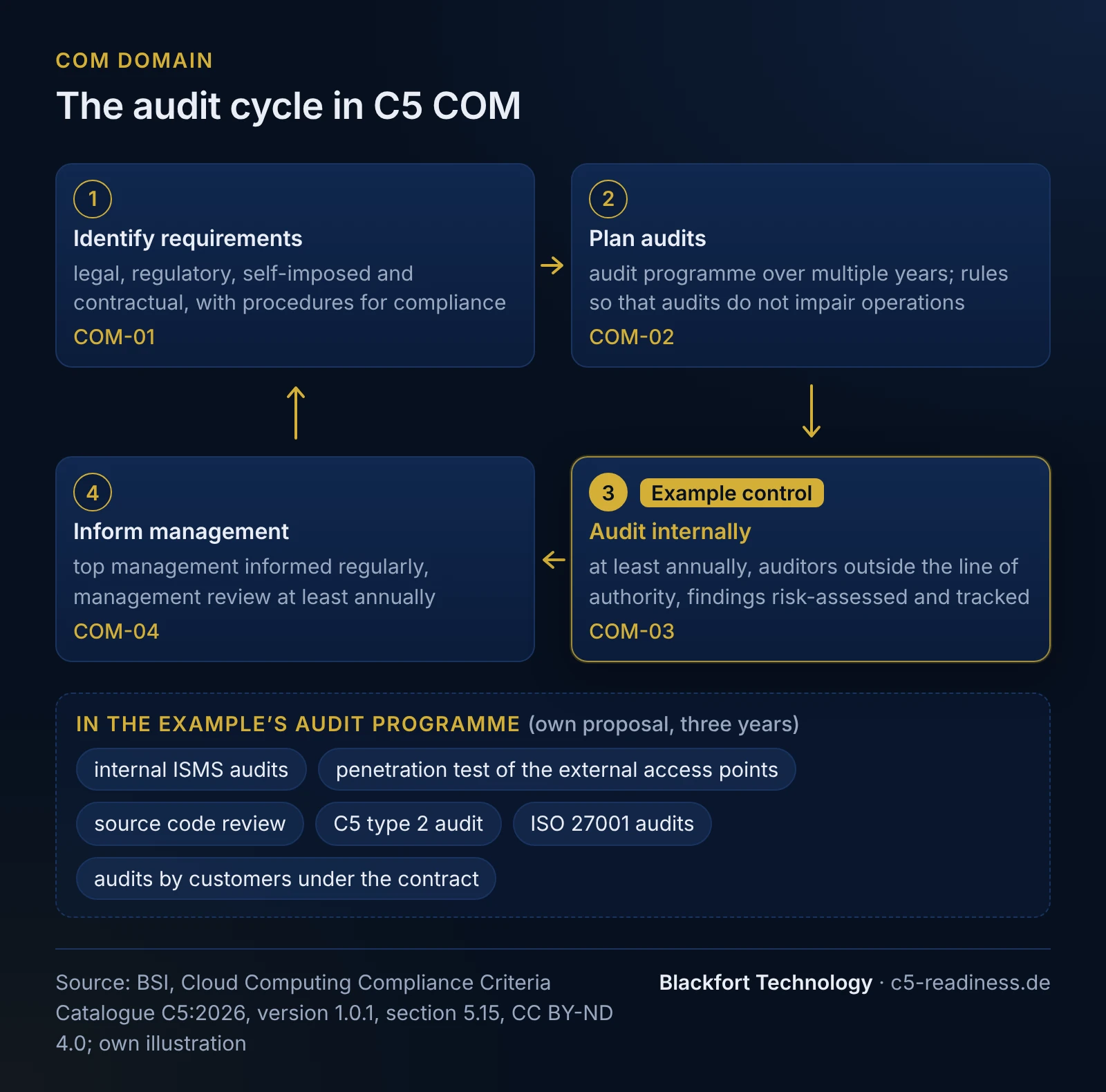
COM is meant to avoid non-compliance with legal, regulatory, self-imposed or contractual information security requirements and to check compliance (objective in section 5.15). The domain is the provider’s audit cycle: identify requirements, plan audits, audit internally, inform management.
It comprises four criteria, COM-01 to COM-04, with 7 basic subcriteria, one sharpening and 7 complementing additional subcriteria. All four already existed in C5:2020. According to the BSI change history, the basic criteria of COM-01 and COM-04 are unchanged; their additional criteria are new. COM-02 now requires an audit programme over multiple years and names configuration reviews, penetration tests and source code reviews; COM-03 additionally checks the effectiveness of organisational and operational measures and requires a separation of the line of authority between auditors and the audited.
If you run an ISMS under ISO/IEC 27001, you have a good basis for COM-03 and COM-04; the catalogue itself refers to clauses 9.2 (internal audits) and 9.3 (management review) of the standard. What can be taken over from ISO 27001 overall is shown on the page C5 and ISO 27001.
Starting point: an ISO 27001-certified SaaS provider with a small team
Fictitious example, not a client. A provider runs fleet management software for companies as SaaS: vehicle data, driving licence checks, damage reports and fuel cards. The service runs on the infrastructure of a large cloud service provider. 25 employees, an ISO 27001 certificate for development and operations. A leasing group requires a C5 type 2 report and its own audit right in the contract.
Before the project, the situation looks like this:
- There is a register of legal requirements, but it only lists data protection and commercial law. Contractual commitments to customers, such as certificates and deadlines from framework agreements, are only found in the contracts.
- The information security officer plans the internal audits anew every year. There is no plan beyond the current year.
- The information security officer reports to the head of operations and also audits operations.
- Last year the annual penetration test ran at the end of the month, when customers generate their billing; the service was slow for an hour.
- The management review takes place annually, but the minutes contain no information security metrics.
Who is responsible for what: provider, platform, customer?
COM lies with the provider; the platform, in the example a subservice organisation, runs its own compliance programme. The customer only plays a part in COM-02. Our classification for the example:
| Aspect | Provider | Platform (subservice organisation) | Customer (company) |
|---|---|---|---|
| Identifying the requirements for the service | documents requirements and procedures for complying with them (COM-01) | identifies the requirements for its own infrastructure | - |
| Audit programme and rules for audits | plans internal and external audits over multiple years and protects operations while doing so (COM-02) | specifies which audit activities are permitted on its infrastructure, for example for penetration tests | responds appropriately to outages or degradations caused by audits; exercises agreed audit rights in line with its own requirements |
| Internal audits and management review | performs them at least annually (COM-03, COM-04) | audits its own ISMS (outside your audit under the carve-out method) | - |
Only COM-02 contains complementary customer criteria. Whichever customer controls you assume belong in the system description as complementary customer controls (CUEC). The auditor does not test them at the customer, only whether they are fairly presented.
What does a multi-year audit programme look like?
COM-02.01B requires a documented and implemented audit programme over multiple years that defines the scope and frequency of the audits and takes into account the management of change, policies and the results of the risk assessment. The catalogue gives a time frame of three years with internal and external audits as an example; the sharpening subcriterion COM-02.01AS prescribes exactly three years. For our example, the compliance audit plan could look like this (own proposal, not catalogue text):
| Audit | Type | Year 1 | Year 2 | Year 3 | Reason in the programme |
|---|---|---|---|---|---|
| Internal ISMS audit of operations and platform | internal | yes | yes | yes | highest risk according to the risk assessment |
| Internal ISMS audit of development and change management | internal | yes | - | yes | change management, results of previous audits |
| Internal ISMS audit of HR, procurement, service providers | internal | - | yes | - | lower risk, rotation |
| Penetration test of the external access points | commissioned externally | yes | yes | yes | COM-02.02B no. 5 |
| Source code review of the in-house security features | internal with external support | yes | - | yes | COM-02.02B no. 6 |
| C5 type 2 audit | third party | yes | yes | yes | contract with customers |
| ISO 27001 surveillance and recertification audit | third party | surveillance | surveillance | recertification | certificate |
| Audit by customers under the contract | second party | as needed | as needed | as needed | agreed audit rights |
Under COM-02.02B this includes a risk-based policy that prevents adverse effects of audits on operations, among other things through read-only access, performing risky activities in maintenance windows or outside peak periods, and logging of the audit activities. In the example, this rule would have prevented the penetration test at the end of the month. You prepare the external C5 follow-up audit itself separately, see C5 follow-up audit.
Example control description for COM-03
COM-03 requires internal audits at least annually by subject matter experts that check compliance with the policies and the effectiveness of the measures against the risks to network and information systems (COM-03.01B). The auditors are not in the line of authority of the area under review; if the size of the provider does not allow this, alternative measures ensure impartiality (COM-03.02B). Findings are subjected to a risk assessment and tracked (COM-03.03B). Our example control for the provider above (own wording, not catalogue text):
| Field | Example |
|---|---|
| Control ID | K-COM-03-01 Internal ISMS audit according to the audit programme |
| Mapped to | COM-03.01B to COM-03.03B; planning under COM-02.01B |
| Objective | Every area within the scope of the ISMS is audited by impartial subject matter experts at the intervals set in the audit programme, at least annually overall; every finding is risk-assessed and tracked until it is closed. |
| Owner | information security officer (planning and follow-up); external auditor commissioned by management (execution for operations); management (acknowledgement) |
| Trigger and frequency | scheduled according to the audit programme; additionally event-driven after significant changes to the service |
| Execution | The information security officer plans the scope and criteria of each audit according to the programme and the risk assessment. Because the information security officer reports to the head of operations, they do not audit operations themselves; management commissions an external auditor for this. The information security officer audits the other areas. Audit activities on system components run with read-only access and are logged. The audit report lists the findings with their rating. |
| Check | Every finding goes into the risk register with a risk assessment and into the action list with a deadline. The information security officer reports the status to management every quarter and in the management review. |
| Escalation | If an action on a finding rated high exceeds its deadline, management decides on compensating measures or on accepting the risk. |
| Evidence | Audit programme, audit plans and reports, engagement of the external auditor, risk register, action list with closure notes, reports to management |
The solution with external support for one area is one of several conceivable alternative measures; clarify early with the auditor which one they consider sufficient. For a type 2 report the auditor also tests whether the control operated effectively throughout the period.
What evidence the auditor wants to see
COM evidence consists mainly of ISMS documents. The timing matters: the programme, the reports and the management review must have been valid or have taken place in the audit period. Examples from our scenario:
| Evidence | Criterion | Source | Owner | Timing |
|---|---|---|---|---|
| Register of requirements with procedures for compliance | COM-01.01B | ISMS document repository, contract repository | information security officer, contract management | version valid in the period |
| Audit programme over multiple years | COM-02.01B | ISMS document repository | information security officer | version valid in the period with approval |
| Policy for planning and conducting audits | COM-02.02B | ISMS document repository | information security officer | version valid in the period |
| Logs of the audit activities on system components | COM-02.02B | logging system | operations | every technical audit in the period |
| Reports of the internal audits | COM-03.01B | audit reports | information security officer | all audits in the period |
| Evidence of the auditors’ independence | COM-03.02B | organisation chart, engagement of external auditors | management | valid in the period |
| Risk assessment and tracking of the findings | COM-03.03B | risk register, action list | information security officer | all findings in the period |
| Minutes of the management review with information security performance | COM-04.01B | management meeting minutes | management, information security officer | at least one review in the period or in the last twelve months |
The register under COM-01 does not have to be a single register; according to the supplementary information it may be spread across several documents. How to maintain such evidence across domains is shown on the page Evidence and documentation.
Possible gaps: cause, effect, remedy
The following gaps follow from the wording of the criteria and the scenario above. If a single subcriterion is not met, the criterion counts as not met, and the auditor reports the deviation (sections 3.4.12 and 3.4.13).
| Possible gap | Cause | Effect | Remedy |
|---|---|---|---|
| Register of requirements incomplete | Only laws are recorded, no contractual or self-imposed requirements. | COM-01.01B requires all four types of requirements together with the procedures for complying with them. | Add commitments from contracts, certificates and internal policies to the register, with owners. |
| Audit programme for one year only | Audits are planned anew every year. | COM-02.01B requires a programme over multiple years with scope and frequency. | A three-year programme based on risk, updated annually. |
| Auditors in the line of authority | Small team, the information security officer audits the area they report to. | COM-03.02B requires a separation or alternative measures for impartiality. | External auditors or a review by another unit for this area, rationale documented. |
| Audits impair operations | Penetration tests and configuration reviews without rules on timing and access. | COM-02.02B requires rules that prevent adverse effects. | Policy with read-only access, maintenance windows and logging, approval before every technical audit. |
| Management review without security performance | The review covers revenue and projects, information security only in passing. | COM-04.01B requires that top management is regularly informed about the information security performance and that this information is included in the management review performed at least annually. | A fixed agenda item with metrics, audit results, incidents and open actions. |
How to put these gaps in order together with those of other domains is shown on the page Prioritising measures.
All criteria of the COM domain
Titles as in the English version 1.0.1, number of subcriteria counted per section 5 (B = basic, AS = sharpening, AC = complementing). The column “What it covers” is our own short description, not catalogue text; the wording of the criteria in the catalogue is binding.
| ID | Title (catalogue) | B/AS/AC | What it covers |
|---|---|---|---|
| COM-01 | Identification of Applicable Legal, Regulatory, Self-imposed or Contractual Requirements | 1/0/1 | Which requirements apply to the information security of the service and how the provider complies with them. |
| COM-02 | Policy for Planning and Conducting Audits | 2/1/1 | Audit programme over multiple years and rules so that audits do not impair the service. |
| COM-03 | Internal Audits of the Information Security Management System | 3/0/3 | Internal audits at least annually by impartial personnel, findings risk-assessed and tracked. |
| COM-04 | Information on Information Security Performance and Management Assessment of the ISMS | 1/0/2 | Regular information of top management and a management review at least annually. |
Additional criteria with an effect on sales include COM-01.01AC (overview of the procedures for compliance on customer request), COM-02.01AC (contractually agreed information and audit rights, also as a group audit) and COM-03.03AC (interfaces through which customers check compliance with selected contractual agreements in real time). In the example, the leasing group requires an audit right, so COM-02.01AC is an obvious candidate.
Relationship to ISO/IEC 27001:2022
COM largely reflects requirements from the main body of the standard, not only from Annex A. The following mapping is our own, unofficial classification by topic. The BSI has not yet published a cross-reference for C5:2026. The catalogue refers to the BSI website for it (section 3.3). So far the table there covers C5:2020 only, and the BSI says the table for C5:2026 is “scheduled for publication in the near future” (as of 6 November 2026). According to the catalogue, even an official table only shows thematic proximity, not fulfilment of the criteria (section 3.3). The short labels are ours, not titles from the standard.
| C5:2026 | ISO/IEC 27001:2022 | Topic (short label) | What C5 additionally requires in concrete terms (our assessment) |
|---|---|---|---|
| COM-01 | Clause 4.2; Annex A.5.31 | Requirements of interested parties, legal and contractual requirements | Procedures for compliance per requirement, related to the cloud service |
| COM-02 | Clause 9.2; Annex A.8.34 | Audit programme, protection of systems during audits | Programme over multiple years, penetration tests of external access points and source code reviews as mandatory aspects of the policy |
| COM-03 | Clause 9.2; Annex A.5.35, A.5.36 | Internal audits, independent review | at least annually, separation of the line of authority, risk assessment of every finding |
| COM-04 | Clauses 9.1, 9.3 | Performance evaluation, management review | at least annually, with information on information security performance |
Frequently asked questions
Are my internal audits under ISO 27001 sufficient for COM-03?+
What do small providers without an independent internal audit function do?+
How long does the audit programme have to be?+
Does the C5 audit itself count as an audit in the programme?+
Does the register of requirements have to contain specific laws?+
Read more
- C5 criteria catalogue: structure, basic and additional criteria
- C5 vs ISO 27001: what you can reuse and what is missing
- C5 follow-up audit: type 2 operation, deviations and C5:2026
- C5 OPS: making operations audit-ready under C5:2026
- Choosing a C5 auditor: qualifications and IDW PS 860
- C5 documentation: keeping an evidence register for the audit
- C5 system description: minimum content, structure and example
- C5 readiness assessment: gap analysis, action plan and timeline
Sources
- BSI: C5:2026 web page with downloads (German) (retrieved 2026-11-06)
- BSI: C5:2026 web page with downloads (retrieved 2026-11-06)
- BSI: Kriterienkatalog Cloud Computing C5:2026, version 1.1.0 (PDF, German), licensed under CC BY-ND 4.0 (retrieved 2026-11-01)
- BSI: Cloud Computing Compliance Criteria Catalogue C5:2026, version 1.0.1 (PDF), section 5.15 COM-01 to COM-04 with supplementary information, sections 3.3, 3.4.12 and 3.4.13, licensed under CC BY-ND 4.0 (retrieved 2026-11-01)
- BSI: C5:2026 change history (Excel), sheet “Change History”, COM-01 to COM-04 (retrieved 2026-11-01)
- BSI: C5:2026 overview page with downloads (German) (retrieved 2026-11-01)
This content provides general technical and organisational information and does not constitute legal advice (no legal services within the meaning of the German RDG).