

Last updated: 2026-11-06
This page covers the PS (Physical Security) domain of C5:2026, section 5.5 of the catalogue. How criteria and subcriteria are structured in general is explained on the page C5 criteria catalogue. You run the data centre yourself and offer IaaS or colocation? The operator’s view is shown on the page Data centre and hosting; this page is about providers who rent space or use a platform.
What is the PS domain about?
PS protects the buildings and premises in which the service runs. The catalogue states the objective of preventing unauthorised physical access and protecting against theft, damage, loss and outage of operations (section 5.5). The criteria require concrete values: at least two locations at an adequate distance from each other (PS-02.01B), construction elements whose combined resistance withstands a break-in attempt for at least ten minutes (PS-03.03B), revocation of access authorisations after two months without use (PS-04.01B), fire sections with a fire resistance duration of at least 90 minutes or equivalent measures (PS-05.02B), operational redundancy N+1 in power and cooling supply, and UPSes and emergency power supplies tested annually (PS-06.01B).
The domain comprises eight criteria, PS-01 to PS-08, with 28 basic subcriteria, 2 sharpening and 10 complementing additional subcriteria. According to the change history, PS-08 on workplace security is new compared with C5:2020. PS-01 to PS-07 apply to data centres and server rooms in which customer data is processed, including the locations for backup and redundancy and the technical utilities. According to the supplementary information on PS-01, offices and server rooms in which no customer data is processed or stored fall under PS-08.
Starting point: own servers in colocation, backups at a hyperscaler
Fictitious example, not a client. A provider runs a platform with which emergency medical services document their call-outs and transmit them to the receiving hospitals. Production runs on the provider’s own servers in rented, lockable rack cages in two colocation data centres in different cities in Germany; the backups are stored encrypted in the object storage of a large cloud provider. The office has a small server room with test and development systems. A district authority requires a C5 type 2 report.
Before the project, the situation looks like this:
- Both data centre operators hold ISO 27001 certificates; nobody has requested their audit reports.
- For the cages, each operator keeps a list of the persons with access. It still includes an administrator who has left and a service provider who has not been on site for a year.
- Switching between the two locations was tested once during setup and not since.
- For troubleshooting, extracts of real call-out data are occasionally copied to the test systems in the office.
Who is responsible for what: provider, platform, customer?
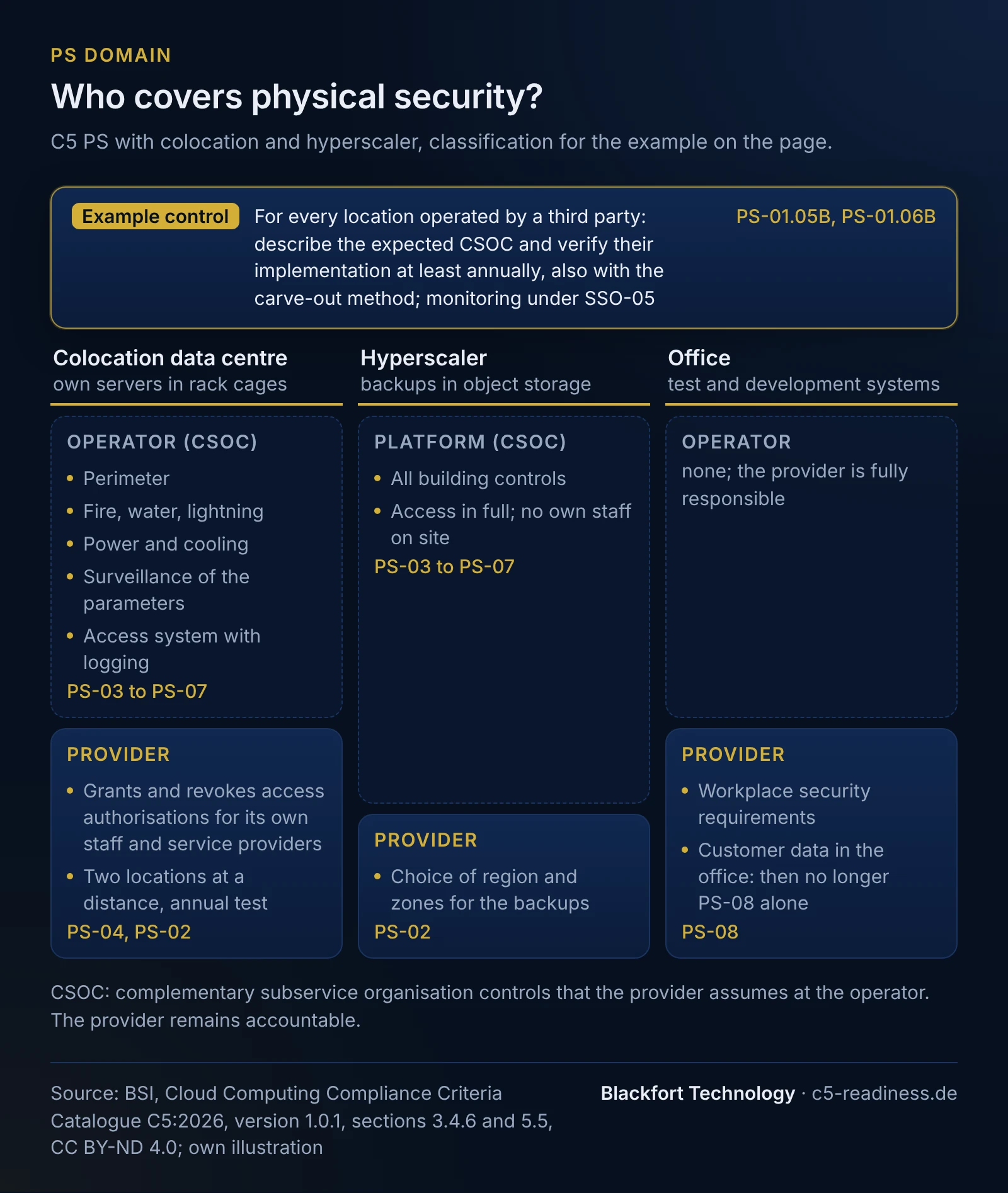
According to section 3.4.6, where data centres are operated by third parties it is generally to be assumed that a subservice organisation relationship exists, in particular for the criteria on physical security. This applies to colocation as much as to the infrastructure of a hyperscaler; the supplementary information on PS-01.05B explicitly names server housing, colocation and IaaS as examples of premises operated by third parties. In our classification, pure colocation is not itself a cloud service, because the definition in the catalogue requires self-service provisioning (section 1.2); according to the BSI FAQ, something that is not a cloud service cannot be the subject of a C5 audit of its own, but it can be considered in the audit of a cloud service. For you as the party renting the space, this means: the operator implements the building controls, and you describe and monitor them as complementary subservice organisation controls (CSOC), that is, the controls you assume at the subservice organisation; hardware and operation of the servers in the cage remain with you. The provider chooses whether to have the subservice organisation’s controls audited as well (inclusive method) or to exclude them (carve-out method); the basics are on the page C5 scope. Our classification for the example:
| Aspect | Provider | Platform (subservice organisation) | Customer (emergency medical service, district) |
|---|---|---|---|
| Building, perimeter, fire protection, utilities, environmental monitoring in the data centres (PS-03, PS-05, PS-06, PS-07) | describes the expected CSOC and verifies their implementation (PS-01.05B, PS-01.06B) | colocation operator and hyperscaler implement the controls; outside the audit with the carve-out method | - |
| Access to the rack cages (PS-04) | decides who among its own staff and service providers gets access, and has authorisations revoked | colocation operator runs the access control system and logs entries | - |
| Access at the hyperscaler | none; no own staff on site | complete | - |
| Redundancy model (PS-02) | defines the locations, plans the redundancy and tests it annually | provide the locations | ensures under the complementary customer criteria that the redundancy model and the evidence match its own availability requirements |
| Office with test and development systems (PS-08) | complete | - | - |
Commissioning, storage, transport and decommissioning of your own servers in the cage are covered by the AM domain (AM-06, AM-07, AM-10, AM-11). The complementary subservice organisation controls (CSOC; PS-01.05B speaks of “the complementary subservice organisation controls (CSOC) expected at the service organisations”) are controls that the provider assumes at the subservice organisation when designing its control system. With the carve-out method the auditor does not audit them itself, only whether the assumptions in the system description are fairly presented. Under 3.4.6 the provider remains accountable and monitors the subservice organisations under SSO, in particular SSO-05.
Responsibility matrix: which criterion lies with whom
The table above shows the boundary roughly. For the system description and the monitoring you need the mapping per criterion. This is how we set it up for the example; “Provider” means the control is part of your own control system and is audited even with the carve-out method, “CSOC” means you assume it at the operator and monitor it.
| Criterion | Colocation data centre | Hyperscaler (backups) | Office |
|---|---|---|---|
| PS-01 Security requirements | Provider: define requirements, describe and verify CSOC; CSOC: implementation in the building | Provider: describe and verify CSOC; CSOC: implementation | - |
| PS-02 Redundancy model | Provider: two locations at a distance, annual test | Provider: choice of region and zones for the backups | - |
| PS-03 Perimeter protection | CSOC | CSOC | - |
| PS-04 Access control | Provider: granting and revoking authorisations for its own staff and service providers, reconciliation of the lists; CSOC: access system, multi-factor authentication, logging, visitors | CSOC | - |
| PS-05 Protection against fire, water, lightning | CSOC | CSOC | - |
| PS-06 Power and utilities | CSOC; Provider: maintenance agreements for its own equipment in the cage, where PS-06.04AC is included | CSOC | - |
| PS-07 Surveillance of parameters | CSOC; Provider: receipt of alarms, where contractually provided for | CSOC | - |
| PS-08 Workplaces | - | - | Provider |
The matrix shows three things. First, PS-01 stays with the provider even with the carve-out method: PS-01.05B requires the document to describe the expected CSOC and the measures for monitoring them, PS-01.06B the verification of their implementation. Second, the redundancy model is an architecture decision of the provider. According to the supplementary information on PS-02, an architecture that provides the service simultaneously from more than two locations can represent an alternative fulfilment; whether two zones of a hyperscaler region meet the requirement for locations at an adequate distance is something you should assess and justify on the basis of the platform’s information. The definitions in section 1.2 help as a yardstick (a zone comprises at least two locations in close proximity, each location is exclusive to a single zone), as does the supplementary information on PS-02: the distance depends on the assessment of elementary risks at the site, and very extensive events such as floods or earthquakes are not considered. Third, granting access authorisations for your own staff remains your task, even though the operator runs the system.
The office is a special case: if customer data is processed or stored there, as with the copied call-out data in the example, PS-01 to PS-07 apply to the server room; according to the supplementary information on PS-01, the catalogue provides PS-08 for premises in which no customer data is processed or stored. We recommend keeping real customer data away from the test systems; DEV-07.03B in any case requires approval and anonymisation for customer data used in tests (see DEV).
Example control description for PS-01
Our example control for the provider above (own wording, not catalogue text):
| Field | Example |
|---|---|
| Control ID | K-PS-01-01 Verification of the data centre operators’ CSOC |
| Mapped to | PS-01.05B, PS-01.06B; monitoring under SSO-05 |
| Objective | For every location where customer data is processed or backed up, it is described which physical controls the provider assumes at the operator, and it is evidenced at least annually that the operator has implemented them. |
| Owner | Head of operations (execution); checked by the information security officer; purchasing (contractual rights to reports and site visits) |
| Trigger and frequency | annually per operator; additionally when a contract is concluded, when a location changes and when the operator reports a security incident |
| Execution | The CSOC list per location is derived from PS-03 to PS-07, for example an access system with logging and multi-factor authentication for areas with systems for customer data, a fire alarm system with reporting to the fire department, N+1 for power and cooling, annual tests of UPS and emergency power supply. The head of operations requests the current audit reports or certificates, maps the controls audited there to the CSOC list and documents which CSOC are evidenced, which are not and which period is covered. For CSOC that are not evidenced, the head of operations obtains supplementary evidence, for example a record of the emergency power supply tests, or plans a site visit. |
| Check | The information security officer checks the evaluation for completeness and ensures that deviations in the operators’ reports have been assessed. |
| Escalation | If a CSOC is not evidenced or the operator reports a deviation, this goes into the risk register as a risk; the risk owner decides on measures, for example a follow-up request or a change of location. |
| Evidence | CSOC list per location, operators’ reports and certificates with date, evaluation per operator, risk entries, contract clauses on reports and site visits |
How to evaluate the reports of subservice organisations as a whole and record them in the inventory is shown on the page Subservice inventory. Important for type 2: the evaluation must have taken place within the audit period, and the operator’s report should cover a period that matches yours.
What evidence the auditor wants to see
With the carve-out method the auditor does not look at the building controls itself. The auditor does, however, want to see the controls that remain with the provider. Examples from our scenario:
| Evidence | Criterion | Source | Owner | Timing |
|---|---|---|---|---|
| Security requirements for buildings and premises with security areas, derived from policy, protection needs and risk assessment | PS-01.01B, PS-01.02B | ISMS documentation | information security officer | version valid in the period |
| CSOC list and description of the monitoring per location | PS-01.05B | ISMS documentation, system description | head of operations | version valid in the period |
| Evaluation of the operators’ reports | PS-01.06B | evaluation record | head of operations | annual evaluation in the period |
| Redundancy concept and record of the switchover test | PS-02.01B to 03B | operations documentation, test record | head of operations | at least one test per year |
| Operators’ access lists reconciled with the staff and service provider list, revocation requests | PS-04.01B | operators’ lists, tickets | head of operations | every reconciliation in the period |
| Security requirements for the office based on a risk assessment | PS-08.01B | ISMS documentation | information security officer | version valid in the period |
An evidence register maps each subcriterion to its evidence; how to keep one is shown on the page Evidence and documentation.
Possible gaps: cause, effect, remedy
The following gaps follow from the wording of the criteria and the scenario above. If a single subcriterion is not met, the criterion counts as not met, and the auditor reports the deviation (sections 3.4.12 and 3.4.13).
| Possible gap | Cause | Effect | Remedy |
|---|---|---|---|
| CSOC not described | The provider relies on the operator’s certificate. | PS-01.05B requires the expected CSOC and the measures for monitoring them to be described; without them, the basis for the presentation in the system description is missing as well. | Derive the CSOC list per location from PS-03 to PS-07. |
| Operators’ reports not evaluated | Reports never requested. | PS-01.06B requires verification of the implementation of the CSOC under SSO-05. | Contractual right to reports, annual evaluation as in K-PS-01-01. |
| Outdated access authorisations | The operators’ lists are not reconciled. | PS-04.01B requires a specified procedure for granting and modifying authorisations and their revocation after two months without use, with exceptions only through the process under SP-03. | Quarterly reconciliation with the staff and service provider list, departures as the trigger for revocation requests. |
| Redundancy not tested | Test only at setup. | PS-02.03B requires the effectiveness of the redundancy to be checked at least annually by tests and exercises. | Combine the annual switchover test with the business continuity test under BCM-04 (see BCM). |
| Customer data in the office server room | Copies of real data for troubleshooting. | The room then falls under PS-01 to PS-07, which an office does not meet. | Only anonymised test data, troubleshooting in production with logged access. |
All criteria of the PS domain
Titles as in the English version 1.0.1, number of subcriteria counted per section 5 (B = basic, AS = sharpening, AC = complementing). The column “What it covers” is our own short description, not catalogue text; the wording of the criteria in the catalogue is binding.
| ID | Title (catalogue) | B/AS/AC | What it covers |
|---|---|---|---|
| PS-01 | Physical Security and Environmental Control Requirements | 6/0/5 | Security areas, requirements for data centres derived from risks and, for data centres operated by third parties, the expected CSOC and their verification. |
| PS-02 | Redundancy Model | 3/2/0 | Operation from at least two locations at an adequate distance, designed for the availability commitments, tested annually. |
| PS-03 | Perimeter Protection | 6/0/1 | Structural shell and security measures against break-ins, with a minimum resistance time. |
| PS-04 | Physical Site Access Control | 3/0/0 | Electronic access control with a granting procedure, revocation of unused authorisations, multi-factor authentication for system rooms, logging and rules for visitors. |
| PS-05 | Protection against Threats from Outside and from the Environment | 4/0/0 | Structural, technical and organisational measures against fire, smoke, lightning and water. |
| PS-06 | Protection against Interruptions caused by Power Failures and similar Risks to Supply Facilities | 3/0/4 | Redundant power and cooling supply, tested UPSes and emergency power supplies, maintenance and protection of the lines. |
| PS-07 | Surveillance of Operational and Environmental Parameters | 2/0/0 | Monitoring of utilities and environment with automatic alerting. |
| PS-08 | Workplace Security Requirements | 1/0/0 | Security requirements for offices based on a risk assessment. |
The additional criteria are aimed mainly at data centre operators, for example PS-01.02AC (self-sufficient operation of a location for at least 72 hours in the event of a failure of the external power supply), PS-02.01AS (more than two locations, so that a third remains if two locations fail) and PS-03.01AC (permanently present security personnel, video surveillance and anti-burglary systems). If a customer requires them, with data centres operated by third parties they mainly affect your CSOC.
Relationship to ISO/IEC 27001:2022 Annex A
The following mapping is our own, unofficial classification by topic. The BSI has not yet published a cross-reference for C5:2026. The catalogue refers to the BSI website for it (section 3.3). So far the table there covers C5:2020 only, and the BSI says the table for C5:2026 is “scheduled for publication in the near future” (as of 6 November 2026). According to the catalogue, even an official table only shows thematic proximity, not fulfilment of the criteria (section 3.3). The short labels are ours, not titles from the standard. What you can reuse from a certified ISMS as a whole is shown on the page C5 and ISO 27001.
| C5:2026 | ISO/IEC 27001:2022 Annex A | Topic (short label) | What C5 additionally requires in concrete terms (our assessment) |
|---|---|---|---|
| PS-01, PS-03 | A.7.1 | Security areas and perimeter | Description and verification of the CSOC, minimum resistance time |
| PS-02 | A.8.14 | Redundancy | at least two locations at a distance, annual test |
| PS-04 | A.7.2, A.7.6 | Access | revocation after two months without use, multi-factor authentication for system rooms |
| PS-05 | A.7.5 | Environmental threats | fire resistance of 90 minutes or equivalent measures, fire alarm reporting to the fire department |
| PS-06 | A.7.11, A.7.12, A.7.13 | Utilities, cabling, maintenance | N+1, annual tests, check of the lines at least every two years |
| PS-07 | A.7.4, A.7.11 | Monitoring | automatic alerting when the control range is exceeded |
| PS-08 | A.7.3, A.7.7 | Offices and workplaces | requirements explicitly based on a risk assessment |
Frequently asked questions
Do I have to implement PS if my service runs at a hyperscaler?+
Is a colocation data centre a subservice organisation?+
Is the data centre’s ISO 27001 certificate sufficient as evidence?+
Do I need two data centres?+
Does PS also apply to my office?+
Read more
- C5 criteria catalogue: structure, basic and additional criteria
- C5 scope: service boundary, platform reports, carve-out
- C5 for data centres and hosting: attestation for IaaS and colocation
- C5 AM: asset management and asset inventory under C5:2026
- C5 subservice inventory: example and report review
- C5 SSO: controlling and monitoring service organisations under C5:2026
- C5 BCM: business continuity and restore tests under C5:2026
- C5 system description: minimum content, structure and example
- C5 readiness assessment: gap analysis, action plan and timeline
Sources
- BSI: C5:2026 web page with downloads (German) (retrieved 2026-11-06)
- BSI: C5:2026 web page with downloads (retrieved 2026-11-06)
- BSI: Kriterienkatalog Cloud Computing C5:2026, version 1.1.0 (PDF, German), sections 1.2, 3.3, 3.4.6, 3.4.12, 3.4.13 and 5.5 (PS-01 to PS-08), licensed under CC BY-ND 4.0 (retrieved 2026-11-01)
- BSI: Cloud Computing Compliance Criteria Catalogue C5:2026, version 1.0.1 (PDF), sections 1.2, 3.3, 3.4.6, 3.4.12, 3.4.13 and 5.5, licensed under CC BY-ND 4.0 (retrieved 2026-11-01)
- BSI: C5 FAQ (German), question “Kann nur ein Cloud-Dienst ein C5-Testat erhalten?” (can only a cloud service receive a C5 attestation?) (retrieved 2026-11-01)
- BSI: C5:2026 overview page with downloads (German) (retrieved 2026-11-01)
This content provides general technical and organisational information and does not constitute legal advice (no legal services within the meaning of the German RDG).