

Last updated: 2026-11-06
This page covers the PSS domain (Product Safety and Security) of C5:2026, section 5.17 of the catalogue. How criteria and subcriteria are structured in general is explained on the page C5 criteria catalogue.
What is the PSS domain about?
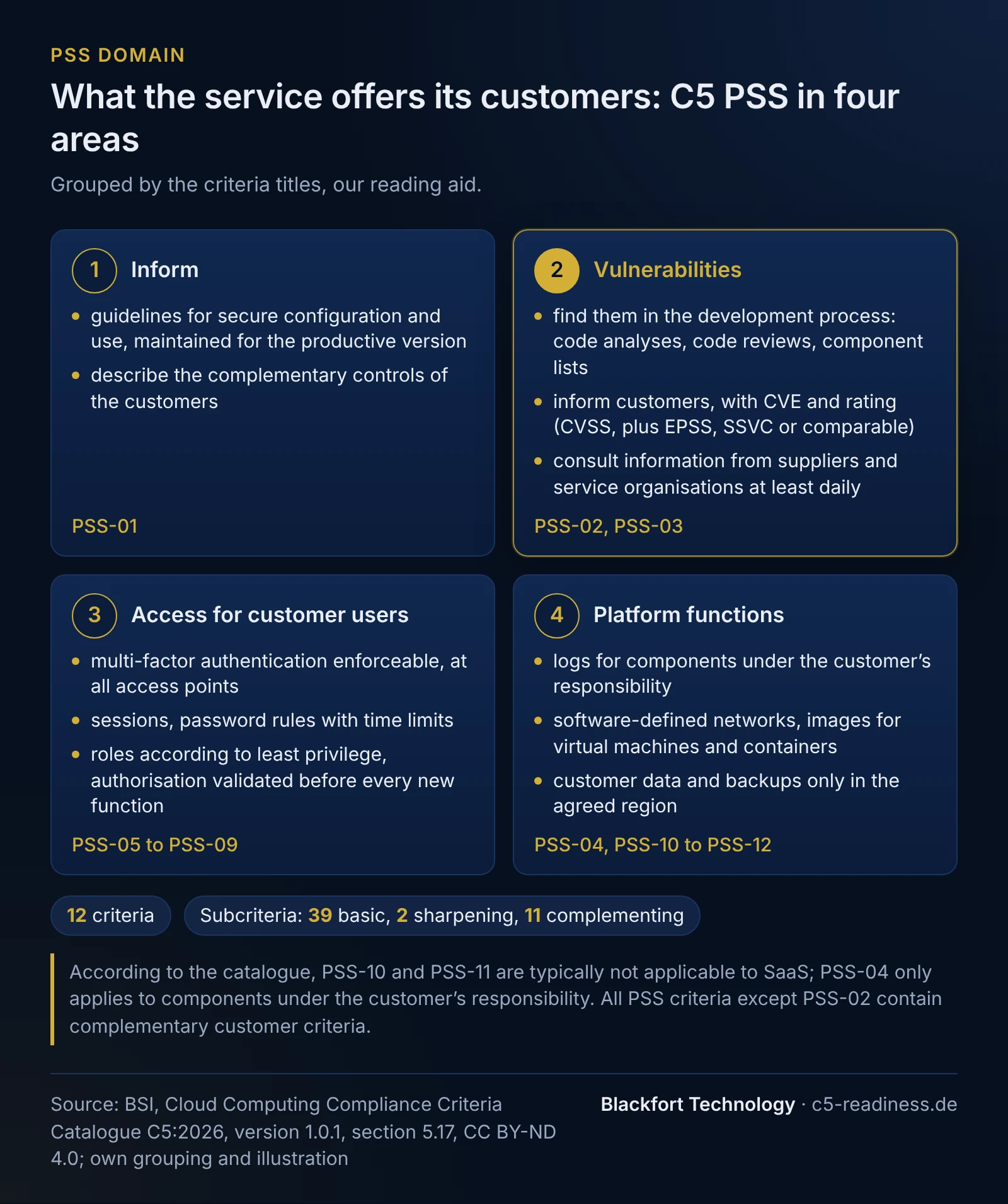
PSS looks at what the service delivers to its customers. The catalogue states the objective as providing customers with up-to-date information on secure configuration and known vulnerabilities, as well as appropriate mechanisms for troubleshooting and logging and for the authentication and authorisation of the customers’ users (section 5.17). How the provider’s own personnel log in and which rights they have is governed by the IAM domain.
The domain comprises twelve criteria, PSS-01 to PSS-12, with 39 basic subcriteria, 2 sharpening and 11 complementing additional subcriteria. All twelve already existed with the same number in C5:2020, but several have been tightened considerably. According to the BSI change history, PSS-05 now requires multi-factor authentication instead of “strong” authentication, PSS-03 requires suppliers’ vulnerability information to be consulted at least daily, and PSS-12 requires the provider’s service organisations to adhere to the selected region as well.
Starting point: a SaaS provider with a web application, an API and an app
Fictitious example, not a client. A provider runs management software for insurance brokers as SaaS: client files, contracts, claims and commissions. It includes a web application, an application programming interface (API) for comparison calculators and a mobile app that the brokers install on their own devices. The service runs in a German region of a large cloud service provider.
Before the project, the situation looks like this:
- There is a help page with user manuals. It contains no security guidance, for example on assigning roles or on the customers’ obligations.
- A tool in the pipeline finds vulnerabilities in libraries. Customers learn nothing about them, not even when a vulnerability in the app is not fixed.
- Users can switch on multi-factor authentication themselves. A brokerage cannot make it mandatory for its staff.
- Password reset links are valid for seven days.
- According to the platform setting, the backups are stored in a second region in another European country; the contract only mentions “data centres in Germany”.
Who is responsible for what: provider, platform, customer?
PSS describes what the provider delivers to its customers; eleven of the twelve criteria therefore have a customer side. The platform in the example is a subservice organisation. Our classification for the example:
| Aspect | Provider | Platform (subservice organisation) | Customer (brokerage) |
|---|---|---|---|
| Guidelines for secure use | publishes and maintains them for the productive version (PSS-01) | - | derives its own rules for configuration and use from them and checks compliance with them |
| Vulnerabilities in the service and in the app | finds them in the development process and informs customers (PSS-02, PSS-03) | publishes vulnerability information on its services, which the provider consults at least daily | takes the information into its risk management and updates the app on its devices |
| Logs for customers | provides logging for components under the customer’s responsibility, where applicable (PSS-04) | - | activates and configures it according to its own requirements |
| Authentication, sessions, passwords, roles of customer users | provides the mechanisms (PSS-05 to PSS-09) | - | enforces multi-factor authentication, assigns and reviews roles, sets the session duration |
| Region of data processing | ensures through architecture and contract that customer data and backups stay in the agreed region (PSS-12) | also adheres to the selected region | selects the region according to its own requirements |
All PSS criteria except PSS-02 contain complementary customer criteria. PSS-01.03B additionally requires the user documentation to describe all necessary complementary user entity controls (CUECs). The same list belongs in the system description as complementary customer controls (CUEC); how to agree them with customers is shown on the page Complementary customer criteria. The auditor does not test these controls at the customer, only whether they are fairly presented.
Which PSS criteria apply to a SaaS service?
Not every PSS criterion fits every service model. The catalogue says so itself in the supplementary information:
- PSS-10 Software Defined Networking and PSS-11 Images for Virtual Machines and Containers: each criterion “is typically not applicable to the SaaS service model”; they concern services with which customers run their own networks, machines or containers. How the provider separates customers from one another is shown on the page Tenant separation, how it operates its own container platform in an auditable way on the page Containers and Kubernetes.
- PSS-04 Error handling and Logging Mechanisms only applies to system components under the responsibility of the customer. For SaaS services their number may be so limited that the criterion is not applicable.
- PSS-12 Region of Data Processing and Storage does not require offering multiple regions or partitions; a provider that offers only one partition does not deviate from the criterion.
You exclude a criterion that is not applicable with a justification; according to minimum content item 4, the justification belongs in the system description. According to section 3.4.3 it may only be based on the nature and design of the service or on the provider’s principles, procedures and measures, never on controls being missing or ineffective. For the example, the description states: customers do not operate their own networks, machines or containers, so PSS-10 and PSS-11 are not applicable. PSS-04 deserves a closer look, because with the mobile app and the roles of the customer administrators the example has areas that the customer controls itself.
According to the catalogue, PSS-12 supplements the general condition GC-01, in which you state countries, regions and locations, see General conditions; for customers with sovereignty requirements it is, according to the catalogue, a prerequisite for technical service sovereignty, see C3A.
Example control description for PSS-03
PSS-03 requires a coordinated process through which customers receive regularly updated information about known vulnerabilities associated with the service: known exploited vulnerabilities, those with a patch or mitigating measure (N-Day) and those for which the provider is unlikely to provide a patch (Forever-Day), with a justification (PSS-03.01B). This also applies to assets that customers have to install themselves, in the example the app. The vulnerabilities are presented with CVE references and with assessments based on CVSS and on EPSS, SSVC or a similar metric (PSS-03.04B), and the provider consults the vulnerability information of its suppliers and service organisations at least daily (PSS-03.05B). Our example control for the provider above (own wording, not catalogue text):
| Field | Example |
|---|---|
| Control ID | K-PSS-03-01 Vulnerability information for customers |
| Mapped to | PSS-03.01B to PSS-03.05B; handling under OPS-18 |
| Objective | Customers can always find an up-to-date list of the known vulnerabilities in the service and the app with rating and remedy; new information from suppliers is assessed by the next day at the latest. |
| Owner | head of product security (execution); checked by the information security officer |
| Trigger and frequency | daily automatic retrieval of the security advisories of the platform and the suppliers; event-driven for every new finding from the pipeline, the component list (SBOM) or an external report |
| Execution | A tool matches the component list of the service and the app against the advisories every day and creates a ticket for every match. Product security assesses the impact on the service, adds CVSS and EPSS and decides on remediation, mitigation or justified non-remediation. Every vulnerability affecting customers appears in the security section of the customer portal with CVE, rating, status and remedy; for the app, with the version that fixes it. |
| Check | The tool reports when a daily retrieval does not take place. Every month the information security officer compares open tickets affecting customers with the entries in the portal and, for Forever-Day vulnerabilities, checks the justification. |
| Escalation | If a retrieval fails for two days or a supplier does not provide daily information, the related risk is managed under OIS-07, as PSS-03.05B provides. |
| Evidence | Log of the daily retrievals, tickets with assessment, versions of the portal page, review records of the information security officer |
According to the supplementary information on PSS-03.03B, the component list does not have to be handed over to customers; it serves to identify vulnerabilities. Whether the control covers all subcriteria is for the auditor to assess; for a type 2 report the auditor also tests whether it operated effectively throughout the period.
What evidence the auditor wants to see
Much of the PSS evidence consists of properties of the product: configurations, functions, published documents. The auditor wants to see them for the version that was in productive use in the period. Examples from our scenario:
| Evidence | Criterion | Source | Owner | Timing |
|---|---|---|---|---|
| Guidelines for secure use with the complementary controls of the customers | PSS-01.01B to PSS-01.04B | help and security section of the customer portal | product management | versions in the period, aligned with the productive version |
| Results of code analyses and code reviews | PSS-02.01B to PSS-02.03B | pipeline, version control | development | sample of changes in the period |
| Vulnerability list for customers and retrieval logs | PSS-03.01B to PSS-03.05B | customer portal, software composition analysis tool | product security | ongoing, sample of days in the period |
| Configuration of the enforceable multi-factor authentication | PSS-05.01B, PSS-05.02B | product documentation, test account | development | state in the period, changes in between |
| Session and password rules with time limits | PSS-06.02B, PSS-07.01B | configuration, test evidence | development | state in the period |
| Role model for customer users and review function for rights | PSS-08.01B to PSS-08.04B | product documentation | product management | state in the period |
| Validation of authorisation before new functions are released | PSS-09.02B | test reports in the change process | development | sample of releases in the period |
| Region settings of storage and backups, contract clause | PSS-12.01B to PSS-12.04B | configuration export of the platform, contract template | operations, contract management | state at the beginning and end of the period |
An evidence register records which evidence belongs to which subcriterion; how to maintain one is shown on the page Evidence and documentation.
Possible gaps: cause, effect, remedy
The following gaps follow from the wording of the criteria and the scenario above. If a single subcriterion is not met, the criterion counts as not met, and the auditor reports the deviation (sections 3.4.12 and 3.4.13).
| Possible gap | Cause | Effect | Remedy |
|---|---|---|---|
| No security guidelines for customers | The documentation explains how to operate the service, not how to configure it securely. | PSS-01.02B names 16 aspects that the guidelines address where applicable; PSS-01.03B requires a description of all complementary controls of the customers. | Build a security section in the portal along these aspects, reconcile the list of customer controls with the system description. |
| Customers learn nothing about vulnerabilities | Vulnerabilities are fixed internally but not published. | PSS-03.01B requires information on known vulnerabilities, including those without a patch; PSS-03.04B their presentation with CVE and rating. | A vulnerability list in the portal as in the control above. |
| Multi-factor authentication cannot be enforced | Users can switch it on, the customer cannot make it mandatory. | PSS-05.01B requires mechanisms that can force multi-factor authentication, at all access points; PSS-05.02B that the customer can enforce it for privileged users. | A setting for customer administrators that makes multi-factor authentication mandatory for all or selected roles, including for the app and the API. |
| Reset links valid for too long | The validity was extended for convenience. | PSS-07.01B no. 3 limits password reset procedures to at most 48 hours; initial passwords lose their validity after a maximum of 14 days. | Limit the periods technically, inform users about every change or reset. |
| Backups outside the agreed region | Default setting of the platform for geo-redundancy. | PSS-12.01B requires that customer data and its backups are processed and stored only in the region specified in the contract. | Adjust the region of the backups or change the contract and the customer information; announce changes of region in advance under PSS-12.04B. |
How to put these gaps in order together with those of other domains is shown on the page Prioritising measures. Product changes such as enforceable multi-factor authentication need a release before the audit period begins.
All criteria of the PSS domain
Titles as in the English version 1.0.1, number of subcriteria counted per section 5 (B = basic, AS = sharpening, AC = complementing). The column “What it covers” is our own short description, not catalogue text; the wording of the criteria in the catalogue is binding.
| ID | Title (catalogue) | B/AS/AC | What it covers |
|---|---|---|---|
| PSS-01 | Guidelines and Recommendations for Cloud Service Customers | 4/0/1 | Published guidance on secure configuration and use, with the complementary controls of the customers. |
| PSS-02 | Identification of Vulnerabilities of the Cloud Service | 3/0/1 | Code analyses, code reviews and checks of component lists in the development process. |
| PSS-03 | Informing Customers about Known Vulnerabilities | 5/0/2 | Vulnerability information with CVE and rating for customers, daily retrieval from suppliers. |
| PSS-04 | Error handling and Logging Mechanisms | 6/0/1 | Logs for components under customer responsibility that the customer can control and evaluate. |
| PSS-05 | Authentication Mechanisms | 2/0/1 | Enforceable multi-factor authentication at all access points for the customers’ users. |
| PSS-06 | Session Management | 2/0/0 | Session management according to the state of the art, invalidation on inactivity. |
| PSS-07 | Confidentiality of Authentication Information | 3/0/0 | Password rules with time limits, secure storage and verified distribution of credentials. |
| PSS-08 | Roles and Rights Framework | 4/0/0 | Role model for customer users based on least privilege and segregation of duties, with a review function. |
| PSS-09 | Authorisation Mechanisms | 3/0/1 | Access controls on all functions, validated before every new or changed function. |
| PSS-10 | Software Defined Networking | 2/0/0 | Confidentiality in software-defined networks, typically not applicable to SaaS. |
| PSS-11 | Images for Virtual Machines and Containers | 1/0/2 | Approved, labelled and hardened images, typically not applicable to SaaS. |
| PSS-12 | Region of Data Processing and Storage | 4/2/2 | Customer data and backups only in the agreed region, including at service organisations. |
Additional subcriteria with an effect on sales include PSS-01.01AC (timely notification about planned modifications to the service), PSS-03.02AC (disclosure of vulnerabilities in accordance with the Common Security Advisory Framework version 2.0 or higher and the BSI Technical Guideline TR-03191), PSS-12.01AS (cloud service derived data only in the region as well) and PSS-12.01AC and PSS-12.02AC (selectable partitions in which identity management, privileged access, logging and keys also remain).
Relationship to ISO/IEC 27001:2022 Annex A
ISO/IEC 27001 governs the ISMS of your own organisation; PSS, by contrast, requires functions and information that the service offers to its customers. The following mapping therefore only shows thematic proximity and is our own, unofficial classification. The BSI has not yet published a cross-reference for C5:2026. The catalogue refers to the BSI website for it (section 3.3). So far the table there covers C5:2020 only, and the BSI says the table for C5:2026 is “scheduled for publication in the near future” (as of 6 November 2026). According to the catalogue, even an official table only shows thematic proximity, not fulfilment of the criteria (section 3.3). The short labels are ours, not titles from the standard.
| C5:2026 | ISO/IEC 27001:2022 Annex A | Topic (short label) | What C5 additionally requires in concrete terms (our assessment) |
|---|---|---|---|
| PSS-01 | no direct counterpart; thematically A.5.37 | Documented procedures | published guidelines for customers with all complementary controls |
| PSS-02, PSS-03 | A.8.8, A.8.25, A.8.28, A.8.29 | Vulnerabilities, secure development and testing | informing customers with CVE, CVSS and EPSS or SSVC, daily retrieval from suppliers |
| PSS-04 | A.8.15 | Logging | logs for customers, controllable and deletable by the customer |
| PSS-05 to PSS-07 | A.5.17, A.8.5 | Authentication procedures and credentials | enforceable multi-factor authentication for customer users, periods of 14 days and 48 hours |
| PSS-08, PSS-09 | A.5.15, A.8.3, A.8.26 | Access control, application requirements | role model for customers, validation of authorisation before every new function |
| PSS-10, PSS-11 | A.8.9, A.8.22 | Configuration, network segregation | functions for customers who operate their own networks, machines or containers |
| PSS-12 | no direct counterpart | - | region through architecture and contract, advance information on changes |
Frequently asked questions
What is the difference between PSS and IAM?+
Do I have to enforce multi-factor authentication for all customer users?+
Do I have to hand over my SBOM to customers?+
How often do I have to check my suppliers’ vulnerability information?+
Do I have to offer multiple regions?+
Read more
- C5 criteria catalogue: structure, basic and additional criteria
- C5 IAM: identity and access management under C5:2026
- C5 OPS: making operations audit-ready under C5:2026
- C5 DEV: development and change management under C5:2026
- BSI C3A: sovereignty criteria for cloud services explained
- C5 general conditions: getting GC-01 to GC-06 right
- C5 tenant separation: evidencing separation of customer data
- C5 Kubernetes: running a container platform ready for audit
- C5 complementary customer criteria and CUEC explained
- C5 system description: minimum content, structure and example
- C5 readiness assessment: gap analysis, action plan and timeline
Sources
- BSI: C5:2026 web page with downloads (German) (retrieved 2026-11-06)
- BSI: C5:2026 web page with downloads (retrieved 2026-11-06)
- BSI: Kriterienkatalog Cloud Computing C5:2026, version 1.1.0 (PDF, German), licensed under CC BY-ND 4.0 (retrieved 2026-11-01)
- BSI: Cloud Computing Compliance Criteria Catalogue C5:2026, version 1.0.1 (PDF), section 5.17 PSS-01 to PSS-12 with supplementary information, sections 3.3, 3.4.3, 3.4.12 and 3.4.13, licensed under CC BY-ND 4.0 (retrieved 2026-11-01)
- BSI: C5:2026 change history (Excel), sheet “Change History”, PSS-01 to PSS-12 (retrieved 2026-11-01)
- BSI: C5:2026 overview page with downloads (German) (retrieved 2026-11-01)
This content provides general technical and organisational information and does not constitute legal advice (no legal services within the meaning of the German RDG).