
Last updated: 2026-11-06
This page covers the BCM domain (Business Continuity Management) of C5:2026, section 5.14 of the catalogue. How criteria and subcriteria are structured in general is explained on the page C5 criteria catalogue.
What is the BCM domain about?
BCM requires the provider to analyse outages of its service in advance, to have plans for them and to test these plans regularly. With four criteria, BCM-01 to BCM-04, it is one of the smallest domains in C5:2026: ten basic subcriteria and four complementing additional subcriteria; there are no sharpening ones. According to the BSI change history, no BCM criterion is without a predecessor in C5:2020. The restore tests of the data backup are in the OPS domain (OPS-08), but belong here in substance, because they show whether your recovery objectives can be achieved.
Starting point: a SaaS provider whose outage is noticed immediately
Fictitious example, not a client. A provider runs inventory management with point-of-sale integration for pharmacies as SaaS. Through it, the pharmacies order from wholesalers, book incoming goods and sell at the till; pharmacies on emergency duty also work at night. The service runs on a cloud platform in one region with several availability zones, and the data backup goes daily to a second region. There is an emergency manual, but the team has never rehearsed a complete recovery in the second region. In tenders, customers ask for the C5 attestation and for the recovery times.
Who is responsible for what: provider, platform, customer?
The provider is responsible for the continuity of its service, even if the platform supplies part of the resilience. Customers, for their part, have to plan for an outage of the service; for this the catalogue lists complementary customer criteria for BCM-02, BCM-03 and BCM-04.
| Aspect | Provider | Platform (subservice organisation) | Customer (pharmacy) |
|---|---|---|---|
| BCM system and business impact analysis | defines policy, roles and methodology, analyses impacts and dependencies (BCM-01, BCM-02) | - | takes an outage of the service into account in its own analysis |
| Plans and recovery | plans the recovery of the service in the second region (BCM-03) | provides data centres, zones and platform services as described in the platform report | compares recovery time and data loss with its own requirements, plans an emergency procedure at the till |
| Tests | tests the plans at least annually and involves relevant third parties (BCM-04) | takes part in tests as a relevant third party; monitoring under SSO-05, see SSO | takes part in tests where agreed |
| Data backup and restore tests | backs up, tests the restore and disposes of the test data (OPS-08) | provides storage in the second region | - |
| Information during an outage | informs the pharmacies about the outage, emergency operation and recovery | - | - |
If your service relies on such precautions at the customer, describe them as complementary customer controls (also called complementary user entity controls, CUEC) in the system description; the complementary customer criteria in the catalogue are general notes. More on this on the page Complementary customer criteria.
How do the four BCM criteria fit together?
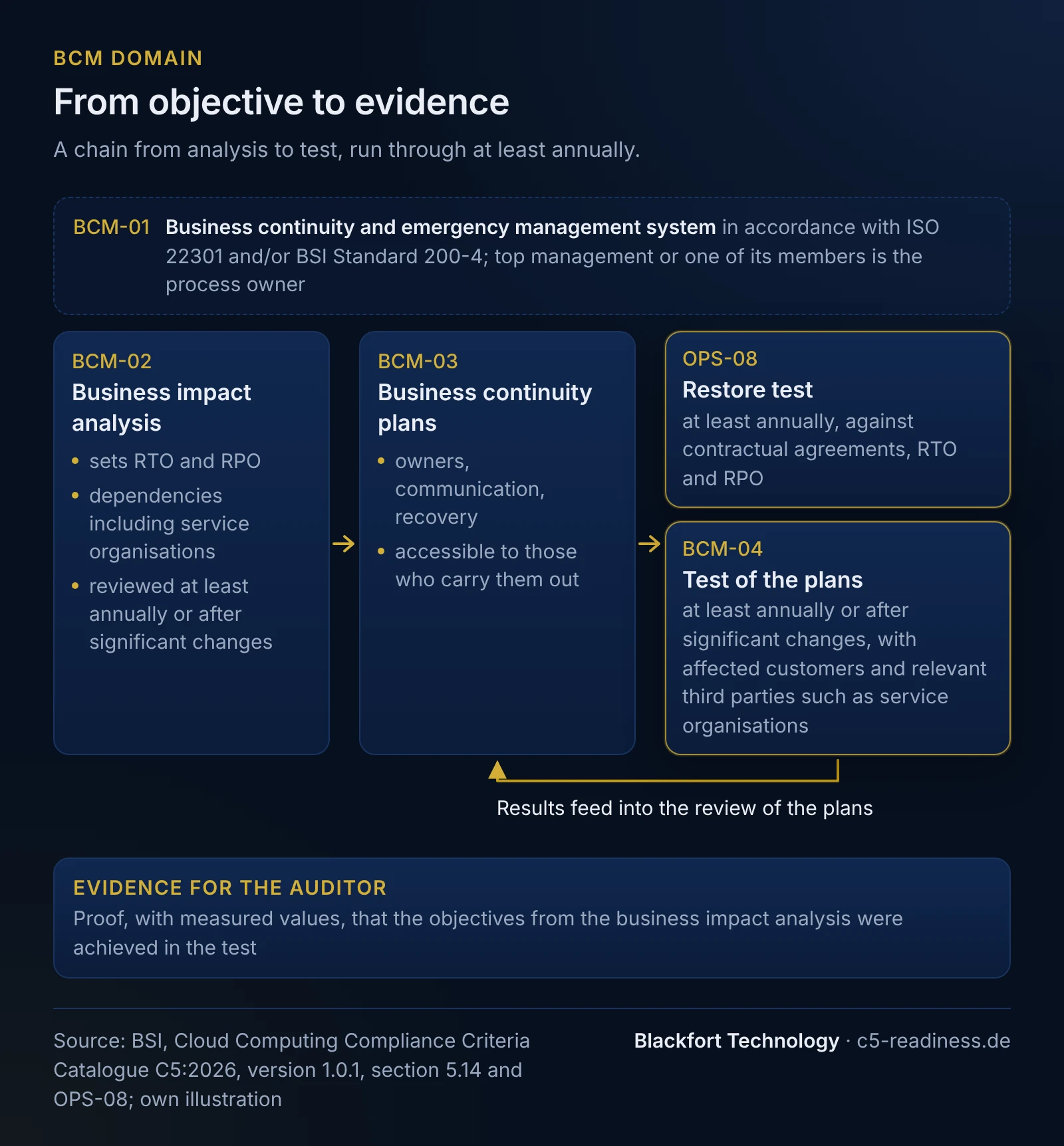
As a chain from analysis to test that is run through at least annually. The list is our summary; the wording of the criteria in the catalogue is binding.
- BCM-01, the system: A business continuity and emergency management system in accordance with ISO 22301 and/or BSI Standard 200-4, with documented policies. A certificate under ISO 22301 can fulfil the basic criterion, but is not required. Top management or one of its members is named as the process owner; the responsibility may be delegated to a person who can steer the business continuity strategy for the whole service just as well.
- BCM-02, the analysis: The business impact analysis determines, among other things, critical products, dependencies including service organisations, the maximum tolerable period of downtime, the recovery time objective (RTO) and the maximum permissible data loss (RPO). Review at least annually or after significant changes.
- BCM-03, the plans: The analysis results in plans with designated owners, communication channels including notification of the customers, recovery procedures and interim solutions. The plans must be accessible to the people who are to carry them out.
- BCM-04, the tests: The plans are tested, documented and evaluated at least annually or after significant changes. Affected customers and relevant third parties, for example service organisations, are involved.
According to the supplementary information on BCM-04, a customer is “affected” if the test pushes the service below the level agreed in the SLA or if the plans can only be tested by the customer taking action. In our understanding, a test in a separate environment that neither restricts the customers nor requires them to act therefore does not need customer involvement. BCM is also linked with service organisations through SSO-06: exit strategies for service organisations with a very high dependency have to be aligned with the business continuity plans.
Recovery and restore evidence: BCM-04 and OPS-08 together
Proof, with measured values, that the objectives from the business impact analysis were achieved in the test. Two types of test complement each other:
| Business continuity test (BCM-04) | Restore test of the data backup (OPS-08) | |
|---|---|---|
| Subject | Business continuity plans, for example recovery of the service after the loss of a region | Restore procedures for backed-up data |
| Frequency under the catalogue | at least annually or after significant changes | regularly, at least annually |
| What it is meant to show | that the plans work; results feed into the review of the plans | whether contractual agreements, RTO and RPO are adhered to |
| Special rules | involvement of affected customers and relevant third parties | restore customer data only in environments with the same access restrictions as production; documentation including the safe disposal of the restored data; report deviations to the responsible personnel |
The complementing subcriterion OPS-08.02AC requires restore tests to be part of business continuity management; even without this additional criterion we recommend keeping both tests in one test plan. If the data backup is not contractually agreed with the customers, OPS-08 is not applicable; you present this in the system description. Policy and monitoring of the data backup (OPS-06, OPS-07) are covered on the page OPS.
In an initial engagement, a disaster recovery test that has not yet been carried out can also be evidenced through records of the planning or templates for the documentation (section 3.4.11); see Type 1 or type 2. You also provide your recovery parameters such as RTO, RPO and minimum business continuity objective to the customers’ subject matter experts on request, and the system description states where this information can be found (general condition GC-03). If contractual availability commitments were missed in the type 2 period or the data backup failed, this belongs in the system description as a significant event, see Significant changes and events.
Example control description for BCM-04
This is how the annual recovery test in the example could be described; the template is our own wording, not catalogue text. The values for RTO and RPO are invented.
| Field | Example |
|---|---|
| Control ID | K-BCM-04-01 |
| Mapped to | BCM-04.01B, BCM-04.02B; supports BCM-03.02B. The quarterly restore tests under OPS-08 are covered by a separate control (K-OPS-08-01). |
| Objective | Recovery of the service in the second region succeeds within the RTO of four hours with data that is no more than one hour old (RPO), as defined in the business impact analysis. |
| Owner | Business continuity manager (control owner, appointed by management as process owner); execution by the head of operations |
| Trigger and frequency | annually in the second quarter according to the test plan; additionally after significant changes, for example a change of database technology or a new region |
| Execution | Scenario from the business impact analysis: loss of the primary region. The team builds the service in the second region from infrastructure code and data backup and measures the time to emergency operation, the time to normal operation and the age of the restored data. The platform provider is involved through an announced support case. Two pilot pharmacies check emergency operation from the customer’s perspective; all customers are informed in advance because the test runs in an announced maintenance window. |
| Check | The test report compares target and actual values for RTO and RPO. Management accepts it. Actions go into the action register with a deadline. |
| Escalation | If RTO or RPO is missed, the head of operations revises the plan within 60 days and repeats the affected part of the test. If a contractual commitment is affected, management decides on informing the customers. |
| Evidence | Test plan, announcement to customers and platform provider, record with timestamps and measured values, list of participants, acceptance, measures, revised plan |
What evidence the auditor wants to see
Documents that refer to each other, and test records with measured values. Our overview for the example:
| Evidence | Criterion | Source | Owner | Timing |
|---|---|---|---|---|
| BCM policy with objectives, roles, scope and methodology; designation of the process owner | BCM-01 | ISMS or BCM document repository, management resolution | business continuity manager | version valid in the period |
| Business impact analysis with RTO, RPO and dependencies | BCM-02 | BCM documentation | business continuity manager with the business units | review at least annually, date visible |
| Business continuity plans with owner and approval | BCM-03 | emergency manual, accessible outside the affected systems | plan owner | review at least annually |
| Test plan, test records, evaluation, actions | BCM-04 | test documentation, action register | head of operations | at least one test in the period |
| Restore tests with measured values and evidence of disposal | OPS-08 | test records, tickets | head of operations | at least annually, quarterly in the example |
| Announcements of tests to customers and service organisations | BCM-04 | emails, status page, support case | customer service | per test |
| Exit strategy for the cloud platform, aligned with the plans | SSO-06.02B | BCM documentation | head of operations | valid version |
How to keep this evidence in a register is shown on the page Evidence and documentation.
Possible gaps: cause, effect, remedy
We derive the gaps from the requirements of the catalogue; they are not auditor findings.
| Possible gap | Cause | Effect | Remedy |
|---|---|---|---|
| RTO in the contract, in the analysis and in the test do not match | sales, operations and BCM set values independently of each other | the test does not show whether the commitment to customers can be achieved; OPS-08.02B requires exactly this assessment | set one value per service in the business impact analysis, derive contracts and information under GC-03 from it, measure it in the test |
| Restore test only for the database | the test restores a database snapshot in a test environment | whether the whole service runs within the target time with keys, configuration and network remains open | test a complete recovery annually, with shorter restore tests in between |
| Restored customer data remains in a test account | test environment with broader access rights, no clean-up step | OPS-08.03B and OPS-08.04B not met, customer data outside the production access rights | target environment with the same access restrictions as production, disposal as a mandatory step in the record |
| Emergency manual exists only in the wiki of the affected system | documentation in the same cloud environment as the service | in an outage the plans are not accessible (BCM-03.01B no. 2) | copy outside the platform, synchronised regularly, used in the test |
| Outage of a service organisation missing from the analysis | the analysis only considers own systems | dependencies under BCM-02.01B no. 3 incomplete, no exit strategy under SSO-06 | take service organisations from the directory under SSO-04 into the analysis, add the scenario “loss of a service organisation” |
All criteria of the BCM domain
Titles as in the English version 1.0.1, number of subcriteria counted per section 5 (B = basic, AS = sharpening, AC = complementing). The column “What it covers” is our own short description, not catalogue text; the wording of the criteria in the catalogue is binding.
| ID | Title (catalogue) | B/AS/AC | What it covers |
|---|---|---|---|
| BCM-01 | Business Continuity and Emergency Management System | 4/0/0 | The management system for continuity with policies, a process owner from top management and visible commitment of leadership. |
| BCM-02 | Business Impact Analysis | 2/0/0 | Analysis of the consequences of disruptions with objectives for recovery and data loss. |
| BCM-03 | Business Continuity Plans | 2/0/0 | Plans that follow from the analysis, with responsible persons, communication and recovery procedures. |
| BCM-04 | Testing Business Continuity | 2/0/4 | Regular tests of the plans involving affected customers and third parties; as additional criteria, exercises and customer information on tests. |
Closely related, but in other domains: data backup and recovery OPS-06 to OPS-09 (OPS), exit strategies SSO-06 (SSO) and the information on recovery parameters in general condition GC-03. Security incident management is covered by the SIM domain.
Relationship to ISO/IEC 27001:2022 Annex A
The following mapping is our own, unofficial classification by topic. The BSI has not yet published a cross-reference for C5:2026. The catalogue refers to the BSI website for it (section 3.3). So far the table there covers C5:2020 only, and the BSI says the table for C5:2026 is “scheduled for publication in the near future” (as of 6 November 2026). According to the catalogue, even an official table only shows thematic proximity, not fulfilment of the criteria (section 3.3). The short labels are ours, not titles from the standard. BCM-01 itself refers to ISO 22301 and BSI Standard 200-4; ISO/IEC 27001 covers continuity only from the perspective of information security.
| C5:2026 | ISO/IEC 27001:2022 Annex A | Topic (short label) | What C5 additionally requires in concrete terms (our assessment) |
|---|---|---|---|
| BCM-01, BCM-03 | A.5.29, A.5.30 | Disruptions and ICT continuity | management system in accordance with ISO 22301 and/or BSI Standard 200-4, process owner from top management; plans accessible to those who carry them out |
| BCM-02 | A.5.30 | Impact analysis | business impact analysis with RTO, RPO and dependencies including service organisations, reviewed at least annually |
| BCM-04 | A.5.30 | Continuity tests | tests at least annually or after significant changes, with affected customers and relevant third parties |
| OPS-08 (with BCM) | A.8.13, A.8.14 | Data backup, redundancy | restore tests at least annually against contract, RTO and RPO |
Frequently asked questions
Do we need an ISO 22301 certificate for C5?+
Is the high availability of the cloud platform enough as emergency preparedness?+
Do we have to involve our customers in every test?+
How often do restore tests have to take place?+
What applies if we have not yet carried out a recovery test at the initial audit?+
Read more
- C5 OPS: making operations audit-ready under C5:2026
- C5 SSO: controlling and monitoring service organisations under C5:2026
- C5 general conditions: getting GC-01 to GC-06 right
- C5 significant events and changes in a type 2 report
- C5 type 2 or type 1 report: differences, period, choice
- C5 documentation: keeping an evidence register for the audit
- C5 readiness assessment: gap analysis, action plan and timeline
Sources
- BSI: C5:2026 web page with downloads (German) (retrieved 2026-11-06)
- BSI: C5:2026 web page with downloads (retrieved 2026-11-06)
- BSI: Kriterienkatalog Cloud Computing C5:2026, version 1.1.0 (PDF, German), licensed under CC BY-ND 4.0 (retrieved 2026-11-01)
- BSI: Cloud Computing Compliance Criteria Catalogue C5:2026, version 1.0.1 (PDF), sections 3.3, 3.4.11, GC-03, OPS-08 and 5.14 (BCM-01 to BCM-04), SSO-06, licensed under CC BY-ND 4.0 (retrieved 2026-11-01)
- BSI: C5:2026 change history (Excel), sheet “Change History” (retrieved 2026-11-01)
- BSI: C5:2026 overview page with downloads (German) (retrieved 2026-11-01)
This content provides general technical and organisational information and does not constitute legal advice (no legal services within the meaning of the German RDG).