

Last updated: 2026-11-06
This page covers the SP domain (Security Policies and Procedures) of C5:2026, section 5.2 of the catalogue. How criteria and subcriteria are structured in general is explained on the page C5 criteria catalogue.
What is the SP domain about?
SP governs the cloud service provider’s policy framework. The catalogue states the objective as “Provide policies and procedures regarding security requirements and to support business requirements” (section 5.2). Three criteria cover this: SP-01 sets out how policies are structured, versioned, approved and communicated; SP-02 governs review and approval; SP-03 the handling of exceptions.
The domain has eleven basic subcriteria, no sharpening and three complementing additional subcriteria, all of them under SP-03. Its effect reaches far: the supplementary information on SP-01 lists 32 policies and procedures from other criteria to which these rules apply, from the Information Security Policy (OIS-02) through the Policy for the Use of Cryptographic Mechanisms (CRY-01) to the Policy for Security Incident Management (SIM-01). Why you should therefore define the uniform structure under SP-01 before all other policies is explained on the page prioritising measures. This page is about the two processes on which audits in this domain depend: approval and exceptions.
Starting point: many policies, no order
Fictitious example, not a client. A provider runs a learning platform through which hospitals and care facilities organise mandatory training for their staff, for example on hygiene, fire safety and data protection. The provider has around 35 employees, and the service runs as SaaS on the infrastructure of a large cloud provider. A hospital group requires a C5 type 2 report.
Before the project, the situation looks like this:
- Around 40 policies and instructions sit in the wiki, each structured differently. Some name no owner, some have no date.
- Approval happens by agreement in the team chat. Who agreed there and whether that person was authorised to do so can no longer be traced.
- Some documents have not been looked at for three years, although the service now uses a new database.
- A large customer uploads participant lists via SFTP with password login, although the internal cryptography policy requires keys. Sales agreed to the deviation by e-mail.
- An older network device cannot run the prescribed monitoring agent. This is known, but not recorded anywhere.
The last two points correspond exactly to the two examples the catalogue gives for exceptions: an organisational unit deviates in order to meet the requirements of a customer, and a system component lacks technical properties to configure it as prescribed.
Who is responsible for what: provider, platform, customer?
SP is the provider’s responsibility. The platform has its own policy framework, which is not part of your audit. The customer is involved in exceptions: SP-03 is the only criterion of the domain with complementary customer criteria. Our classification for the example:
| Aspect | Provider | Platform (subservice organisation) | Customer (hospital, care facility) |
|---|---|---|---|
| Policies and procedures for the service | creates, approves, versions, communicates and reviews them (SP-01, SP-02) | its own policies; outside your audit under the carve-out method | - |
| Roles of other organisations in the policies | describes roles and dependencies of customers and subservice organisations in every policy (SP-01.01B no. 4) | provides the information on its own obligations, for example from its documentation on shared responsibility | - |
| Exceptions to policies | keeps the list of exceptions, assesses and approves exceptions through the risk process (SP-03) | - | ensures, under the complementary customer criteria, that it obtains information about exceptions in order to assess the risks to its own information security |
| Customer-specific exception (SFTP with password) | approves it only through the exception procedure and documents the compensating controls | - | requests it, accepts the residual risks in the contract |
You set out in the contract which information on exceptions you provide to customers. The customer controls you assume belong in the system description as complementary customer controls (CUEC).
What does an auditable approval path for policies look like?
SP-01.04B requires approval by top management or an authorised body, SP-02.02B approval of revised versions by the appropriate level of management before they become effective. According to the supplementary information, top management is the appropriate level for the information security policy. For the auditor to be able to follow this, responsibility has to be defined per document type. Our approval matrix for the example:
| Document type | Examples | Expert review | Approval | Review |
|---|---|---|---|---|
| Information security policy | OIS-02 | Information security officer | Management | annually and on significant changes |
| Topic-specific policies | Policy for Identities and Access Rights (IAM-01), cryptography (CRY-01), logging (OPS-10), data backup (OPS-06) | responsible head of department | Information security officer as authorised body, authorised in writing by management | annually and on significant changes |
| Procedures and work instructions | process for granting access rights, restore test, emergency change | experienced person in the team | responsible team lead, with acknowledgement by the information security officer | annually and on significant changes |
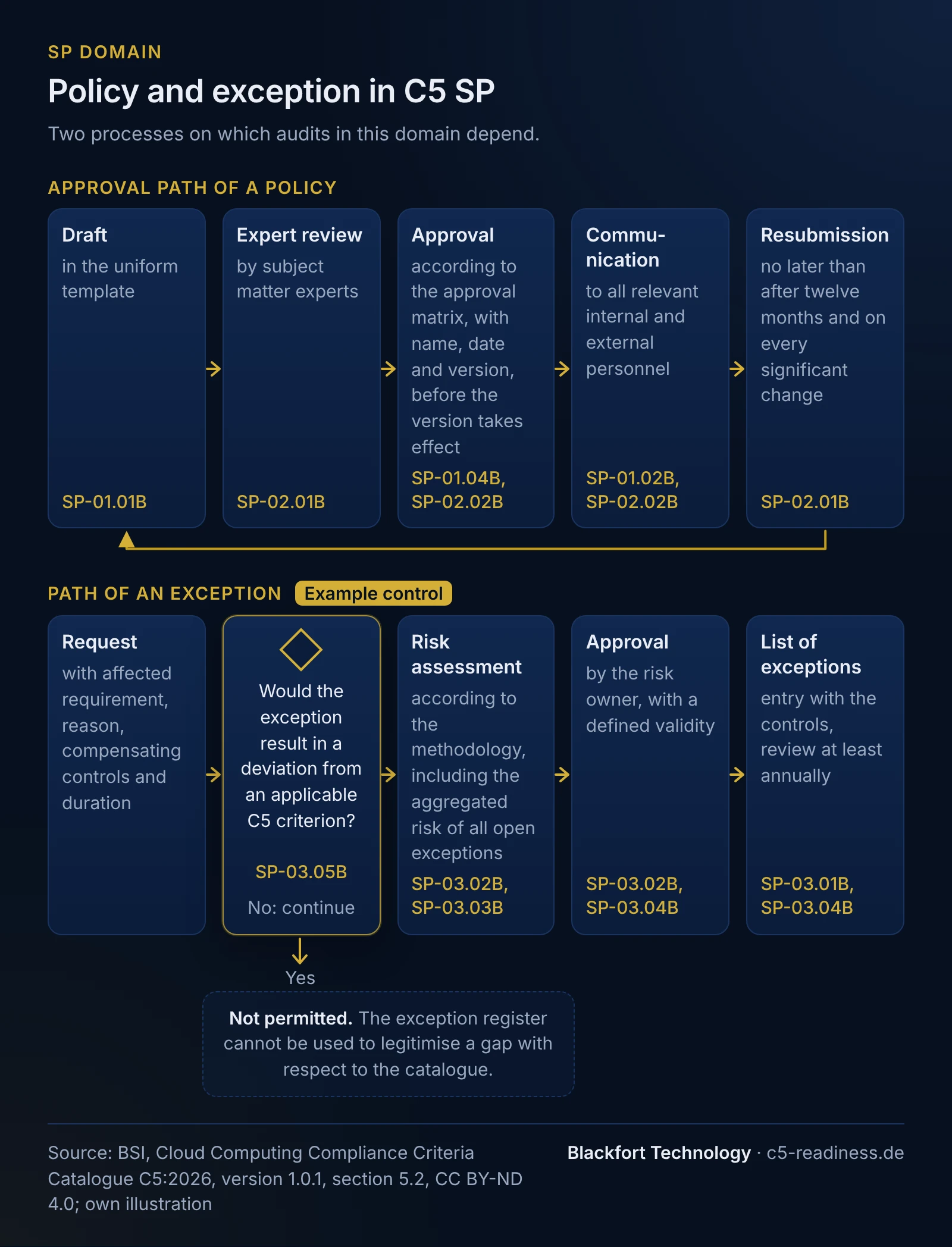
The authorisation of the information security officer is itself evidence: it shows that the information security officer is an “authorised body” within the meaning of SP-01.04B. The approval path itself is the same for every document:
- Draft in the uniform template with objectives, scope, roles with substitution, roles of other organisations, measures and legal requirements (SP-01.01B).
- Expert review by subject matter experts, with a view to organisational and technical changes and to new legal or regulatory requirements (SP-02.01B).
- Approval according to the matrix, in the document management system with name, date and version, before the version takes effect (SP-01.04B, SP-02.02B).
- Communication to all relevant internal and external personnel, appropriate to the need, for example with read confirmation or a short training session on significant changes (SP-01.02B, SP-02.02B).
- Resubmission no later than twelve months after approval and additionally on every significant change to the service (SP-02.01B).
As significant changes, the supplementary information on SP-02 names, among others, major changes to architecture or platform, substantial legal changes such as NIS2, DORA or GDPR, reorganisations, major security incidents and changes in top management. For the move to the new database in the example this means: the affected policies should have been reviewed at the time of the move, not only at the next annual date.
How do you keep an exception register under SP-03?
SP-03.01B requires a list of all exceptions with the associated controls. Every exception goes through the risk process under OIS-07 with approval and risk acceptance by the risk owners (SP-03.02B), the aggregated risk from several exceptions is taken into account (SP-03.03B), every approval has a defined validity and is reviewed at least annually (SP-03.04B). Our template, with the two cases from the example:
| Field | A-2026-04 SFTP with password | A-2026-07 network device without agent |
|---|---|---|
| Affected requirement | internal cryptography policy, section on login to transfer services | procedure for monitoring system components |
| Reason | requirement of a customer whose system cannot use key-based login | the device does not technically support the agent |
| Compensating controls | separate account for this customer only, access only from its IP addresses, long random password in the vault, alert on failed logins | monitoring via the network functions of the upstream device, monthly review of the configuration |
| Check against C5 (SP-03.05B) | information security officer checks whether the exception would result in a deviation from an applicable C5 criterion; result and reasoning in the entry | as left |
| Risk and aggregated view | assessment according to the methodology; aggregated risk of all open exceptions in the same run | as left |
| Approval | risk owner operations; information to the customer according to the contract | risk owner operations |
| Valid until | end of the contract year, twelve months at most | replacement of the device, six months at most |
| Next review | on expiry, no later than after twelve months | on expiry |
SP-03.05B sets the hard limit: exceptions that would result in a deviation from an applicable C5 criterion within the scope of the audit are not permitted. An example: a team wants to postpone the annual review of access rights by six months. IAM-05.01B requires it at least once a year; there must be no exception to this, the review has to take place. The exception register therefore cannot be used to legitimise a gap with respect to the catalogue.
Example control description for SP-03
Our example control for the provider above (own wording, not catalogue text):
| Field | Example |
|---|---|
| Control ID | K-SP-03-01 Approval and monitoring of exceptions |
| Mapped to | SP-03.01B to SP-03.05B |
| Objective | Every deviation from an information security policy or procedure is known, risk-assessed, time-limited and approved by a risk owner; no exception results in a deviation from an applicable C5 criterion. |
| Owner | Information security officer (register, check against C5, aggregated view); risk owners (approval); requester (implementation of the compensating controls) |
| Trigger and frequency | event-driven on every request; monthly check for expiring exceptions; annual overall review of all exceptions with the risk owner |
| Execution | Request via a form in the ticket system with affected requirement, reason, compensating controls and requested duration. The information security officer checks SP-03.05B and assesses the risk according to the methodology, also for all open exceptions together. The risk owner approves or rejects; only then does the exception apply. Sales and support do not promise customers any deviation without an approved exception. |
| Check | Every month the information security officer reconciles the register with the expiry dates and asks the requesters whether the exception is still needed. Once a year the information security officer checks by sample whether the compensating controls are actually running. |
| Escalation | If an exception expires without being extended or closed, a notification goes to the risk owner; after 14 days management decides. An expired exception is recorded as a deviation in the ISMS. |
| Evidence | Exception register with history, requests and approvals, assessment including the aggregated view, record of the monthly check and of the annual review |
The monthly check for expiry goes beyond the basic criteria and corresponds to the complementing subcriterion SP-03.02AC. We recommend it even if you do not include that subcriterion, because otherwise expired exceptions continue unnoticed.
What evidence the auditor wants to see
For SP, what counts are documents with version, approval and date, and the records showing that they were communicated and reviewed. Examples from our scenario:
| Evidence | Criterion | Source | Owner | Timing |
|---|---|---|---|---|
| Policy template and list of all policies and procedures with version, owner and approval date | SP-01.01B, SP-01.03B | document management system | Information security officer | status at the start and end of the period |
| Approval records per version, approval matrix, authorisation of the information security officer | SP-01.04B, SP-02.02B | document management system, management | Management, information security officer | every version valid in the period |
| Read confirmations, onboarding material, notifications about new versions | SP-01.02B, SP-02.02B | document management system, learning platform | Team leads | sample from the period |
| Records of the annual and event-driven reviews | SP-02.01B | document management system, tickets | responsible heads of department | every review in the period, reference to triggering changes |
| Exception register with compensating controls | SP-03.01B | ticket system | Information security officer | status and changes in the period |
| Risk assessment per exception and aggregated view, approvals with validity | SP-03.02B to 04B | risk register, ticket system | Information security officer, risk owners | all exceptions in the period |
| Check of every exception against the applicable C5 criteria | SP-03.05B | entry in the register | Information security officer | all exceptions in the period |
An evidence register assigns each subcriterion its evidence; how to keep one is shown on the page evidence and documentation. You will find a template for it under C5 templates.
Possible gaps: cause, effect, remedy
The following gaps follow from the wording of the criteria and the scenario above. If a single subcriterion is not met, the criterion counts as not met, and the auditor reports the deviation (sections 3.4.12 and 3.4.13).
| Possible gap | Cause | Effect | Remedy |
|---|---|---|---|
| Approval cannot be evidenced | Agreement in the chat, without defined responsibility. | SP-01.04B and SP-02.02B require approval by an authorised body before the version becomes effective; without a record, the evidence for every version is missing. | Approval matrix, approval in the document management system with name and date, written authorisation for delegated approvals. |
| Review overdue | No resubmission date, no link to the change process. | SP-02.01B requires a review at least annually and on significant changes; documents with an older status are a deviation in the period. | Resubmission after twelve months in the document management system, check field “affected policies” in the change ticket. |
| Exceptions promised by e-mail | Sales agrees to deviations directly. | SP-03.01B requires a list of all exceptions, SP-03.02B approval by the risk owner. | Exceptions only via the form, rule for sales and support, record old cases retrospectively. |
| Exceptions without expiry date | Approved “until further notice”. | SP-03.04B requires a defined validity and a review at least annually. | Mandatory field “valid until”, twelve months at most, monthly expiry check. |
| Individual assessment without the overall picture | Each exception is assessed on its own. | SP-03.03B and SP-03.04B require consideration of the aggregated risk from a combination of single exceptions. | assess all open exceptions together with every new exception and at the annual review. |
All criteria of the SP domain
Titles as in the English version 1.0.1, number of subcriteria counted per section 5 (B = basic, AS = sharpening, AC = complementing). The column “What it covers” is our own short description, not catalogue text; the wording of the criteria in the catalogue is binding.
| ID | Title (catalogue) | B/AS/AC | What it covers |
|---|---|---|---|
| SP-01 | Documentation, Communication and Provision of Policies and Procedures | 4/0/0 | Uniform structure of all policies, derived from the information security policy, with version control, approval and communication appropriate to the need. |
| SP-02 | Review and Approval of Policies and Procedures | 2/0/0 | Review at least annually and on significant changes, approval of revised versions before they become effective. |
| SP-03 | Exceptions from Existing Policies and Procedures | 5/0/3 | List of all exceptions with risk assessment, approval, time limit and annual review; no exception that results in a deviation from C5. |
The three complementing subcriteria belong to SP-03: approval by the appropriate level of management (SP-03.01AC), monitoring of the list to prevent approved exceptions from expiring (SP-03.02AC) and timely remediation of deviations (SP-03.03AC).
Relationship to ISO/IEC 27001:2022
An ISMS certified to ISO/IEC 27001 brings a lot to SP. According to the supplementary information on SP-02.01B and SP-03.01B, controls on these criteria are most likely also tested in the ISO certification audit; in a separate audit, the C5 auditor can inspect the ISO report instead of testing again, if the evidence provided is conclusive enough. What else can be reused from ISO is set out on the page C5 and ISO 27001.
The following mapping is our own, unofficial classification by topic. The BSI has not yet published a cross-reference for C5:2026. The catalogue refers to the BSI website for it (section 3.3). So far the table there covers C5:2020 only, and the BSI says the table for C5:2026 is “scheduled for publication in the near future” (as of 6 November 2026). According to the catalogue, even an official table only shows thematic proximity, not fulfilment of the criteria (section 3.3). The short labels are ours, not titles from the standard.
| C5:2026 | ISO/IEC 27001:2022 | Topic (short label) | What C5 additionally requires in concrete terms (our assessment) |
|---|---|---|---|
| SP-01 | Clause 7.5, A.5.1, A.5.37 | Documented policies and procedures | uniform structure with mandatory content, including roles of customers and subservice organisations |
| SP-02 | A.5.1 | Review of policies | at least annually and on significant changes to the service, approval before the version becomes effective |
| SP-03 | no direct counterpart; close to clauses 6.1.3 and 8.3 | Exceptions and risk acceptance | list of exceptions, aggregated risk, time limit, prohibition of exceptions that deviate from C5 |
Frequently asked questions
Who has to approve policies?+
How often do policies have to be reviewed?+
May I deviate from a policy for a customer?+
Does every exception need an expiry date?+
Does SP-01 apply only to the policies in the SP domain?+
Read more
- C5 criteria catalogue: structure, basic and additional criteria
- Prioritising C5 measures: blockers, dependencies, sequence
- C5 OIS: organisation of information security under C5:2026
- C5 documentation: keeping an evidence register for the audit
- Free C5 templates: scope sheet, evidence register, CUEC matrix
- C5 vs ISO 27001: what you can reuse and what is missing
- C5 readiness assessment: gap analysis, action plan and timeline
Sources
- BSI: C5:2026 web page with downloads (German) (retrieved 2026-11-06)
- BSI: C5:2026 web page with downloads (retrieved 2026-11-06)
- BSI: Kriterienkatalog Cloud Computing C5:2026, version 1.1.0 (PDF, German), licensed under CC BY-ND 4.0 (retrieved 2026-11-01)
- BSI: Cloud Computing Compliance Criteria Catalogue C5:2026, version 1.0.1 (PDF), section 5.2 SP-01 to SP-03, section 5.7 IAM-05, sections 3.3, 3.4.12 and 3.4.13, licensed under CC BY-ND 4.0 (retrieved 2026-11-01)
- BSI: C5:2026 overview page with downloads (German) (retrieved 2026-11-01)
This content provides general technical and organisational information and does not constitute legal advice (no legal services within the meaning of the German RDG).