

Last updated: 2026-11-06
This page covers the PI (Portability and Interoperability) domain of C5:2026, section 5.10 of the catalogue. How criteria and subcriteria are structured in general is explained on the page C5 criteria catalogue.
What is the PI domain about?
PI answers three questions that customers ask before a procurement: How do I connect the service to my systems? Do I get my data back if I leave? And what happens to it at the provider afterwards? The catalogue sums this up in its objective: enabling access to the service via other cloud services or IT systems of the customers, obtaining the stored customer data at the end of the contractual relationship and deleting it securely from the provider (section 5.10).
The domain comprises three criteria, PI-01 to PI-03, with 6 basic subcriteria and 5 complementing additional subcriteria; there are no sharpening ones. All three criteria already existed with the same number in C5:2020. According to the BSI change history, the obligation to document interfaces has moved to the PSS domain (PSS-01); PI-01 now deals with the implementation of the interfaces. PI-03 now allows exceptions to deletion if a court order requires them or known future financial and legal obligations still require the data.
The catalogue does not require new technology just for portability: according to the supplementary information on PI-01, the provider is required neither to develop new technologies nor to share information protected as intellectual property or as a trade secret.
Starting point: a SaaS provider whose customers want to switch
Fictitious example, not a client. A provider runs software for time recording and project billing for engineering and architecture firms. The service runs on the infrastructure of a large cloud provider, with a managed database, object storage for receipts and plans and a search index. The firms connect their accounting via a REST interface. For a contract renewal, a large customer asks for a C5 report and asks in the questionnaire how it gets its data back at the end of the contract.
Before the project, the situation looks like this:
- The REST interface is documented, and the accounting entries can be exported as CSV. There is no export for receipts, plans and the change log; customers have to ask support.
- The contract terms say: “After the end of the contract, the data will be deleted.” A time frame for handing over the data, a deletion date and the customers’ cooperation are missing.
- A tenant is deleted with a script that a developer starts when needed. Backups expire on their own after their retention period; nobody knows exactly whether the search index is deleted too.
- The customer does not receive proof of deletion.
None of these points stands out in day-to-day operations. They only show up when a customer terminates, and that is exactly the case the auditor wants to see evidenced.
Who is responsible for what: provider, platform, customer?
With SaaS, PI is largely the provider’s responsibility: the customer depends on the export functions the service offers. For IaaS- and PaaS-like services it is the other way round according to the supplementary information on PI-02: there the customer is generally responsible for extracting and backing up its data itself. In the example the platform is a subservice organisation. Our classification for the example:
| Aspect | Provider | Platform (subservice organisation) | Customer (engineering firm) |
|---|---|---|---|
| Interfaces to the service | builds and operates them with standard protocols and formats, encryption and authentication (PI-01.01B) | provides network, load balancers and certificate services | checks before use and with every change whether the interfaces are adequate for its protection needs |
| Export during the contract | offers export functions or an extraction service (PI-01.02B) | - | retrieves its data |
| Rules for handing over data at the end of the contract | sets them out in the contract (PI-02.01B) | - | requests or retrieves the data in time and stores it according to the legal requirements that apply to it |
| Deletion after the end of the contract | deletes in all its own storage and evidences the deletion (PI-03) | deletes storage media and data carriers of its infrastructure according to its own procedures (outside your audit under the carve-out method) | clarifies its own retention obligations and initiates deletion accordingly |
All three PI criteria contain complementary customer criteria. Whichever customer controls you assume for your service, for example that the customer retrieves its data within the time frame, belong in the system description as complementary customer controls (CUEC). The auditor does not test them at the customer, only whether they are presented appropriately.
What has to be in the contract on handing over data?
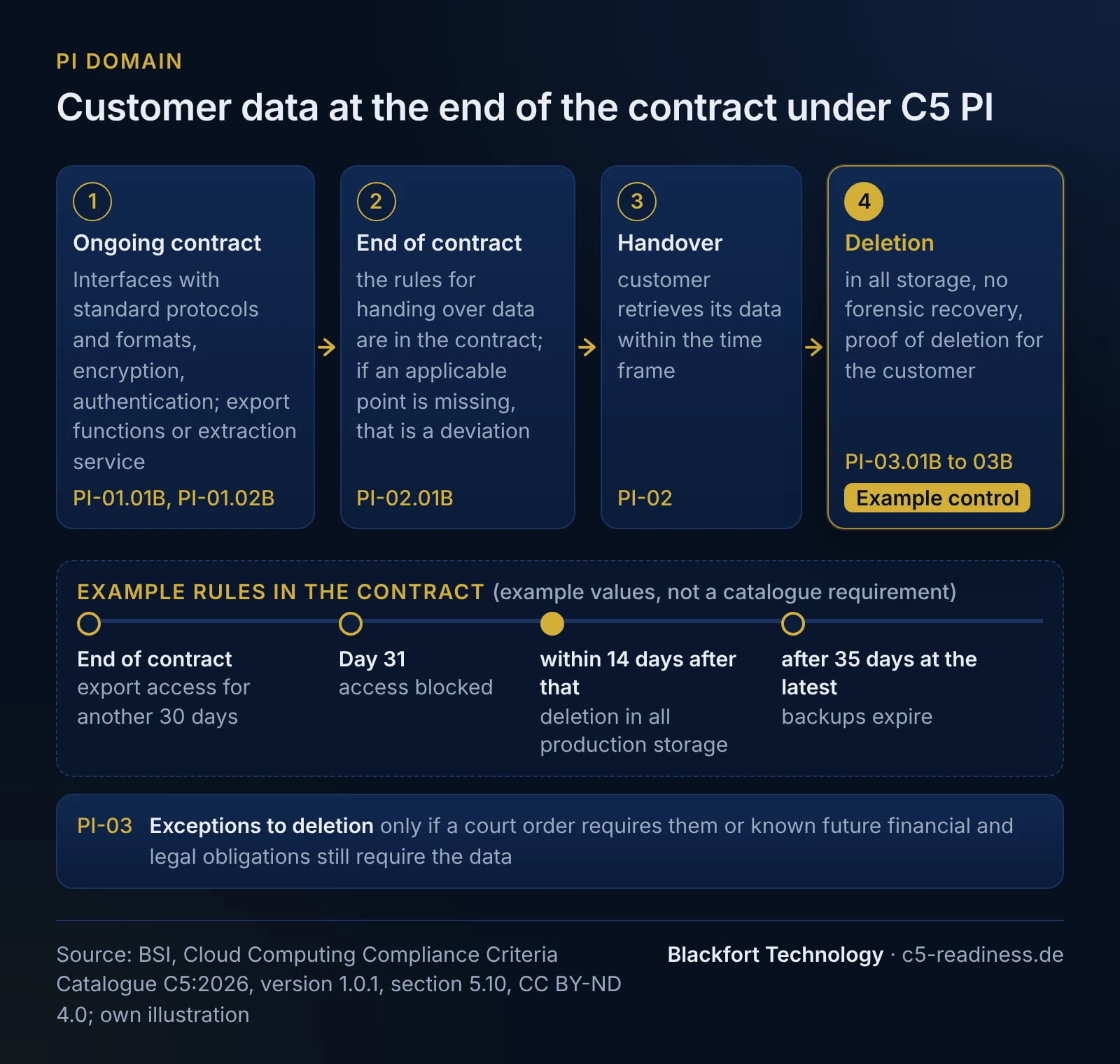
PI-02.01B requires the contractual agreements to govern the provision of customer data after the end of the contract, insofar as the aspects are applicable to the service. If an applicable aspect is missing from the contract, the criterion is not met according to the supplementary information, and the auditor notes a deviation. Read the exact wording of the seven aspects in the catalogue. For the example we have derived guiding questions and our own example rules from them:
| Guiding question (own) | Example rule in the contract (fictitious) |
|---|---|
| Which data does the customer receive, in what scope and format? | Accounting entries, master data and change log as CSV and JSON, receipts and plans in the original uploaded format. |
| How does the customer receive it? | Itself via the export function and the interface; for more than 500 GB on request as an encrypted download that the provider makes available. |
| Under which conditions and time frames is data provided during the term? | Export at any time without involvement of the provider. |
| How can the contract be terminated, and how long is the data available afterwards? | Notice period according to the main contract; export access for 30 days after the end of the contract. |
| From when is the data inaccessible and deleted? | Access blocked on day 31, deletion in all production storage within 14 days after that, backups expire after 35 days at the latest. |
| What does the customer have to do itself? | Start the export in time, check completeness, observe its own retention obligations. |
| Who owns the data? | The customer data remains the property of the customer during the term and afterwards. |
The time frames are example values, not catalogue requirements; the catalogue does not set a specific duration. As possible legal requirements it names the EU Data Act and, for Germany, retention obligations under Section 147 of the German Tax Code (AO) and Section 257 of the German Commercial Code (HGB). Which of these apply to your service and your contracts has to be assessed legally in the individual case. Providers that include the complementing subcriterion PI-02.01AC review these requirements at least once a year and adjust the contracts; with PI-02.02AC the provider additionally hands over cloud service derived data, such as usage logs.
Example control description for PI-03
PI-03 requires three things: the deletion of customer data, cloud service derived data and account data at the end of the contract complies with the contractual agreements (PI-03.01B), it prevents recovery by forensic means in line with the established rules of technology (PI-03.02B), and it is documented so that the customer obtains proof (PI-03.03B). The catalogue names multiple overwriting or deletion of the encryption key as examples of suitable methods. Our example control for the provider above (own wording, not catalogue text):
| Field | Example |
|---|---|
| Control ID | K-PI-03-01 Deletion of a tenant after the end of the contract |
| Mapped to | PI-03.01B to PI-03.03B; deletion date under PI-02.01B |
| Objective | After the contractual handover period has expired, all customer data, cloud service derived data and account data of a tenant are deleted in all of the provider’s storage and cannot be recovered, and the customer has proof of deletion. |
| Owner | Head of operations (execution); contract management (trigger); checked by the information security officer |
| Trigger and frequency | event-driven: every end of contract in the contract register; additionally a monthly reconciliation between contract register and active tenants |
| Execution | At the end of the contract the contract register creates a ticket. On day 31 operations blocks the tenant. The deletion routine removes the tenant’s database schema, object storage area and search index and deletes its tenant-specific key in the key management service; this also makes encrypted backups unreadable. Account data is deleted except for invoice data subject to a statutory retention obligation; this exception is recorded in the ticket with legal basis and deletion date. |
| Check | After the run, the routine checks whether any objects, tables or index entries still exist under the tenant ID and otherwise aborts with an error. Each month the information security officer reviews the list of all terminated contracts against deletion logs and open exceptions. |
| Escalation | If a tenant has not been deleted 14 days after the block, a notification goes to the head of operations; every overrun of the contractual deadline is recorded and assessed as a deviation. |
| Evidence | Ticket with timestamps, log of the deletion routine with check result, log of the key deletion, deletion confirmation to the customer |
Deletion via the key is our recommendation for backups that cannot be processed individually; it requires every tenant to have its own key. How to manage keys is covered by the CRY domain. Whether the control covers all subcriteria is for the auditor to assess.
What evidence the auditor wants to see
For PI, evidence comes from the contract, the interface documentation and the cases of terminated contracts. If no contract ends in the audit period, there is no real deletion case; then clarify early with the auditor how you evidence the procedure. Examples from our scenario:
| Evidence | Criterion | Source | Owner | Timing |
|---|---|---|---|---|
| Interface documentation with protocols, data formats and authentication | PI-01.01B | developer portal, version control | product management | versions valid in the period with date of change |
| Configuration of transport encryption at the interfaces | PI-01.01B | configuration export of the load balancer | operations | state at the start and end of the period |
| Description of the export functions and the extraction service | PI-01.02B | user documentation | product management | version valid in the period |
| Contract template with the rules for handing over data | PI-02.01B | contract repository | contract management | version valid in the period |
| List of terminated contracts with export, block and deletion | PI-02.01B, PI-03.01B | contract register, ticket system | contract management, operations | all cases in the period |
| Description of the deletion procedure with method per storage | PI-03.02B | operations manual | head of operations | version valid in the period |
| Deletion logs and deletion confirmations to customers | PI-03.03B | logging system, ticket system | operations | all cases in the period |
An evidence register records which evidence belongs to which subcriterion; how to keep one is shown on the page Evidence and documentation.
Possible gaps: cause, effect, remedy
The following gaps follow from the wording of the criteria and the scenario above. If a single subcriterion is not met, the criterion counts as not met, and the auditor reports the deviation (sections 3.4.12 and 3.4.13).
| Possible gap | Cause | Effect | Remedy |
|---|---|---|---|
| Contract covers the handover only in general terms | The contract terms predate the customers’ wish for C5. | If applicable aspects of PI-02.01B are missing, the criterion is not met according to the supplementary information. | Extend the contract template along the seven aspects, switch existing contracts at the next renewal. |
| Not all data can be exported | The export covers only the main objects; attachments and logs are missing. | PI-01.02B requires suitable technical means for extracting customer data, and an extraction service for large volumes. | Export for all types of data named in the contract, a described extraction service for the rest. |
| Deletion does not cover all storage | The deletion script knows database and object storage, but not search index, caches and logs. | The deletion does not comply with the contract (PI-03.01B), and remnants remain recoverable (PI-03.02B). | Inventory the data flow per tenant, deletion routine with a check for remaining data. |
| No proof of deletion for the customer | The deletion runs technically but is not documented or communicated. | PI-03.03B is not met, even though the data is deleted. | Deletion confirmation with date, scope and method to the customer, filed in the ticket. |
| Exceptions without a reason | Data is kept longer “just in case”. | PI-03.01B only allows exceptions in case of a valid court order or for known future financial and legal obligations. | Document and follow up every exception with legal basis, scope and deletion date. |
Which gaps to close first is decided by prioritising measures across all domains. Contract changes need lead time; plan them before the start of a type 2 period.
All criteria of the PI domain
Titles as in the English version 1.0.1, number of subcriteria counted per section 5 (B = basic, AS = sharpening, AC = complementing). The column “What it covers” is our own short description, not catalogue text; the wording of the criteria in the catalogue is binding.
| ID | Title (catalogue) | B/AS/AC | What it covers |
|---|---|---|---|
| PI-01 | Safety of Input and Output Interfaces | 2/0/3 | Interfaces with standard protocols and formats, encryption, integrity checks and means for extracting data. |
| PI-02 | Contractual Agreements for the Provision of Data | 1/0/2 | Contract rules on which data the customer receives at the end of the contract, how and by when. |
| PI-03 | Secure Deletion of Data | 3/0/0 | Deletion according to the contract, without forensic recovery and with proof for the customer. |
The complementing subcriteria of PI-01 concern customer requirements that can come up in sales: an application firewall in front of administration interfaces accessible from public networks (PI-01.01AC), and the connection of customers’ own identity providers via a standardised protocol with clear documentation (PI-01.02AC, PI-01.03AC). Which of them you include depends on your customers.
Relationship to ISO/IEC 27001:2022 Annex A
The following mapping is our own, unofficial classification by topic. The BSI has not yet published a cross-reference for C5:2026. The catalogue refers to the BSI website for it (section 3.3). So far the table there covers C5:2020 only, and the BSI says the table for C5:2026 is “scheduled for publication in the near future” (as of 6 November 2026). According to the catalogue, even an official table only shows thematic proximity, not fulfilment of the criteria (section 3.3). The short labels are ours, not titles from the standard.
| C5:2026 | ISO/IEC 27001:2022 Annex A | Topic (short label) | What C5 additionally requires in concrete terms (our assessment) |
|---|---|---|---|
| PI-01 | A.5.14, A.8.26 | Information transfer, security requirements for applications | Means for customers to extract data, as a service for large volumes |
| PI-02 | no direct counterpart; thematically closest A.5.31 | Legal and contractual requirements | Seven contractual aspects of handing over data, missing aspects are a deviation |
| PI-03 | A.8.10, A.7.14 | Deletion of information, disposal of storage media | Proof of deletion for the customer, exceptions only for two reasons |
Frequently asked questions
Does C5 prescribe a time frame for handing over the data after the end of the contract?+
Do I have to hand over data in a particular format?+
Is it enough to let backups expire after their retention period?+
May I keep data after the end of the contract, such as invoice data?+
Does PI also apply to IaaS and PaaS services?+
Read more
- C5 criteria catalogue: structure, basic and additional criteria
- C5 SSO: controlling and monitoring service organisations under C5:2026
- C5 OPS: making operations audit-ready under C5:2026
- C5 CRY: cryptography and key management under C5:2026
- C5 PSS: product security of the cloud service under C5:2026
- C5 system description: minimum content, structure and example
- C5 documentation: keeping an evidence register for the audit
- C5 readiness assessment: gap analysis, action plan and timeline
Sources
- BSI: C5:2026 web page with downloads (German) (retrieved 2026-11-06)
- BSI: C5:2026 web page with downloads (retrieved 2026-11-06)
- BSI: Kriterienkatalog Cloud Computing C5:2026, version 1.1.0 (PDF, German), licensed under CC BY-ND 4.0 (retrieved 2026-11-01)
- BSI: Cloud Computing Compliance Criteria Catalogue C5:2026, version 1.0.1 (PDF), section 5.10 PI-01 to PI-03, sections 3.3, 3.4.12 and 3.4.13, licensed under CC BY-ND 4.0 (retrieved 2026-11-01)
- BSI: C5:2026 change history (Excel), sheet “Change History”, PI-01 to PI-03 (retrieved 2026-11-01)
- BSI: C5:2026 overview page with downloads (German) (retrieved 2026-11-01)
This content provides general technical and organisational information and does not constitute legal advice (no legal services within the meaning of the German RDG).