

Last updated: 2026-11-06
This page covers the IAM domain (Identity and Access Management) of C5:2026, section 5.7 of the catalogue. How criteria and subcriteria are structured in general is explained on the page C5 criteria catalogue.
What is the IAM domain about?
IAM secures the provider’s own access. The catalogue states the objective as “Secure the authorisation and authentication of users of the cloud service provider to prevent unauthorised access” (section 5.7). The German version of the catalogue adds that these are usually privileged users. This means internal and external personnel as well as system components that have a role in automated authorisation processes, that is, technical accounts and service identities. How your customers’ users sign in and which roles they have in the service is governed by PSS-05 to PSS-09 in the Product security domain.
The domain comprises nine criteria, IAM-01 to IAM-09, with 49 basic subcriteria, 6 sharpening and 14 complementing additional subcriteria. In C5:2020 it was called IDM; no IAM criterion is new without a predecessor. The numbers IDM-01 to IDM-07 map to IAM-01 to IAM-07. For 08 and 09 the topics are swapped: the authentication mechanisms (C5:2020 IDM-09) are now in IAM-08, the confidentiality of authentication information (C5:2020 IDM-08) in IAM-09. The BSI change history still shows the old order here, so map old controls by their topic.
Starting point: a SaaS provider before its first audit
Fictitious example, not a client. A provider runs a platform for video consultations and appointment management for medical practices. The service runs on the infrastructure of a large cloud service provider, in a managed Kubernetes cluster and a managed database. Around 60 employees, including an operations team of six, a support team and two external developers from a service provider. Sign-in runs through a central identity service with single sign-on.
Before the project, the situation looks like this:
- Administrators sign in to the platform console with multi-factor authentication; deploy pipelines and database maintenance scripts, by contrast, use long-lived static access keys.
- The support team can switch into any practice tenant through an internal admin interface to reproduce errors. The practices are not told about it.
- HR reports leavers to operations by email. Only purchasing knows when the contracts of the external developers end.
- For an outage of the identity service there are two break glass accounts whose passwords are in the vault; when they were last used is not recorded.
Each of these points touches a different criterion. The following sections show where the boundaries of responsibility lie, what a control looks like and what evidence the auditor expects.
Who is responsible for what: provider, platform, customer?
IAM lies almost entirely with the provider. The platform supplies tools, the customer is mainly involved in IAM-07. Our classification for the example:
| Aspect | Provider | Platform (subservice organisation) | Customer (medical practice) |
|---|---|---|---|
| Identities and access rights of its own staff and of service providers | grants, reviews and revokes them (IAM-01 to IAM-05) | - | - |
| Accounts in the console and the services of the platform | sets up roles, multi-factor authentication and logging | provides identity and logging functions; secures access by its own staff to its infrastructure itself (outside your audit under the carve-out method) | - |
| Technical accounts and service identities | are treated like persons under IAM-01, IAM-02, IAM-04 and IAM-05; the provider manages them | provides short-lived sign-in methods for workloads | - |
| Access by the provider to customer data | discloses all cases in advance in the contract and informs the customer of each access (IAM-07) | - | checks under the complementary customer criteria whether the contract lists these cases completely |
| Accounts of the practice staff in the service | provides sign-in and roles (PSS domain) | - | manages its own users and roles |
In the IAM domain only IAM-07 contains complementary customer criteria; for the other eight criteria the catalogue shows a dash there. Whichever customer controls you assume for your service belong in the system description as complementary customer controls (CUEC). The auditor does not test them at the customer, only whether they are presented appropriately.
Example control description for IAM-04
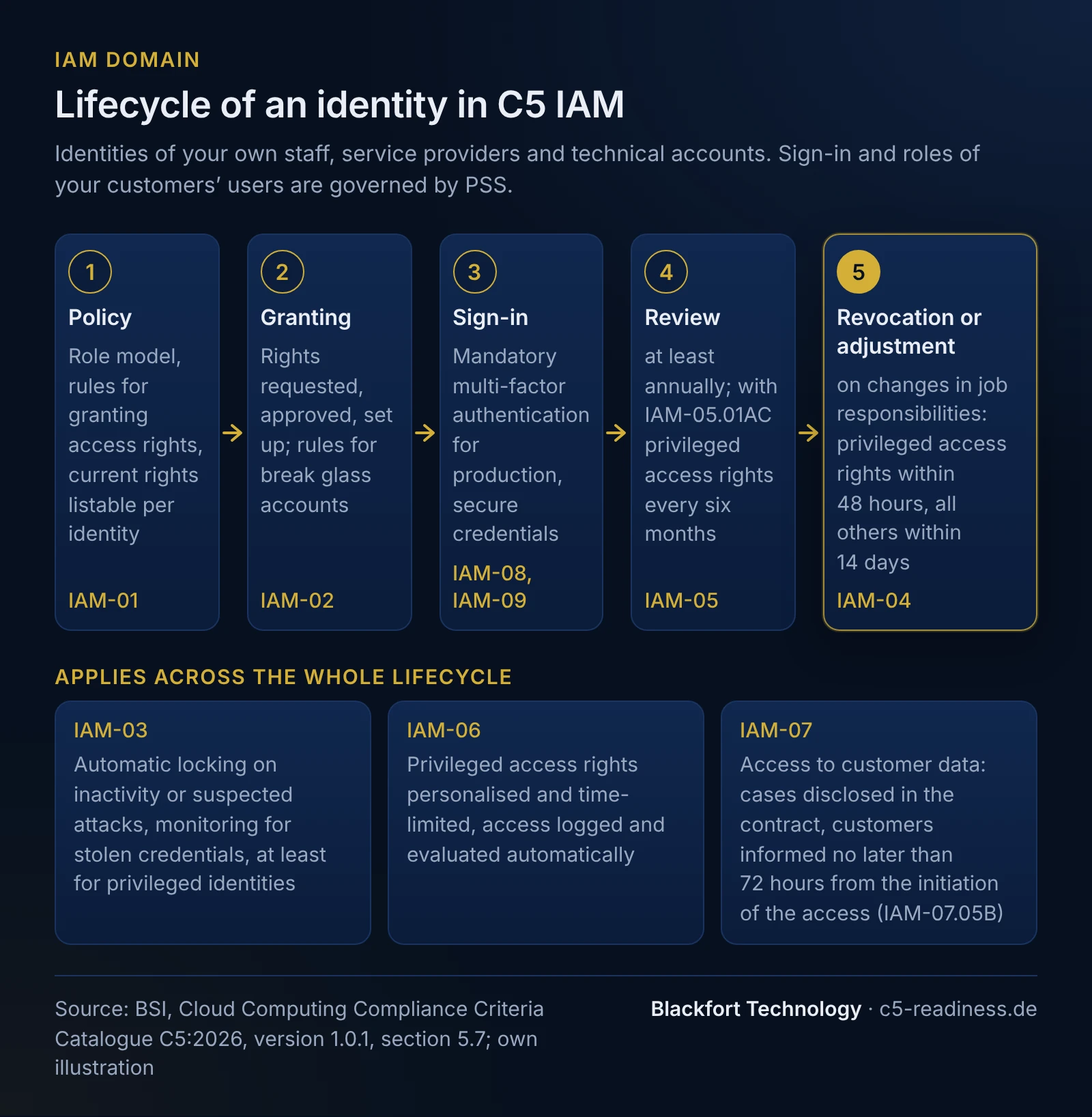
IAM-04 requires access rights to be adjusted or revoked in a timely manner when job responsibilities change. The basic subcriteria set two fixed deadlines: privileged access rights “within 48 hours after the change taking effect” (IAM-04.02B), all others “within 14 days” (IAM-04.03B). After revocation, the granting procedure under IAM-02 is repeated, and temporary access rights for role changes are approved, time-limited and documented. Our example control for the provider above (own wording, not catalogue text):
| Field | Example |
|---|---|
| Control ID | K-IAM-04-01 Adjustment of access rights on departure, transfer and end of contract |
| Mapped to | IAM-04.01B to IAM-04.05B |
| Objective | After a departure, transfer or end of contract, nobody keeps access rights that the new task does not require; privileged access rights are adjusted or revoked within the catalogue deadline of 48 hours, all others within 14 days. |
| Owner | Head of operations (execution); checked by the information security officer; HR and purchasing (notification) |
| Trigger and frequency | event-driven: every change in the HR system (departure, transfer, role change) and every end of contract of external staff recorded in the contract register; additionally a daily automated reconciliation between HR system, contract register and identity service |
| Execution | The HR system creates a ticket with the effective date. Operations revokes privileged access rights within 24 hours of the effective date (internal target time, stricter than the catalogue deadline of 48 hours) and adjusts all other rights within 7 days. New rights after a transfer go through the granting process K-IAM-02-01. Temporary rights are granted with approval and an expiry date in the ticket. |
| Check | The daily reconciliation reports active accounts without a valid HR or contract entry. Each month the information security officer reviews the list of all departures and transfers and compares effective date and revocation time. |
| Escalation | If a privileged access right has not been revoked 24 hours after the effective date, a notification goes to the head of operations; after 40 hours the on-call team locks the account centrally in the identity service. Every breach of a catalogue deadline is recorded and assessed as a deviation. |
| Evidence | Tickets with timestamps, identity service log, report of the daily reconciliation, monthly review record |
The internal target time below the catalogue deadline is our recommendation: it leaves a buffer for weekends and public holidays. Whether the control covers all subcriteria is for the auditor to judge; for a type 2 report the auditor also tests whether it was effective over the whole period.
What evidence the auditor wants to see
For IAM most evidence is produced automatically in the identity service, the ticket system and the logs. What matters is that it is available for the whole audit period and has the right timing. Examples from our scenario:
| Evidence | Criterion | Source | Owner | Timing |
|---|---|---|---|---|
| Authorisation concept with role model and policy for identities | IAM-01.01B, IAM-01.02B | ISMS document repository | information security officer | version valid in the period with approval date |
| List of the currently granted access rights per identity | IAM-01.03B | export from identity service and platform console | operations | reference date at the auditor’s request |
| Approved requests for new or changed access rights | IAM-02.01B | ticket system | respective team lead | sample from the period |
| List of departures and transfers against revocation times | IAM-04.02B, IAM-04.03B | HR system, contract register, identity service log | HR, operations | all cases in the period |
| Record of the access rights review | IAM-05.01B to IAM-05.03B | review record with export | team leads | every run in the period |
| Logs and alerts on privileged access | IAM-06.04B to IAM-06.06B | logging system, alert tickets | operations | ongoing, sample of alerts |
| Information to customers about support access | IAM-07.03B to IAM-07.05B | ticket system with time of access and of the information | head of support | all access in the period |
| Configuration of multi-factor authentication, including for automated access | IAM-08.02B | policy export from identity service and platform | operations | state at the start and end of the period, changes in between |
| Usage log of the break glass accounts | IAM-02.03B | vault and logging system | head of operations | every use in the period |
An evidence register records which evidence belongs to which subcriterion and when it is due; how to keep one is shown on the page Evidence and documentation.
Possible gaps: cause, effect, remedy
The following gaps follow from the wording of the criteria and the scenario above. For all of them: if a single subcriterion is not met, the criterion counts as not met, and the auditor reports the deviation (sections 3.4.12 and 3.4.13).
| Possible gap | Cause | Effect | Remedy |
|---|---|---|---|
| Technical accounts fall through the processes | Granting, review and revocation are set up for persons; service identities and pipeline keys run alongside. | IAM-01, IAM-02, IAM-04 and IAM-05 expressly name system components in automated authorisation processes; without them the list under IAM-01.03B is incomplete and the review under IAM-05.01B has gaps. | Add technical accounts with a responsible person to the inventory and put them in the same review run. |
| Support accesses data without informing customers | The admin interface allows switching into tenants without a ticket reference. | IAM-07.03B requires customers to be informed of such access, unless prohibited by applicable law, whenever the access is to unencrypted data or the contract does not explicitly exclude the information; under IAM-07.05B no later than 72 hours from the initiation of the access. In addition, under IAM-07.06B all instances of unencrypted access must be in the contract in advance. | Switching in only with a ticket, automatic message to the tenant with cause, time, duration, location, type and scope, contract annex with all access cases. |
| Multi-factor authentication only for people at the console | Automated processes use static keys. | IAM-08.02B requires multi-factor authentication for all access to the production environment, expressly also for automated processes. | Switch pipelines and scripts to short-lived sign-in methods bound to the workload and justify in the authentication policy under IAM-08.04B which mechanism applies to which identity type. |
| Deadlines on departure not measurable | Departures arrive by email, contract ends of external staff not at all. | The auditor cannot trace compliance with 48 hours and 14 days; without evidence, effectiveness is not demonstrated. | Event-driven tickets from HR system and contract register as in the control above. |
| Break glass accounts without rules of their own | The accounts are exempt from locking on inactivity, without their use being regulated. | IAM-02.03B requires specific requirements and procedures for such accounts; IAM-03.02B allows exceptions from automatic locking only for identities whose use is restricted to emergency recovery and similar scenarios. | Use only in a documented emergency, alert on every sign-in, password change and review after every use. |
Which of these gaps actually block the audit and in which order you close them is a question of prioritising measures across all domains.
All criteria of the IAM domain
Titles as in the English version 1.0.1, number of subcriteria counted per section 5 (B = basic, AS = sharpening, AC = complementing). The column “What it covers” is our own short description, not catalogue text; the wording of the criteria in the catalogue is binding.
| ID | Title (catalogue) | B/AS/AC | What it covers |
|---|---|---|---|
| IAM-01 | Policy for Identities and Access Rights | 3/0/1 | The written foundation: role model, rules for granting access rights and the ability to list the current rights of every identity. |
| IAM-02 | Granting and Change of Identities and Access Rights | 3/0/0 | The procedure by which access rights are requested, approved and set up, including the rules for break glass accounts. |
| IAM-03 | Risk-Based Procedure for Locking and Withdrawal of Identities | 4/1/3 | Automatic locking on inactivity or suspected attacks and monitoring for stolen credentials, at least for privileged identities. |
| IAM-04 | Withdrawal or Adjustment of Access Rights as the Task Area Changes | 5/0/0 | Rights follow the role: adjustment on departure or change with fixed maximum deadlines. |
| IAM-05 | Regular Review of Access Rights | 5/0/1 | Review of all identities and access rights at least annually and handling of orphaned resources after revocation. |
| IAM-06 | Privileged Access Rights | 9/0/4 | Personalised, time-limited admin rights with logging, automated evaluation and multi-factor authentication at administration interfaces. |
| IAM-07 | Access to Cloud Service Customer Data | 6/3/4 | Separation of the systems and transparency towards customers about when and how the provider’s staff access their data. |
| IAM-08 | Authentication Mechanisms | 7/2/0 | How staff and technical accounts sign in, with mandatory multi-factor authentication for the production environment and a risk-based authentication policy. |
| IAM-09 | Confidentiality of Authentication Information | 7/0/1 | Secure issuing and storage of passwords and other credentials, with deadlines for initial passwords and reset procedures. |
Additional criteria with an effect in sales include IAM-06.03AC (phishing-resistant multi-factor authentication for privileged users), IAM-06.04AC (privileged access management solution with elevation only when needed) and IAM-07.03AS (prior consent of the customer instead of information after the fact). Which ones you include depends on the contracts with your customers.
Relationship to ISO/IEC 27001:2022 Annex A
The following mapping is our own, unofficial classification by topic. The BSI has not yet published a cross-reference for C5:2026. The catalogue refers to the BSI website for it (section 3.3). So far the table there covers C5:2020 only, and the BSI says the table for C5:2026 is “scheduled for publication in the near future” (as of 6 November 2026). According to the catalogue, even an official table only shows thematic proximity, not fulfilment of the criteria (section 3.3). The short labels are ours, not titles from the standard.
| C5:2026 | ISO/IEC 27001:2022 Annex A | Topic (short label) | What C5 additionally requires in concrete terms (our assessment) |
|---|---|---|---|
| IAM-01, IAM-02 | A.5.15, A.5.16, A.5.18 | Rules for access, identities and access rights | 16 minimum aspects of the policy (IAM-01.02B), list of the rights per identity |
| IAM-03 | A.5.16, A.8.5 | Locking and secure sign-in | Monitoring for stolen credentials, with an exception mechanism |
| IAM-04 | A.5.18, A.6.5 | Access rights on departure and change | Maximum deadlines of 48 hours and 14 days |
| IAM-05 | A.5.18 | Review of access rights | At least annually, remediation within seven days, orphaned resources |
| IAM-06 | A.8.2, A.8.15 | Privileged access rights and their logging | Automated evaluation of the logs with alerting |
| IAM-07 | A.8.3; no direct counterpart for informing customers | Restriction of access to information | Informing customers of each access, disclosure of all access cases in the contract |
| IAM-08, IAM-09 | A.5.17, A.8.5 | Sign-in methods and credentials | Multi-factor authentication for all access to production, including automated access |
Frequently asked questions
Does IAM also apply to my customers’ users?+
How quickly do I have to revoke access rights after someone leaves?+
How often do access rights have to be reviewed?+
Do I have to inform customers about every support access to their data?+
Do automated processes also need multi-factor authentication?+
Read more
- C5 criteria catalogue: structure, basic and additional criteria
- C5 OPS: making operations audit-ready under C5:2026
- C5 CRY: cryptography and key management under C5:2026
- C5 PSS: product security of the cloud service under C5:2026
- C5 tenant separation: evidencing separation of customer data
- C5 system description: minimum content, structure and example
- C5 documentation: keeping an evidence register for the audit
- C5 readiness assessment: gap analysis, action plan and timeline
- C5 HR: personnel and security training under C5:2026
Sources
- BSI: C5:2026 web page with downloads (German) (retrieved 2026-11-06)
- BSI: C5:2026 web page with downloads (retrieved 2026-11-06)
- BSI: Kriterienkatalog Cloud Computing C5:2026, version 1.1.0 (PDF, German), licensed under CC BY-ND 4.0 (retrieved 2026-11-01)
- BSI: Cloud Computing Compliance Criteria Catalogue C5:2026, version 1.0.1 (PDF), section 5.7 IAM-01 to IAM-09, sections 3.3, 3.4.12 and 3.4.13, licensed under CC BY-ND 4.0 (retrieved 2026-11-01)
- BSI: C5:2026 change history (Excel), mapping IDM to IAM (retrieved 2026-11-01)
- BSI: C5:2026 overview page with downloads (German) (retrieved 2026-11-01)
This content provides general technical and organisational information and does not constitute legal advice (no legal services within the meaning of the German RDG).