

Last updated: 2026-11-06
This page covers the separation of customer data as a focus topic of C5:2026. The OPS domain as a whole is covered on the page OPS domain; which new focus areas the catalogue sets overall is shown on the page C5:2026.
What is tenant separation about in C5:2026?
The catalogue lists “More detailed consideration of multi-tenancy” as one of the main changes (section 1.1). In the criteria the topic is called “Separation of Datasets”; it means the separation of customer data between different customers and between customers and the provider. Three criteria form the core:
- OPS-30 Policies and procedures (new): Based on a risk assessment under OIS-07, the provider establishes policies that rest on a documented cloud layer model. They show which layers the service uses, which separation measures apply per layer, categorised by confidentiality, integrity and availability and as preventive, detective and reactive, how the measures are monitored and what happens in the event of deviations (OPS-30.01B).
- OPS-31 Implementation: The provider implements measures against threats to the separation, customer data on shared virtual and physical resources is “securely and strictly separated”, and the risk assessment is reviewed as needed, especially in case of architecture changes, and at least annually (OPS-31.01B to 03B). According to the change history, OPS-31 is the successor of OPS-24 from C5:2020.
- COS-06 Separation of data traffic: Customer data traffic in jointly used network environments is separated on network level according to a documented framework (COS-06.01B). For IaaS and PaaS the complementing COS-06.01AC requires physically separated networks or state-of-the-art encryption combined with logical separation. The rest of network security is covered by the COS domain.
Subcriteria in other domains add to this: IAM-07.01B requires partitioning measures that separate customers from each other and the service from the provider’s other systems, IAM-07.02B that a security incident at the components storing the data does not spread to the components managing access to them. OPS-15.01B requires logs that identify access unambiguously at the tenant level. COS-05.02B separates the orchestration networks from the customer networks, OPS-34.02B no. 4 the customer data in containers.
As an example of a layer model the catalogue names the CISA Cloud Security Technical Reference Architecture; the provider may, however, use its own categorisation (supplementary information on OPS-30). Not every combination of protection goal and type of measure has to be covered for every layer; where that is not meaningful, document it comprehensibly in the policy.
Starting point: document management for public authorities
Fictitious example, not a client. A provider runs document management as SaaS for local authorities. All authorities use the same application on the infrastructure of a large cloud provider: a shared Kubernetes cluster, a shared database with a column for the tenant ID, a shared object storage with one directory per tenant and a shared search index. Full-text search and a preview function run as separate services.
Before the project, the situation looks like this:
- Each developer sets the tenant ID in their own queries; there is no central enforcement.
- The search index contains documents of all tenants; filtering happens only at output.
- One shared data key in the platform’s key management applies to all tenants.
- The annual penetration test checks the application from outside, but not whether a user of one authority can see data of another.
- The logs of the preview function contain no tenant ID.
The separation probably works. In this form it cannot be evidenced: the layer model, the risk assessment and tests that would detect a breach of the separation are missing.
Who is responsible for what: provider, platform, customer?
With SaaS, separation above the infrastructure lies with the provider. The platform separates its own customers from each other, that is the provider from other platform customers, not the provider’s tenants among themselves. For OPS-31 and COS-06 the catalogue lists complementary customer criteria. Our classification for the example:
| Aspect | Provider | Platform (subservice organisation) | Customer (local authority) |
|---|---|---|---|
| Layer model, risk assessment, policy | creates them and reviews them at least annually (OPS-30, OPS-31.03B) | - | - |
| Separation in application, database, search index, object storage | implements and tests it (OPS-31.01B, OPS-31.02B) | - | - |
| Separation at hardware, hypervisor, physical network | assesses the platform’s reports | separates its own customers from each other | - |
| Network separation in the cluster and towards administration | separates data traffic according to a documented framework (COS-06.01B, COS-05.02B) | provides network functions | designs its own virtual networks where these are its responsibility (complementary customer criteria for COS-06) |
| Use of the separation functions | provides, for example, separate areas for departments within one authority | - | uses them according to the protection needs of its data (complementary customer criteria for OPS-31) |
Whichever of these customer controls you assume belong in the system description as complementary customer controls (CUEC). How to make the customers’ obligations manageable is shown on the page Complementary customer criteria.
Work product: separation matrix per cloud layer
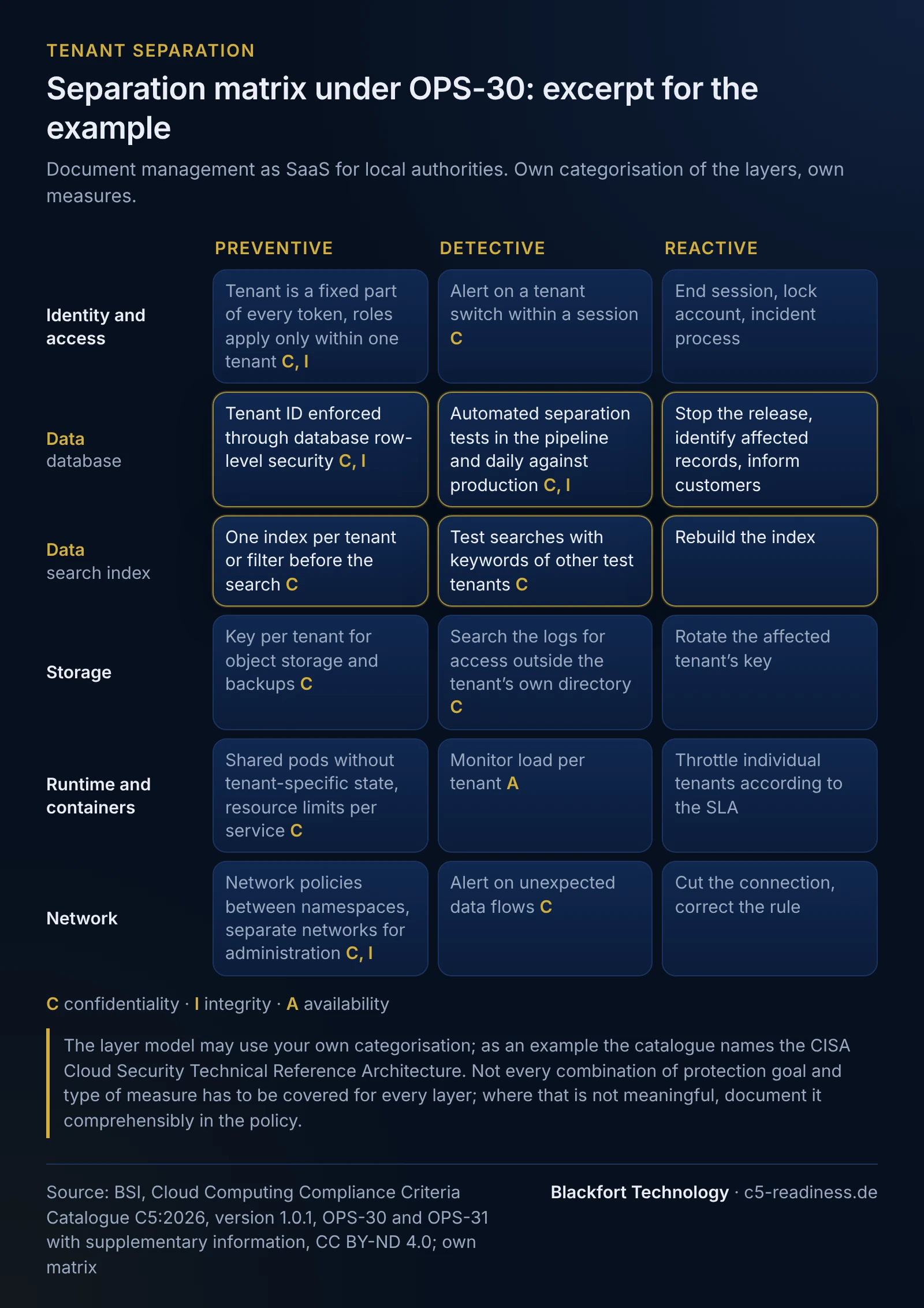
OPS-30.01B requires measures per layer, categorised by protection goal and type of measure. The simplest form is a matrix that serves as policy and audit basis at the same time. An excerpt for the example (own categorisation of the layers, own measures):
| Layer | Preventive | Detective | Reactive |
|---|---|---|---|
| Identity and access | Tenant is a fixed part of every token; roles apply only within one tenant (C, I) | Alert on tokens with a tenant switch within a session (C) | End session, lock account, incident process |
| Data (database) | Tenant ID enforced through database row-level security, not in application code (C, I) | Automated separation tests in the pipeline and daily against production (C, I) | Stop the release, identify affected records, inform customers |
| Data (search index) | One index per tenant or filter before the search (C) | Test searches with keywords of other test tenants (C) | Rebuild the index |
| Storage | Key per tenant for object storage and backups (C); access only through service accounts tied to a tenant | Analysis of the access logs for access outside the tenant’s own directory (C) | Rotate the affected tenant’s key |
| Runtime and containers | Shared pods without tenant-specific state; resource limits per service (C) | Monitoring of load per tenant (A) | Throttling of individual tenants according to the SLA |
| Network | Network policies between namespaces, separate networks for administration (C, I) | Alert on unexpected data flows (C) | Cut the connection, correct the rule |
C, I and A stand for confidentiality, integrity and availability (the asset register on the AM domain page additionally rates authenticity as a fourth protection goal). The diagram below this paragraph shows the same matrix as a printable overview; the table contains a few more details. The matrix does not replace the risk assessment under OIS-07; it shows which measure addresses which risk. According to the supplementary information on OPS-31, cryptographic separation does not have to exist on every resource if the risk assessment does not call for it there.
Example control description for OPS-31
A separation that is only claimed cannot be audited. The following control makes it measurable (own wording, not catalogue text):
| Field | Example |
|---|---|
| Control ID | K-OPS-31-01 Separation tests between tenants |
| Mapped to | OPS-31.01B, OPS-31.02B; OPS-30.01B nos. 3 and 4 (monitoring, response) |
| Objective | A user or service of one tenant can neither read nor write data of another tenant; a breach is detected before a release is shipped, and in production within one day. |
| Responsible | Head of development (execution); checked by the information security officer |
| Trigger and frequency | every build; daily run against production with two fixed test tenants; annual penetration test focused on cross-tenant access, additionally after architecture changes |
| Execution | For every interface and every search function, a test suite tries to read, change or delete data of test tenant B using identifiers of test tenant A. New interfaces are not released without a test case. Once a year an external testing provider specifically tests the separation. |
| Check | Each month the information security officer checks that the suite runs for all interfaces (reconciliation with the interface register) and evaluates the penetration test report. |
| Escalation | A failed test in the build stops the release. A finding in production is treated as a security incident; affected customers are informed. |
| Evidence | Pipeline logs, logs of the daily runs, reconciliation of interface register and test cases, penetration test report with measures |
The penetration test has a purpose of its own here: if the effectiveness of the separation cannot be assessed with reasonable assurance because of a complex implementation, the supplementary information on OPS-31 allows evidence to be provided through expert third-party reviews as well, for example penetration tests. The supplementary information on COS-06 says the same for network separation.
What evidence the auditor wants to see
For tenant separation the auditor needs two things: the reasoning why the measures are sufficient, and evidence that they were effective during the period. Examples from the scenario:
| Evidence | Criterion | Source | Owner | Timing |
|---|---|---|---|---|
| Policy with layer model and separation matrix | OPS-30.01B | ISMS document repository | information security officer | version valid in the period |
| Risk assessment of the separation with the date of the last review | OPS-30.01B, OPS-31.03B | risk register | information security officer | at least one review in the period, plus on architecture changes |
| Results of the separation tests | OPS-31.01B, OPS-31.02B | pipeline, test logs | head of development | ongoing, sample |
| Penetration test report on tenant separation | OPS-31.02B (supplementary information), OPS-22 | testing provider | information security officer | last test before or in the period |
| Network separation framework with export of the network policies | COS-06.01B, COS-05.02B | network documentation, cluster | operations | state at the start and end of the period |
| Logs with tenant ID | OPS-15.01B | logging system | operations | sample from the period |
| Platform report on its tenant separation | OPS-31.02B, SSO | attestation or report of the platform | information security officer | report period overlapping your own |
You evaluate the platform’s report through subservice organisation management (see subservice inventory). How to map evidence to the subcriteria is shown on the page Evidence and documentation.
Possible gaps: cause, effect, remedy
The following gaps follow from the wording of the criteria and the scenario. If a subcriterion is not met, the criterion counts as not met, and the auditor reports the deviation (sections 3.4.12 and 3.4.13).
| Possible gap | Cause | Effect | Remedy |
|---|---|---|---|
| No layer model | The separation is described as “tenant ID in every table”. | OPS-30.01B requires policies based on a documented cloud layer model with measures per layer. | Define the layers of the service and fill in the separation matrix as above, justify gaps in the matrix. |
| Separation depends on the individual developer | Every query sets the tenant ID itself. | OPS-31.02B requires secure and strict separation according to a documented approach; one forgotten filter is enough for data to leak. | Central enforcement in the database or data access layer, separation tests in the pipeline. |
| Shared search index without testing | The index contains all tenants, filtering happens at output. | The index is a shared resource within the meaning of OPS-31.02B; without risk assessment and testing the separation there is not evidenced. | One index per tenant or filter before the search, as a separate row in matrix and test suite. |
| Risk assessment out of date | The assessment predates the search service and the preview. | OPS-31.03B requires a review on architecture changes, at least annually. | Link the review to change management: every new component with customer data triggers a reassessment. |
| Logs without tenant reference | The preview function logs only technical identifiers. | OPS-15.01B requires unambiguous identification at the tenant level; a breach of the separation could not be investigated. | Include the tenant ID in all logs of services that handle customer data. |
Which gaps to close first is a question of prioritising measures.
Criteria on tenant separation
Titles as in the English version 1.0.1, number of subcriteria counted per section 5 (B = basic, AS = sharpening, AC = complementing). The selection beyond OPS-30, OPS-31 and COS-06 is our classification. The column “What it covers” is our own short description, not catalogue text; the wording of the criteria in the catalogue is binding.
| ID | Title (catalogue) | B/AS/AC | What it covers |
|---|---|---|---|
| OPS-30 | Separation of Datasets - Policies and Procedures | 1/0/0 | Policy on separation based on risk assessment and layer model, with measures per layer. |
| OPS-31 | Separation of Datasets - Implementation | 3/0/0 | Implementation on all shared resources, review of the risk assessment at least annually. |
| COS-06 | Separation of Data Traffic in Jointly Used Network Environments | 1/0/1 | Network separation according to a documented framework, as an addition for IaaS and PaaS physical or encrypted. |
| IAM-07 | Access to Cloud Service Customer Data | 6/3/4 | Partitioning measures between customers and towards the rest of the provider, transparency on access by the provider. |
| OPS-15 | Logging and Monitoring - Accountability | 3/0/2 | Identify access per tenant unambiguously. |
| COS-05 | Networks for Administration | 2/0/1 | Administration and orchestration networks separated from the customers’ networks. |
Access by your own staff to customer data under IAM-07.03B et seq. is covered on the page IAM domain.
Relationship to ISO/IEC 27001:2022 Annex A
The following mapping is our own, unofficial classification by topic. The BSI has not yet published a cross-reference for C5:2026. The catalogue refers to the BSI website for it (section 3.3). So far the table there covers C5:2020 only, and the BSI says the table for C5:2026 is “scheduled for publication in the near future” (as of 6 November 2026). According to the catalogue, even an official table only shows thematic proximity, not fulfilment of the criteria (section 3.3).
| C5:2026 | ISO/IEC 27001:2022 Annex A | Topic (short label) | What C5 additionally requires in concrete terms (our assessment) |
|---|---|---|---|
| OPS-30, OPS-31 | A.8.3, A.5.23 | Access restriction, cloud services | Layer model, matrix by protection goal and type of measure, annual review of the risk assessment |
| COS-06, COS-05.02B | A.8.22 | Network separation | Documented framework, encryption as an addition for IaaS and PaaS |
| OPS-15.01B | A.8.15 | Logging | Identification at the tenant level |
Frequently asked questions
Is a tenant ID in the database enough as separation?+
Do I have to encrypt every tenant with its own key?+
Which layer model should I use?+
How do I evidence a complex separation?+
Does COS-06 also apply to SaaS?+
Read more
- C5 OPS: making operations audit-ready under C5:2026
- C5 IAM: identity and access management under C5:2026
- C5 COS: communication security and network segmentation
- C5 Kubernetes: running a container platform ready for audit
- C5 confidential computing: OPS-32 and OPS-33 in C5:2026
- C5 CRY: cryptography and key management under C5:2026
- C5 system description: minimum content, structure and example
- C5 documentation: keeping an evidence register for the audit
- C5 readiness assessment: gap analysis, action plan and timeline
Sources
- BSI: C5:2026 web page with downloads (German) (retrieved 2026-11-06)
- BSI: C5:2026 web page with downloads (retrieved 2026-11-06)
- BSI: Kriterienkatalog Cloud Computing C5:2026, version 1.1.0 (PDF, German), licensed under CC BY-ND 4.0 (retrieved 2026-11-01)
- BSI: Cloud Computing Compliance Criteria Catalogue C5:2026, version 1.0.1 (PDF), section 1.1, OPS-30, OPS-31, COS-05, COS-06, IAM-07, OPS-15 with supplementary information, sections 3.3, 3.4.12 and 3.4.13, licensed under CC BY-ND 4.0 (retrieved 2026-11-01)
- BSI: C5:2026 change history (Excel), OPS-30 new, C5:2020 OPS-24 to OPS-31 (retrieved 2026-11-01)
This content provides general technical and organisational information and does not constitute legal advice (no legal services within the meaning of the German RDG).