

Last updated: 2026-11-06
This page covers the OIS domain (Organisation of Information Security) of C5:2026, section 5.1 of the catalogue. How criteria and subcriteria are structured in general is explained on the page C5 criteria catalogue.
What is the OIS domain about?
OIS governs how the cloud service provider organises and manages information security. The catalogue states the objective as “Plan, implement, maintain and continuously improve the information security framework within the organisation” (section 5.1). In practice this means: there is an ISMS with a scope that covers the service, an information security policy adopted by top management, clear boundaries towards customers and service providers, segregated duties and a risk process with named risk owners.
The domain comprises ten criteria, OIS-01 to OIS-10, with 34 basic subcriteria, 2 sharpening and 5 complementing additional subcriteria. According to the change history, OIS-05 (threat intelligence), OIS-09 (risk treatment) and OIS-10 (information security in project management) are new compared with C5:2020. The numbers have shifted: the risk management policy, OIS-06 in C5:2020, is now OIS-07. Many other criteria refer to OIS-07, for example “Based on a risk assessment (cf. OIS-07)” in AM-10 to AM-12. A weak risk process therefore has effects far beyond this domain.
Starting point: a SaaS provider with an ISO certificate
Fictitious example, not a client. A provider runs a platform on which medium-sized companies and local authorities receive incoming electronic invoices, check them and pass them on to their accounting. The provider has around 70 employees, and the service runs as SaaS on the infrastructure of a large cloud provider. The provider is certified to ISO/IEC 27001, the scope covers development and operations. Some customers are local government administrations.
Before the project, the situation looks like this:
- The risk register is a spreadsheet that the information security officer revises once a year before the surveillance audit. The move to a new database architecture in spring did not trigger a reassessment.
- The information security officer signs off residual risks herself, because otherwise nobody feels responsible.
- What customers have to do themselves is scattered across terms and conditions, service description and an onboarding wiki. There is no coherent document on it.
- The operations team reads security warnings from vendors and authorities when they happen to notice them; there is no link to the risk register.
- The project “AI-assisted document recognition” has been running for three months without anyone having assessed its risks.
- A “security meeting” takes place once a month; minutes exist only occasionally.
Who is responsible for what: provider, platform, customer?
OIS lies with the provider. Even if it outsources activities to subservice organisations, the responsibility for the risks remains with the provider according to the supplementary information on OIS-08 and OIS-09. Our classification for the example:
| Aspect | Provider | Platform (subservice organisation) | Customer (company, local authority) |
|---|---|---|---|
| ISMS and information security policy (OIS-01, OIS-02) | runs the ISMS with a scope that covers the service; top management adopts the policy and communicates it to personnel and customers | runs its own ISMS; outside your audit under the carve-out method | - |
| Shared security responsibility model (SSRM, OIS-03) | documents interfaces, dependencies and obligations to cooperate, reviews the model regularly, announces changes in advance | describes its own division of responsibility; the provider incorporates it into its model | ensures, under the complementary customer criteria, that responsibilities, obligations to cooperate and reporting channels from the contract are defined and set up on its side |
| Risk assessment and treatment (OIS-07 to OIS-09) | assesses all risks within its own area of responsibility, including the dependency on the platform (OIS-08.02B) | risks of its own infrastructure; the provider monitors them under SSO | takes on shared risks that the provider maps to customer controls and describes in the user documentation (OIS-09.07B) |
| Contact with authorities (OIS-06) | maintains contact with the National IT Situation Centre (Nationales IT-Lagezentrum) and CERT-Bund as appropriate, because public sector customers use the service | - | - |
Whichever customer controls you assume belong in the system description as complementary customer controls (CUEC); how to agree these obligations with customers is shown on the page complementary customer criteria. The auditor does not test such controls at the customer, only whether they are presented appropriately.
What does an auditable role and committee model look like?
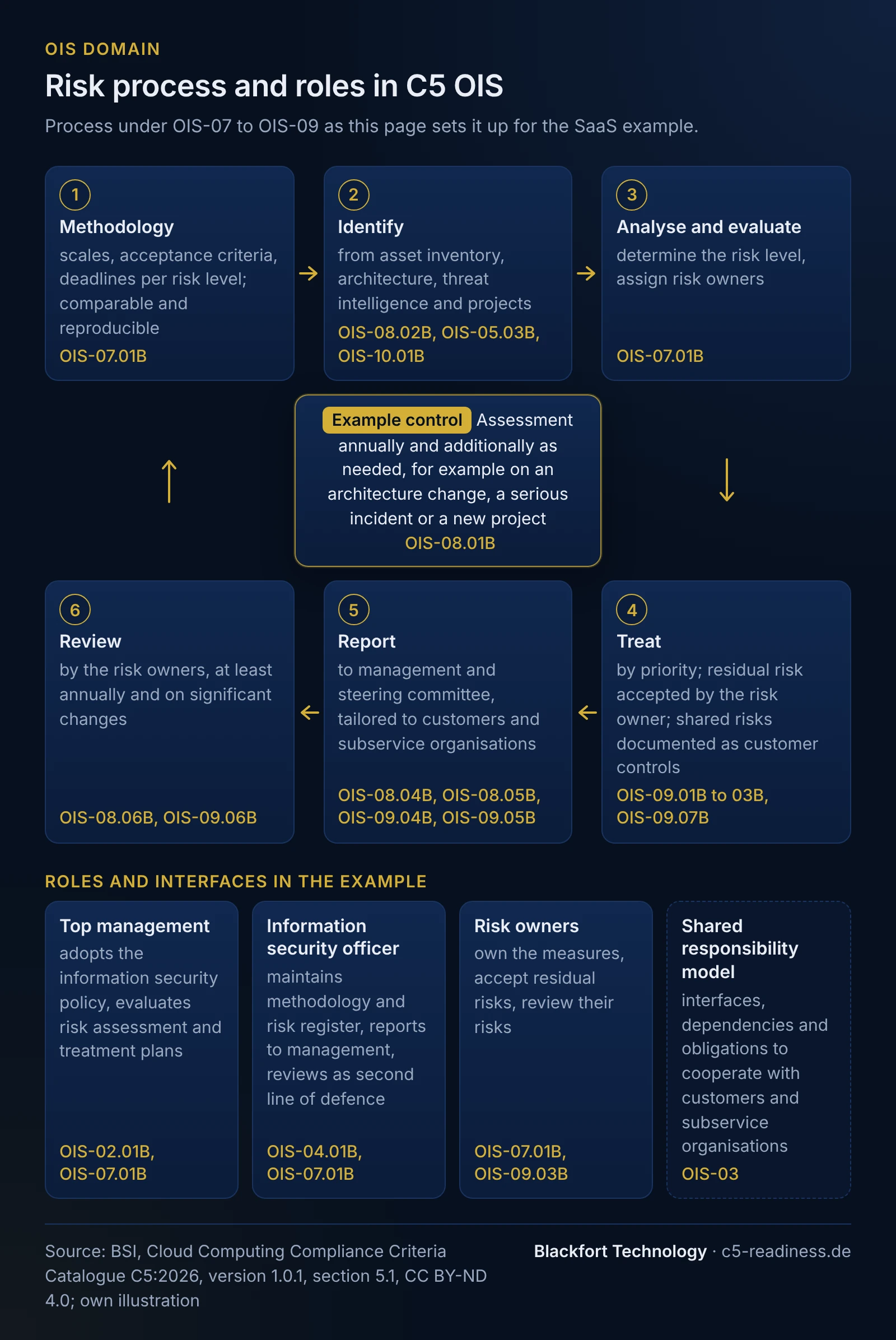
The catalogue does not prescribe a particular committee. It does, however, require actions by particular roles: top management adopts the policy (OIS-02.01B), risk owners accept residual risks (OIS-07.01B, OIS-09.03B), the level of management responsible for the security of the cloud service evaluates risk assessment and treatment plans (OIS-07.01B no. 6). According to the supplementary information on OIS-04, roles that review risks should be different from roles that own risks. An information security steering committee appears in the catalogue only in a list of examples (supplementary information on SP-02). We recommend one anyway, because that is where the decisions with date and participants are made that the auditor wants to see. Our model for the example:
| Role or committee | Task in the ISMS | Reference | Not combined with |
|---|---|---|---|
| Management (top management) | adopts and communicates the information security policy, evaluates the risk assessment and the status of treatment plans every six months, appoints the risk owners | OIS-02.01B, OIS-02.02B, OIS-07.01B no. 6 | - |
| Information security officer | maintains methodology and risk register, facilitates assessments, reports to management, reviews as second line of defence | OIS-04.01B, OIS-07.01B | risk owner for operations or development |
| Risk owners (head of operations, head of development, head of support) | own the measures, accept residual risks in their area, review their risks at least annually | OIS-07.01B no. 4, OIS-08.06B, OIS-09.03B | review of their own risks |
| Information security steering committee (management, information security officer, risk owners, data protection) | quarterly and as needed: situation from threat intelligence, new and changed risks, exceptions, status of treatment plans; decisions with minutes | OIS-05.03B, OIS-08.04B, OIS-09.04B | - |
| Project managers | report projects with an impact on the service or security, have risks assessed according to the methodology | OIS-10.01B | acceptance of project risks without a risk owner |
The column “Not combined with” is the core of an inventory of conflicts under OIS-04.04B. How small teams solve segregation of duties with compensating controls is shown on the page C5 for SaaS providers. Exceptions to policies go through the same risk process; the procedure for this is on the page security policies and procedures.
How does the risk process under OIS-07 to OIS-09 work?
OIS-07 requires a documented methodology that delivers comparable and reproducible results; OIS-08 governs the assessment, OIS-09 the treatment. The catalogue allows qualitative, semi-quantitative and quantitative methods and does not require specific formal frameworks; lean forms of documentation are expressly possible where appropriate. This is how we set up the process for the example:
| Step | What happens | Trigger | Criterion |
|---|---|---|---|
| 1 Methodology | scale for likelihood and impact per protection goal (confidentiality, integrity, availability, authenticity), criteria for risk acceptance, deadlines per risk level | once, reviewed annually | OIS-07.01B |
| 2 Identify | collect risks from asset inventory, architecture, threat intelligence and projects; check mandatory aspects, for example separation of customers, interfaces accessible from public networks, dependency on service organisations, key management | annually and on every trigger | OIS-08.02B, OIS-05.03B, OIS-10.01B |
| 3 Analyse and evaluate | determine the risk level, assign a risk owner, compare against the acceptance criteria | with step 2 | OIS-07.01B nos. 1 to 3 |
| 4 Treat | treatment plan with measure, deadline and owner, prioritised by risk level; residual risk accepted by the risk owner; risks shared with customers go into the user documentation as customer controls | after every evaluation | OIS-09.01B to 03B, OIS-09.07B |
| 5 Report | results to management and steering committee; tailored information to customers and subservice organisations where contract or law provide for it | quarterly and as needed | OIS-08.04B, OIS-08.05B, OIS-09.04B, OIS-09.05B |
| 6 Review | risk owners review analysis, evaluation and treatment for adequacy; treatment options on every change to the assessment | at least annually and on significant changes to the service | OIS-08.06B, OIS-09.06B |
As triggers, the supplementary information on OIS-08.01B names, among others, changes to the threat landscape, security incidents, new legal or contractual requirements, changes to the organisation or the architecture, events at service organisations, exceptions to policies and critical vulnerabilities. Record in your methodology which of these triggers lead to an assessment in your organisation and who reports them.
Example control description for OIS-08
OIS-08.01B requires the risk management process to be performed “as needed and at least annually”, OIS-08.06B a review by the risk owners at least annually and in case of significant changes to the service. This is exactly where a register that is only maintained before the audit fails. Our example control for the provider above (own wording, not catalogue text):
| Field | Example |
|---|---|
| Control ID | K-OIS-08-01 Risk assessment as needed and annually |
| Mapped to | OIS-08.01B, OIS-08.02B, OIS-08.06B, OIS-09.06B |
| Objective | Every risk within the provider’s area of responsibility has a current assessment and a risk owner; changes to the service, incidents and new threats lead promptly to a new assessment. |
| Owner | Information security officer (execution and facilitation); risk owners (evaluation, review, acceptance); management (evaluation of the results) |
| Trigger and frequency | annual overall assessment in the first quarter; as needed within 20 working days of a defined trigger: change to the architecture (change ticket flagged “security-relevant”), security incident of the two highest severity levels, new project with an impact on the service, threat intelligence report requiring action, exception to a policy |
| Execution | For each trigger the information security officer opens an entry in the risk register with a reference to the triggering ticket. Together with the risk owner, the affected risks are reassessed according to the methodology, the mandatory aspects under OIS-08.02B are checked and the treatment options are reviewed. New measures go into the treatment plan with a deadline. |
| Check | Every quarter the information security officer reconciles the list of triggers (change tickets, incidents, project list, list of exceptions) with the register entries. The steering committee sees deviations and open treatment measures in the quarterly report. |
| Escalation | If the assessment for a trigger is missing after 20 working days or a treatment deadline is exceeded, management decides on a measure or acceptance at the next steering committee; the overrun is recorded as a deviation. |
| Evidence | Risk register with change history, references to triggering tickets, minutes of the assessments with date and participants, quarterly reconciliation, minutes of the steering committee |
The 20 working days are our recommendation; the catalogue sets no deadline for the assessment as needed. What matters is that your methodology sets a deadline and that you meet it. For a type 2 report the auditor tests whether the control was effective over the whole period, including whether every trigger in the period had an assessment.
What evidence the auditor wants to see
For OIS, evidence consists mostly of documents and minutes with date, version and approval. Examples from our scenario:
| Evidence | Criterion | Source | Owner | Timing |
|---|---|---|---|---|
| ISMS documentation with scope, statement of applicability and result of the last management review | OIS-01.01B, OIS-01.02B | ISMS document repository | Information security officer | version valid in the period |
| Description of scope and boundaries of the service under the provider’s own control, with exclusions and shared responsibility | OIS-01.03B | ISMS documentation, architecture overview | Information security officer, head of operations | version valid in the period |
| Information security policy with approval by management and evidence of communication to personnel and customers | OIS-02.01B to 03B | approval record, intranet, customer portal | Management | approval date, publication |
| SSRM document with review date and change notifications to customers | OIS-03.01B to 05B | customer portal, dispatch log | Product management, information security officer | every version and every notification in the period |
| Inventory of conflicts and measures for segregation of duties | OIS-04.04B | ISMS documentation | Information security officer | status in the period |
| Threat intelligence reports with references to register entries | OIS-05.01B to 03B | situation reports, risk register | Head of operations | every report in the period |
| Risk methodology, risk register with history, treatment plan with acceptance of residual risks | OIS-07.01B, OIS-08.01B to 06B, OIS-09.01B to 06B | risk register, minutes | Information security officer, risk owners | annual assessment and all triggers in the period |
| Risk assessments in projects | OIS-10.01B | project documents | Project managers | all relevant projects in the period |
An evidence register assigns each subcriterion its evidence and due date; how to keep one is shown on the page evidence and documentation.
Possible gaps: cause, effect, remedy
The following gaps follow from the wording of the criteria and the scenario above. If a single subcriterion is not met, the criterion counts as not met, and the auditor reports the deviation (sections 3.4.12 and 3.4.13).
| Possible gap | Cause | Effect | Remedy |
|---|---|---|---|
| Risk assessment only once a year | The register is maintained for the ISO audit, changes to the service trigger nothing. | OIS-08.01B requires the process to be performed as needed as well; the architecture change without reassessment is a deviation in the type 2 period. | Define triggers in the methodology and link them to the change, incident and project processes, as in K-OIS-08-01. |
| Residual risks accepted by the information security officer | No named risk owners. | OIS-07.01B no. 4 and OIS-09.03B place acceptance in the hands of the risk owners; at the same time the information security officer mixes the reviewing and the owning role (OIS-04). | Management appoints risk owners, acceptance with date and name in the register. |
| No coherent SSRM | Customer obligations are scattered across terms and conditions, service description and wiki. | OIS-03.01B requires an established, documented and communicated model, OIS-03.05B timely announcement of changes; without it the basis for the CUEC in the system description is missing as well. | one document with references to the contract parts, review under SP-02, change notifications before they take effect. |
| Threat intelligence without follow-up | Warnings are read but not evaluated. | OIS-05.02B and 05.03B require correlation, analysis and integration of the insights into the risk process. | fixed list of sources, monthly situation report, register entry where action is needed. |
| Projects without risk assessment | Projects start without security involvement. | OIS-10.01B requires risks to be treated in all projects that may have a direct or significant impact on the service. | Security check as a mandatory step at project start, define the threshold for “significant impact” in the methodology. |
Which of these gaps block the audit and in which order to close them is settled in prioritising measures; risk methodology and first assessment are part of the foundation there.
All criteria of the OIS domain
Titles as in the English version 1.0.1, number of subcriteria counted per section 5 (B = basic, AS = sharpening, AC = complementing). The column “What it covers” is our own short description, not catalogue text; the wording of the criteria in the catalogue is binding.
| ID | Title (catalogue) | B/AS/AC | What it covers |
|---|---|---|---|
| OIS-01 | Information Security Management System (ISMS) | 3/1/1 | An ISO/IEC 27001-compliant ISMS with a scope that covers development and operation of the service, and the boundaries of the service under the provider’s own control. |
| OIS-02 | Information Security Policy | 3/0/0 | The policy of top management with security objectives, strategy and organisational structure, communicated to personnel and customers. |
| OIS-03 | Interfaces and Dependencies | 5/0/0 | The SSRM with customers and third parties, its regular review and timely announcement of changes. |
| OIS-04 | Segregation of Duties | 4/0/2 | Segregation of conflicting tasks based on a risk assessment, compensating controls and an inventory of conflicts. |
| OIS-05 | Threat Intelligence | 3/0/0 | Collect and analyse information on threats and feed it into the risk process. |
| OIS-06 | Contact with Relevant Government Agencies and Interest Groups | 1/0/0 | Contact with the National IT Situation Centre and CERT-Bund if public sector organisations in Germany use the service. |
| OIS-07 | Risk Management Policy | 1/0/0 | The methodology: comparable and reproducible, with risk owners, acceptance criteria and evaluation by management. |
| OIS-08 | Application of the Risk Management Policy - Risk Assessment | 6/1/2 | The assessment as needed and at least annually, with mandatory aspects for cloud services and reporting to internal and external parties. |
| OIS-09 | Application of the Risk Management Policy - Risk Treatment | 7/0/0 | The treatment plan by priority, accepted residual risks and mapping of shared risks to customer controls. |
| OIS-10 | Information Security in Project Management | 1/0/0 | Risk assessment and treatment in projects with an impact on service and security. |
The additional criteria concern the certificate (OIS-01.01AS, OIS-01.01AC), monitoring of segregation of duties (OIS-04.01AC, OIS-04.02AC) and risk management: OIS-08.01AS additionally requires monitoring the evolution of the risks, OIS-08.01AC integration into an enterprise risk management programme, OIS-08.02AC consideration of internal threat actors.
Relationship to ISO/IEC 27001:2022
OIS-01.01B requires an ISO/IEC 27001-compliant ISMS; according to the supplementary information, a certificate is not needed for the basic subcriterion, the auditor evaluates the documentation in a focused way. The sharpening OIS-01.01AS requires a valid certification whose scope covers the service. What you can reuse from a certified ISMS and what is still missing is set out on the page C5 and ISO 27001.
The following mapping is our own, unofficial classification by topic. The BSI has not yet published a cross-reference for C5:2026. The catalogue refers to the BSI website for it (section 3.3). So far the table there covers C5:2020 only, and the BSI says the table for C5:2026 is “scheduled for publication in the near future” (as of 6 November 2026). According to the catalogue, even an official table only shows thematic proximity, not fulfilment of the criteria (section 3.3). The short labels are ours, not titles from the standard.
| C5:2026 | ISO/IEC 27001:2022 | Topic (short label) | What C5 additionally requires in concrete terms (our assessment) |
|---|---|---|---|
| OIS-01 | Clauses 4 to 10 | Management system | Scope with organisational units, locations, zones and regions of the service; boundaries of the service under the provider’s own control |
| OIS-02 | Clause 5.2, A.5.1 | Management policy | Communication of the policy to customers as well |
| OIS-03 | no direct counterpart; close to A.5.2 and A.5.23 | Division of responsibility | documented SSRM with announcement of changes |
| OIS-04 | A.5.3 | Segregation of duties | Inventory of conflicts, compensating controls |
| OIS-05 | A.5.7 | Threat information | Integration into the risk process |
| OIS-06 | A.5.5, A.5.6 | Contacts with authorities | National IT Situation Centre and CERT-Bund for public sector customers |
| OIS-07 to OIS-09 | Clauses 6.1.2, 6.1.3, 8.2, 8.3 | Risk assessment and treatment | Mandatory aspects for cloud services, assessment as needed, mapping of shared risks to customer controls |
| OIS-10 | A.5.8 | Security in projects | Threshold based on the impact on service, controls and service commitments |
Frequently asked questions
Do I need an ISO 27001 certificate for OIS?+
Does there have to be a security committee?+
How often does the risk assessment have to run?+
What is the shared security responsibility model (SSRM) under OIS-03?+
Does OIS-06 apply if I have no public authorities as customers?+
Read more
- C5 criteria catalogue: structure, basic and additional criteria
- C5 vs ISO 27001: what you can reuse and what is missing
- C5 SP: security policies and exceptions under C5:2026
- Prioritising C5 measures: blockers, dependencies, sequence
- C5 SSO: controlling and monitoring service organisations under C5:2026
- C5 complementary customer criteria and CUEC explained
- C5 readiness assessment: gap analysis, action plan and timeline
Sources
- BSI: C5:2026 web page with downloads (German) (retrieved 2026-11-06)
- BSI: C5:2026 web page with downloads (retrieved 2026-11-06)
- BSI: Kriterienkatalog Cloud Computing C5:2026, version 1.1.0 (PDF, German), licensed under CC BY-ND 4.0 (retrieved 2026-11-01)
- BSI: Cloud Computing Compliance Criteria Catalogue C5:2026, version 1.0.1 (PDF), section 5.1 OIS-01 to OIS-10, sections 3.3, 3.4.12 and 3.4.13, licensed under CC BY-ND 4.0 (retrieved 2026-11-01)
- BSI: C5:2026 change history (Excel), mapping of C5:2020 to C5:2026 (retrieved 2026-11-01)
- BSI: C5:2026 overview page with downloads (German) (retrieved 2026-11-01)
This content provides general technical and organisational information and does not constitute legal advice (no legal services within the meaning of the German RDG).